November 10, 2026 · 14 min read
Captioning Accuracy Rates: What the Numbers Mean
Captioning accuracy rates explained: how WER and NER are calculated, what studies found for AI and human captions, what US rules say, and how to improve yours.

Captioning accuracy rates tell you what share of spoken words appear correctly on screen. Published studies put live AI captions anywhere from the high 80s to about 98.5 percent, depending on the audio, the speaker and the vocabulary. Human live captioners average around 99 percent in the same research. The number you get in your own room depends far more on conditions than on the label on the tool.
This guide explains how accuracy is calculated, what the research reports, what US rules actually say, and what you can change before an event starts.
TL;DR
- Accuracy is usually measured as WER (word error rate) or NER (a score that weighs how much each error hurts understanding). The same caption stream can look better or worse depending on the method.
- Studies of live captions report roughly 96 to 99 percent for stenography and respeaking, and a wide range for automatic captions, from the 80s up to about 98.5 percent in the best-case tests.
- The FCC’s 2014 caption rules name accuracy as a quality standard but set no numeric percentage for live captions. Under the ADA, the question is whether communication is effective.
- Audio quality, names and jargon, accents and multiple speakers move the number most. You control the first two.
- Live Caption AI is an AI captioning tool. It is not certified or human-reviewed, so plan for effective communication, not a percentage promise.
Table of Contents
- What a captioning accuracy rate actually measures
- What studies report for AI and human live captions
- What US rules say about caption accuracy
- What moves accuracy up or down
- A pre-event checklist to raise your live caption accuracy
- Translation adds another layer
- Perspective
- Put captions on every phone in the room
- Reading an accuracy claim from any provider
- FAQ
- Sources
What a captioning accuracy rate actually measures
Two methods dominate. They answer slightly different questions.
Word error rate (WER)
WER counts every insertion, deletion and substitution, then divides by the number of words in the source. The formula is (insertions + deletions + substitutions) divided by source words, and the US National Institute of Standards and Technology recommends it for evaluating speech recognition systems.
A quick example. A speaker says 1,000 words. The captions drop 8 words, add 4 that were not said and get 18 wrong. That is 30 errors, a WER of 3 percent, or 97 percent accuracy.

WER treats every error the same. “Teh” for “the” and “hypotension” for “hypertension” each count as one.
NER (Number, Edition, Recognition)
NER was built for live captioning. It starts from the word count and subtracts deductions for each error. The score is (words minus NER deductions) divided by words, times 100. Its six error types carry deductions from 0 (a correct edit) to -1.0 (a false information error).
That matters because a live captioner often condenses speech on purpose to keep up. NER does not punish a harmless edit, and it punishes a meaning-changing mistake heavily. The model dates from 2012 and has since been adopted by universities, broadcasters, access providers and regulators in countries including the UK, Spain, France, Switzerland, Italy, South Africa and Australia.
The NER threshold for acceptable live captions is 98 percent, with errors classed as minor, standard or serious by their effect on comprehension.
Captions are not transcripts
One more distinction. Harvard’s accessibility office explains that a transcript is text with no timing attached, while captions split that text into time-coded frames synced to the audio. A tool can produce an accurate transcript and still caption badly if timing and placement are off. A rate quoted for one is not automatically true for the other.
What studies report for AI and human live captions
The broadest dataset comes from a 2023 study of about 17,000 live captions. In its 2020 US sample, stenography averaged 99.1 percent, respeaking 98.6 percent and automatic captions 96.3 percent. A 2018 UK sample put automatic captions at 95.7 percent.
Other results vary widely, which is the point:
| Source | What it measured | Reported result |
|---|---|---|
| 2023 live caption study | About 17,000 live captions, US 2020 sample | Steno 99.1%, respeaking 98.6%, automatic 96.3% |
| 2025 NER study of AI captions | Lexi AI captions, English and Spanish | 98.56% English, 98.26% Spanish |
| Ofcom UK TV study | 78,000 human captions, 2013 to 2015 | 98.4% overall |
| 2025 3Play Media data, via a university guide | Speech recognition engines | WER accuracy 80 to 93%, formatting accuracy 72 to 84% |
| 2023 Zoom lecture study | Machine vs. human captions | Human not statistically different from YouTube automatic captions |
| 2019 Streaming Media article | ASR live captioning across major providers | Just under 68% |
How do you read a spread like that? Three things explain most of it.
- Age. Speech recognition has improved quickly. The 2019 figure describes older systems and should not be read as today’s performance.
- Method. WER on clean read speech and NER on messy live events are different tests.
- Content. The best AI results in the 2025 study came with clear speech. The same research notes that AI captions reach near-human quality except for colloquial content with several speakers.
One more finding is worth keeping. A 2024 study of eleven speech recognition services found that accuracy varied strongly between vendors, with no single vendor winning on every sample. Any single percentage on a marketing page describes one test, not your event.
What US rules say about caption accuracy
The 99 percent claim
You will see “99 percent is the legal standard” repeated online. The record is more careful than that.
The FCC adopted caption quality standards in 2014 (FCC 14-12). They cover accuracy, synchronicity, completeness and placement. For live programming, the Commission does not set a numeric accuracy percentage. It recognizes the hurdles of live captioning and evaluates complaints case by case, looking at overall accuracy or understandability.
Those rules govern video programming on television. They are not a rulebook for a church service or a staff meeting. For those settings, the ADA concept that matters is effective communication: people who are deaf or hard of hearing need to follow what is said. Captions are one way to provide that, and the choice should fit the setting, the audience and the stakes.
The 99 percent figure still appears as a best-practice target. Harvard’s guidelines say quality captions for effective communication should be delivered at 99 percent or better, and note that automatic captions generally score lower than live human transcribers.
What accessibility guidance asks for
The W3C Web Accessibility Initiative is direct about recorded media: automatic captions usually need significant editing before they meet accessibility requirements, because wrong text can change the meaning. The practical lesson is to correct captions before you post a recording, and to treat live captions as a way to make the event itself accessible in the moment.
Live Caption AI is an AI captioning tool. It is not a certified or human-reviewed service, and it does not make an organization ADA-compliant on its own. An organization can use it as one part of its ADA effective-communication plan, alongside other steps such as asking attendees what they need.
What moves accuracy up or down
A university captioning guide groups the drivers into three: audio quality, content and duration. Here is what each means in practice.
Audio quality
Background noise, a weak connection and a distant microphone all lower accuracy. The 2019 Streaming Media piece noted that automatic captioning struggles with poor connections, background noise and people talking over one another.
This is the cheapest fix. Put the microphone close to the speaker’s mouth. Use a headset or lapel mic where you can. Our guide to keeping live captions accurate in a noisy room goes through placement step by step.
Names, jargon and uncommon spellings
Proper names, acronyms and technical terms are where generic speech recognition stumbles most. The same university guide notes that some engines can be trained on special words and proper names.
This is where Live Caption AI is built to help. It offers a Medical model, a Worship & Ministry model and a Finance & Earnings model. It also supports up to 100 Custom Terms: names, places and terms the speaker types in before going live. A pastor can add the guest speaker’s name and the book of the Bible being preached. A finance lead can add product names and ticker symbols. If you teach, our post on catching technical terms in lectures shows how to build a term list. For clinical vocabulary, browse the posts on medical terminology captions.
Accents and underrepresented speech
Speech recognition learns from training data. The 2024 arXiv study found that systems perform worse for speakers underrepresented in that data, including people with regional accents and second-language speakers. Expect more variation with a diverse speaker lineup, and give speakers a chance to speak naturally and at an even pace rather than rushing.
Multiple speakers
Research comparing human and automatic captions found different weak spots. Human captioners struggle most with specialized vocabulary and fast single speakers. For automatic captions, the main issues are speaker identification and punctuation, with almost half of errors in multi-speaker content coming from wrong speaker labels. For panels and Q&A, have people use a microphone one at a time.
Duration
Longer content tends to collect more inaccuracies. For all-day events, split sessions and refresh your term list between them.
A pre-event checklist to raise your live caption accuracy
These steps cost little and apply to any live captioning setup.
- Fix the audio first. Close mic, quiet room, stable connection.
- Collect names and terms. Speaker names, local place names, acronyms, product names.
- Pick the closest vocabulary model. Worship, medical or finance, if your content fits one.
- Enter Custom Terms. Up to 100 in Live Caption AI, typed before you go live.
- Ask speakers to share slides or notes ahead. Human captioners ask for this too, and it surfaces the hard words early.
- Brief panelists. One voice at a time, no talking over each other.
- Show attendees how to read the captions. In Live Caption AI they scan a QR code. No app, no account.
- Save the transcript afterward. Review and correct it before you publish a recording.
Translation adds another layer
If you caption for a multilingual audience, translation accuracy builds on source accuracy. A mistake in the original text carries into the translation. Clean audio and a good term list help twice. Live Caption AI translates into one of 29 languages per session: the speaker picks one source language and one target language, and viewers can switch between the original and the translation. For a comparison of approaches, read our guide to live translated captions in the US.
Perspective
We built Live Caption AI because most people who need captions are not served by a stenographer’s schedule or a hardware rental budget. A church with a volunteer team, a school event, a monthly staff meeting: these are the rooms we think about.
Here is our view on accuracy. A single percentage is a weak way to judge a captioning tool. The number that matters is how well people in your room understood what was said. That is why we focus on the things that decide it: names, specialized words and ease of access. Our Medical, Worship & Ministry and Finance & Earnings models, and up to 100 Custom Terms, are designed to get your vocabulary right. A QR code puts captions on every phone in the room, so no one needs hardware, an account or an app.
We are clear about what we are. Live Caption AI is AI captioning. It is not certified or human-reviewed, and it does not make an organization ADA-compliant by itself. It can be part of an effective-communication plan, at $19.99 a month on the Professional plan. Session audio is never stored.
Ryan
Put captions on every phone in the room
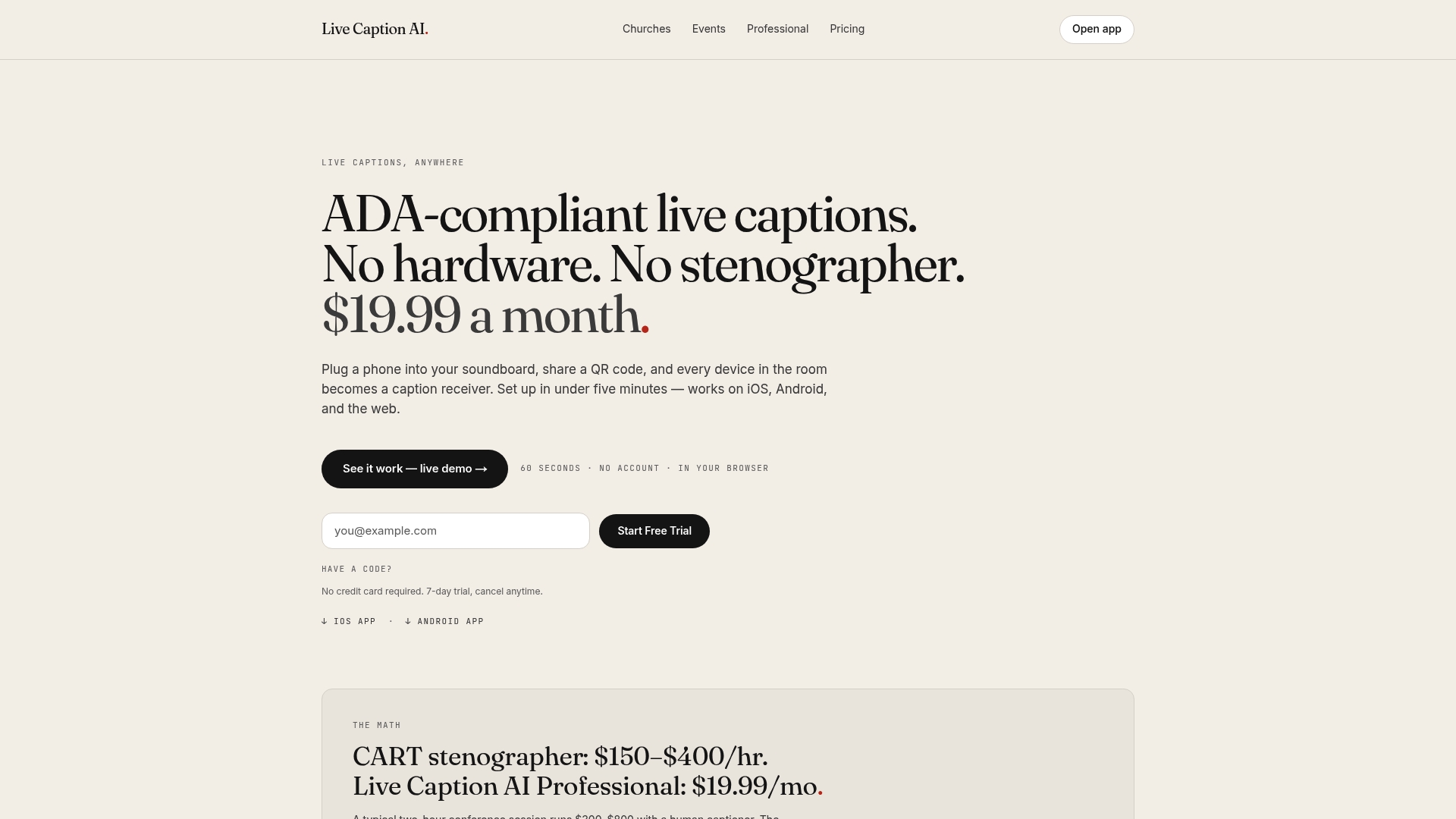
Live Caption AI turns any phone into a caption receiver. The speaker runs it on a phone or laptop. Attendees scan a QR code and read live captions on their own phones. No hardware. No stenographer. No app to install.
The Professional plan is $19.99 a month with unlimited captioning. The Business plan starts from $199 a month. There is also a Free plan, plus translation credit packs: 30 credits for $6.99, 60 for $11.99 and 120 for $19.99, each a one-off purchase. See current details on the pricing page.
Transcripts can be saved and exported as TXT, SRT, JSON or PDF, and AI summaries are included. That makes the review-and-correct step easy before you share a recording.
Reading an accuracy claim from any provider
When you see a number, ask four plain questions:
- Which metric? WER and NER are not interchangeable.
- Which audio? Studio speech and a crowded fellowship hall give different results.
- Which content? Names, jargon and several speakers lower scores.
- Which year? Speech recognition has changed a lot since the 2019 and 2020 samples above.
Match the answer to your stakes. A weekly service, a classroom lecture and a legal or clinical setting call for different levels of assurance. For courtroom or clinical use, an AI tool is not the right fit, and those settings call for qualified professionals. For legal vocabulary, our posts on legal terminology captions cover what to consider. For Spanish-speaking audiences, see Spanish live captions.
FAQ
What is a good captioning accuracy rate?
For live captions, the NER model sets 98 percent as the acceptable threshold. Many accessibility offices cite 99 percent or better as best practice. Your real-world result depends on audio, speakers and vocabulary, so prepare those first.
Does the ADA require 99 percent caption accuracy?
No numeric figure appears in the FCC’s 2014 live captioning rules, which evaluate complaints case by case. The ADA looks at effective communication. Ninety-nine percent is widely used as a best-practice target, not a single legal number for every event.
What is the difference between WER and NER?
WER counts every insertion, deletion and substitution equally. NER weights errors by how much they hurt understanding and does not penalize harmless edits. NER was designed for live captioning, while WER comes from speech recognition testing.
How can I improve live caption accuracy at my event?
Start with audio: a close microphone, a quiet room and a stable connection. Then add the names and terms people will say. In Live Caption AI, choose the closest vocabulary model and enter up to 100 Custom Terms before you go live.
Are AI captions as accurate as human captions?
In the 2020 US sample of a large study, stenography averaged 99.1 percent and automatic captions 96.3 percent. A 2025 study found some AI captions near human levels on clear speech. Results vary by vendor and conditions.
Sources
- Accuracy, University of Melbourne
- Purpose and use of the guidelines, NER Canada
- Fit for What Purpose? NER Certification of Automatic Captions
- The accuracy of automatic and human live captions in English
- Captioning, Harvard University Disability Resources
- Auto-generated Captions, Texas A&M University-Corpus Christi
- Comparison of accuracy of machine-generated or human captions
- How Reliable Is ASR-Generated Live Captioning?, Streaming Media
- Measuring the Accuracy of Automatic Speech Recognition, arXiv
- FCC 14-12, closed captioning quality standards
- Federal Register, 2014 closed captioning quality rules
- Captions/Subtitles, W3C Web Accessibility Initiative