September 30, 2026 · 12 min read
22.1% CER Drop: Accent-Robust Speech-to-Text for Engineers
Practical methods for engineers to cut accent errors in speech-to-text: multi-task training, accent embeddings, layer-adapted fusion, and per-accent...

“Accent recognition” means two different things in speech technology: labeling a speaker’s accent, and making transcription accurate despite one. For engineering teams, the second goal matters far more than the first. Research on where accent information lives in end-to-end ASR models points toward robustness, uncertainty reporting, and disaggregated evaluation as the real priorities.
TL;DR:
- Accent-aware speech recognition systems should focus on disaggregated evaluation metrics like per-accent word error rate and named-entity accuracy to identify specific group performance gaps.
- Implementing layer-adapted fusion and frame-level accent correction techniques can significantly reduce error rates without full model retraining.
- Training data diversity, including accent augmentation and balanced sampling, is critical for reducing bias and improving performance across diverse speaker groups.
- Confidence calibration and real-time telemetry allow better handling of accent-related uncertainties and facilitate targeted model updates.
- Disaggregated, stratified benchmarks and transparent reporting are essential for measuring progress and addressing fairness in multi-accent speech recognition.
Table of Contents
- What accent recognition means and how to measure success
- Core machine learning approaches for accent-aware transcription
- Where to put accent handling in the model architecture
- Datasets and evaluation protocols worth adopting
- A practical workflow for building accent-robust systems
- Measuring and reducing bias in accent-sensitive systems
- How this research applies to live captioning in practice
- Where Live Caption AI fits for multi-accent live captioning
- A researcher’s take on where this field needs to go
- Sources
- FAQ
What accent recognition means and how to measure success
Accent identification (AID) and accent-robust speech recognition are related but separate problems. AID tries to classify a speaker’s accent from audio. Accent-robust ASR tries to transcribe accented speech accurately, regardless of whether the system ever labels the accent at all.
The distinction matters because accent itself resists clean labeling. A single voice can reflect geography, first language, social identity, and speaking style all at once, and none of these map neatly onto a fixed list of categories. Automated accent labels are useful signals, not verified facts. Treating them otherwise creates false confidence in both research claims and product behavior.
For engineers building or evaluating these systems, a few metrics matter more than overall word error rate:
- Per-accent WER and CER, not just an aggregate score across the full test set.
- Named-entity accuracy, since proper nouns and technical terms often fail first for underrepresented accents.
- Confidence calibration, so the system’s certainty estimates match its actual accuracy.
- Disaggregated reporting, breaking results out by subgroup rather than averaging them away.
A model that posts a strong overall WER can still fail badly for specific accent groups. Reporting only the average hides exactly the information a research team or product owner needs to act on.
Core machine learning approaches for accent-aware transcription
Several algorithmic strategies show up repeatedly in the literature, each with different trade-offs.
Multi-task learning trains a model to predict both the transcription and the accent label at once. Sharing representations between the two tasks can improve transcription accuracy, since the accent signal gives the model extra context about pronunciation patterns it would otherwise have to infer. Surveyed work on adversarial and joint-model approaches reports multi-task training combined with accent embeddings delivering meaningful relative WER gains over baseline models, though the exact figure depends heavily on the dataset and protocol used.

Accent embeddings represent a speaker’s accent as a learned vector, either concatenated with standard acoustic features or fused through a dedicated network branch. This approach lets a model condition its predictions on accent without needing a hard classification decision first.
Adversarial pretraining takes a different route. Meta’s AIPNet framework trains a model to separate accent-invariant information (the linguistic content) from accent-specific information (the pronunciation pattern), using an adversarial objective to keep the two apart. This lets a system use unlabeled accented audio for pretraining, which matters given how scarce accent-labeled transcription data remains.
Transfer learning and fine-tuning adapt a general-purpose ASR model to accent-labeled corpora, often starting from a hybrid CTC/attention transformer pretrained on broad data and then specializing.
Here’s the important caveat: these methods are not competing on a shared leaderboard.
Research reports meaningful gains, but protocols vary widely. One survey of adversarial and joint-model methods compiles results including high accuracy for a transformer joint accent-classification model and substantial relative WER improvement from multi-task training paired with accent embeddings. These numbers come from different datasets, languages, and evaluation setups, so they describe what is achievable in a given context, not a ranked comparison of methods.
Where to put accent handling in the model architecture
Architecture decisions matter as much as the training objective. Probing studies on end-to-end ASR found that accent information concentrates heavily in the early encoder layers, which means a model does not need full retraining to adapt. Layer-wise adaptation, adjusting or fine-tuning early layers while leaving the rest of the network intact, can capture most of the benefit at a fraction of the cost.

Recent work builds directly on that finding. Qifusion-Net uses layer-adapted fusion paired with frame-level cross-attention, letting the model correct for accent at the frame level rather than committing to a single accent decision for the whole utterance. On multi-accent test sets, this approach produced relative CER reductions of 22.1% and 17.2% across two benchmarks, and it works in both streaming and non-streaming decoding modes without requiring the system to know the speaker’s accent in advance.
For teams designing the pipeline itself, a few placement decisions recur across the literature:
- Accent embedding extractor: typically placed early, feeding accent-conditioned features into the main encoder.
- AID decoder (when labeling is needed): branches off a shared encoder rather than running as a separate model.
- Fusion module: works best when it operates at the frame level rather than the utterance level, since accent characteristics shift within a single sentence.
Streaming captioning adds its own constraints. Dynamic chunk strategies, where the model processes short rolling windows of audio instead of waiting for full utterances, keep latency low, but they also limit how much context the fusion module has available. Frame-level approaches like Qifusion-Net’s are attractive here precisely because they don’t require a long lookahead window to make an accent-aware correction.
Pro Tip: Start accent adaptation at the encoder’s early layers before considering a full retrain. It’s cheaper and the evidence points there anyway.
Datasets and evaluation protocols worth adopting
Good architecture means little without a test set that can actually reveal failure. A handful of datasets and benchmarks have become reference points for this kind of evaluation.
- Fair-Speech provides demographic metadata alongside roughly 26,500 utterances from 593 speakers, specifically built to support fairness analysis across subgroups.
- FaiST extends fairness benchmarking with stratified test sets designed to surface performance gaps that a single aggregate score would hide.
- AESRC challenge sets and corpora like KeSpeech and MagicData-RMAC support multi-accent training and evaluation, and appear as the benchmarks behind several of the architecture results discussed above.
Fair-Speech and similar datasets show statistically significant subgroup gaps across ASR systems, which is the core argument for disaggregated reporting over a single overall WER. A model can look strong on average while systematically underperforming for specific accent groups, and an aggregate number simply cannot show that.
The practical recommendation follows directly: stratify test sets by accent, dialect, speaker, domain, and recording condition, then report WER and CER for each stratum with confidence intervals rather than a point estimate alone. Pair that with named-entity and semantic accuracy metrics, since word-level error rates can miss cases where the transcription is fluent but factually wrong, a dropped negation or a mistaken date, for example.
A practical workflow for building accent-robust systems
Turning research findings into a working system follows a fairly consistent sequence across teams that publish their methods.
- Collect representative audio. Combine a short fixed prompt with spontaneous speech, across varied recording environments, and get informed consent for how the audio will be used and retained.
- Augment deliberately. Speed perturbation and added background noise are standard and low-risk. TTS-based accent augmentation can help fill gaps in underrepresented accents, but synthetic speech that doesn’t match real pronunciation patterns can introduce its own errors, so validate it against held-out real speech before trusting it.
- Adapt the model. Choose between full fine-tuning on accent-labeled data and lighter embedding-based adaptation depending on how much labeled data is available and whether on-device deployment limits model size.
- Calibrate confidence. A model’s certainty score should track its actual accuracy, especially for accents underrepresented in training.
- Deploy with telemetry. Track per-accent error rates in production, watch for drift as usage patterns shift, and schedule targeted retraining rather than waiting for overall metrics to degrade.
Pro Tip: Build per-accent telemetry into your deployment from day one. Retrofitting subgroup tracking after a quality complaint is much harder than shipping it from the start.
When the system is uncertain, surfacing that uncertainty to the user, rather than silently guessing, tends to preserve trust better than a confident wrong answer.
Measuring and reducing bias in accent-sensitive systems
Disparities across racial, regional, and non-native speaker groups show up repeatedly once researchers look for them, which is exactly why disaggregated evaluation matters more than a single clean benchmark score. Statistical methods like mixed-effect Poisson regression and drop-in-deviance tests can confirm whether an observed subgroup gap is a real, reproducible pattern rather than noise in a small test set, a practice recommended in fairness benchmarking work for speech technology.
Mitigation strategies build on the same techniques covered earlier:
- Balanced sampling during training, so no accent group is a rounding error in the dataset.
- Domain adaptation and adversarial invariance, reducing the model’s reliance on accent-specific shortcuts.
- Transparency and abstention, where the system flags low-confidence output instead of guessing.
For any product surfacing accent information to end users, the guidance is consistent: avoid asserting a definitive accent label. Expose a confidence estimate or skip the label entirely, since accent categories conflate geography, first language, and speaking style in ways no model fully resolves.
How this research applies to live captioning in practice
Streaming captioning adds constraints that a lab benchmark doesn’t face: no time to wait for full utterances, and no opportunity to ask a speaker to repeat themselves. Frame-level fusion techniques matter here because they adapt continuously instead of committing to one accent decision per session.
Domain vocabulary compounds the challenge. A medical term, a legal citation, or a worship reference can trip up a general-purpose model regardless of accent. Live Caption AI addresses this with Medical, Worship, and Finance vocabulary models plus Custom Terms, reducing the specific failure mode where a rare word gets misheard even when the surrounding sentence transcribes cleanly. The QR-code receiver model, turning any phone into a caption display, sidesteps a separate operational problem: getting captions in front of a room without dedicated hardware.
Where Live Caption AI fits for multi-accent live captioning
Live captions on every phone in the room. Live Caption AI turns any phone into a caption receiver through a QR code, no hardware, no stenographer. Medical, Worship, and Finance vocabulary models plus your own Custom Terms handle domain-specific language, translation into one of 29 languages per session supports multilingual audiences, and session audio is never stored.
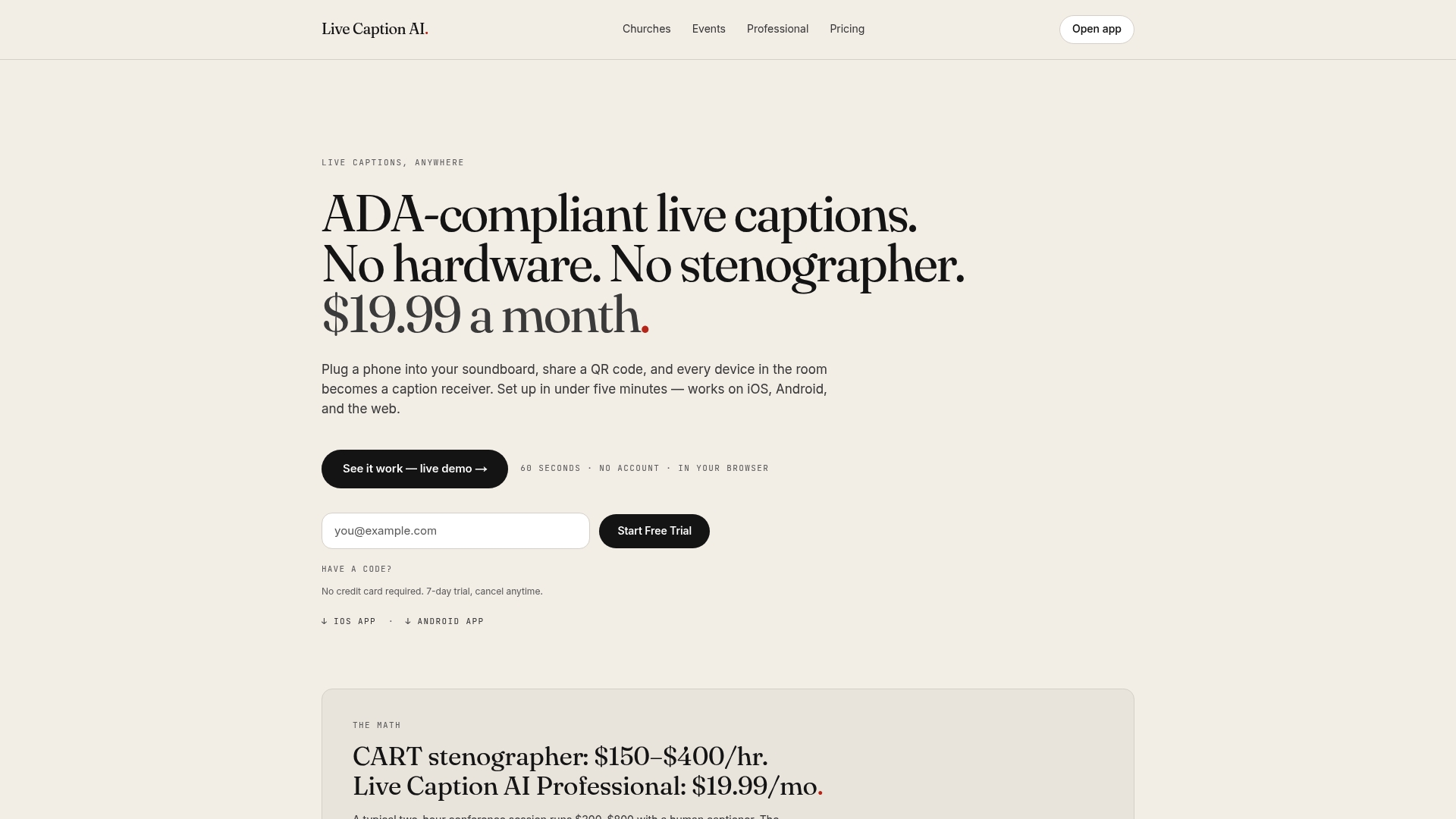
Teams building for multi-accent transcription workflows can start with the Professional plan starting at a monthly price(https://livecaptionai.com/pricing), or check the Business plan for larger organizational deployments. The professional settings page covers the domain vocabulary features in more detail.
A researcher’s take on where this field needs to go
Robustness beats labeling, streaming design can’t be an afterthought, and disaggregated evaluation should be the default, not a footnote in an appendix. The open questions that matter most now: how to serve dialects with almost no labeled data, how to disentangle accent from speaker identity without heavy supervision, and how to label accent at all without reducing someone’s identity to a category a model finds convenient. Reproducible protocols and shared stratified benchmarks would do more for this field than another marginal WER gain on a private test set.
— Ryan
Sources
- How accents are represented in E2E ASR (ACL 2020)
- Qifusion-Net: Layer-adapted Stream/Non-stream Model for End-to-End Multi-Accent Speech Recognition (Interspeech 2024)
- Fair-Speech: a dataset and analysis for fairness in speech recognition (arXiv 2408.12734)
- Adversarial and joint-model approaches to accent robustness (arXiv / ar5iv mirror)
FAQ
Is there an app that can identify a speaker’s accent?
Several browser-based tools ask users to speak briefly and return a probabilistic guess at accent using practical tools that analyze short speech samples to estimate pronunciation patterns and accent-related commentary. These short-sample tools produce estimates, not verified labels, and vendor accuracy claims are often unverified against independent benchmarks.
Can AI identify my accent accurately?
AI can estimate accent as a classification problem when given enough representative labeled speech, but accent labels conflate geography, first language, and speaking style. Most research recommends treating the output as a probabilistic estimate with a confidence score rather than a definitive label.
Which speech-to-text model handles accents best?
No single model wins across every accent and dataset, since reported results come from different benchmarks and protocols rather than one shared leaderboard. Approaches like layer-adapted fusion have shown strong relative CER reductions on specific multi-accent test sets, but the right choice depends on your target accents and latency requirements.
How can I figure out what my accent sounds like to others?
A practical approach is recording a short fixed prompt plus some spontaneous speech, then running it through multiple speech-to-text systems or classifiers and comparing the results. Treat any output as a rough estimate, since even automated classifiers vary and definitive labeling often requires a linguist’s judgment.