October 8, 2026 · 11 min read
Lecture Live Captions for Educators: 7 Steps to Catch Technical Terms
Learn how educators set up lecture live captions, address ADA duties, and prepare course terms for accuracy. Live Caption AI shares captions by QR code.

Live captions are a real-time text version of what a lecturer says, shown on a screen or on students’ own phones as the words are spoken. For most classrooms, the practical move is picking a low-latency caption workflow that handles your subject’s vocabulary instead of struggling along with generic speech-to-text, and that is exactly the gap a tool like Live Caption AI is built to close.
TL;DR:
- Large lecture halls can use phone based ASR captions to avoid display costs, while seminars with overlapping discussion often need CART or human review.
- Title II covers synchronous in person and online classes; institutions must document accommodation requests and aid delivery because captions alone do not ensure compliance.
- For usable live captions, test the microphone and connection beforehand, add course terms, reduce background noise, and avoid overlapping speech that confuses automated systems.
- Monthly subscriptions suit recurring classes, while hourly CART fits occasional high stakes events; Live Caption AI’s Professional plan costs $19.99 per month.
- Live Caption AI supports up to 100 custom terms and translation into 29 languages, but it is neither certified nor a substitute for institutional accommodations.
Table of Contents
- Your toolkit: realistic ways to deliver live captions
- Setting up live captions for a lecture, step by step
- Why the ADA makes captioning an institutional responsibility, not a favor
- What accuracy and latency actually look like in practice
- Budgeting for live captioning: subscriptions vs. per-hour CART
- Implementation checklist: before, during, and after the lecture
- How Live Caption AI fits into lecture captioning
- What deploying captions across a term actually teaches you
- Try Live Caption AI for your next lecture pilot
- FAQ
- Sources
Your toolkit: realistic ways to deliver live captions
Before picking a method, match it to how your class actually runs.
- Built-in platform captions (Zoom, Teams, PowerPoint): free and simple, but accuracy on technical terms is often weak and there is no custom vocabulary control.
- ASR caption apps: fast to set up, work on any device, and some let you add specialized vocabulary models for better accuracy in the moment.
- CART (human captioners): the highest accuracy for high-stakes settings, but it requires booking in advance and costs more per hour.
- Institutional captioning services: consistent and centrally managed, but often slower to deploy for a single class session.
For a large lecture hall, a phone-based ASR app that students can view on their own screens avoids the cost of room displays. A small seminar with heavy discussion benefits from CART or a human-reviewed option, since overlapping speech is harder for automated systems. Hybrid synchronous classes need a method that works for both the in-room audience and remote viewers at once, and recorded lectures can use any method since latency stops mattering after the fact.
Setting up live captions for a lecture, step by step
Getting captions running smoothly takes a few minutes of preparation and almost no attention once class starts.
- Test your microphone and internet connection before the lecture, not during it.
- Start a short test caption session to confirm words are displaying correctly.
- Add custom terms for names, course jargon, or technical vocabulary ahead of time.
- Decide how students will access captions: a QR code, a shared link, or an LMS post.
- Start the live caption session a minute or two before class begins.
- Share the access method and confirm that students who need captions can see them.
- Watch for lag or garbled text in the first few minutes and adjust mic placement if needed.
Pro Tip: Keep the microphone close to your mouth and pause briefly between dense technical phrases; both cuts down on the serious misrecognitions that custom terms alone can’t fix.
Most on-the-fly problems trace back to the same culprits: a muted or misrouted mic, background noise from HVAC or hallway chatter, or a weak Wi-Fi signal slowing the caption feed.
Why the ADA makes captioning an institutional responsibility, not a favor
Live captioning in lecture settings isn’t just a convenience feature. Under Title II, public postsecondary institutions have to make sure communication with students who are deaf or hard of hearing is as effective as communication with everyone else, and real-time captioning counts as an allowable auxiliary aid toward that standard.
- The requirement applies to synchronous in-person classes and online sessions alike, not just recorded content.
- What counts as “effective” is assessed case by case, based on the student’s needs and the nature of the course.
- Captioning works best as part of a documented accommodation workflow, with a clear process for requesting, booking, and confirming the aid.
- Institutions are expected to keep records showing that appropriate aids were offered and used.
Treating captioning as a one-off instructor decision instead of an institutional process is where most compliance gaps show up.
What accuracy and latency actually look like in practice
Accurate captions that lag behind the speaker by several seconds are still a problem for live classroom use: students can’t follow a discussion or answer a question off text that arrives after the moment has passed. Latency, not just accuracy, is what determines whether captions actually help in real time.
A few tactics make a measurable difference:
- Use a dedicated microphone close to the speaker rather than relying on a laptop’s built-in mic.
- Turn on a subject-specific vocabulary model when one is available for your field.
- Add custom terms for names, acronyms, and course-specific jargon before the session starts.
- Pause briefly between complex phrases instead of speaking in one continuous stream.
- Avoid overlapping speech during discussion, since most ASR systems process one voice at a time.
- Reserve a human captioner for the most sensitive or highest-stakes sessions, such as exams or formal presentations.
Students consistently report that captions and transcripts improve engagement with lecture content, even though measured effects on test scores are mixed across studies. That gap between perceived usefulness and test-score impact is worth remembering when you’re pitching a captioning pilot to colleagues: the engagement case is strong even where the grade-improvement case isn’t settled.
Budgeting for live captioning: subscriptions vs. per-hour CART
Pricing generally falls into two shapes: a flat monthly subscription for automated captioning, or a per-hour rate for human CART captioners, which climbs fast with volume and gets more expensive when heavy editing or review is added.
- A subscription model suits classes that run captions every session, since the cost doesn’t scale with hours used.
- Per-hour CART suits occasional high-stakes events where accuracy matters more than frequency.
- A campus-wide license can work out cheaper than individual department subscriptions once enough instructors are using captions regularly.
- Starting with a free tier or a short trial period on a single course lets you judge fit before committing budget.
Implementation checklist: before, during, and after the lecture
Turning captioning into a repeatable process, rather than a one-time setup, is what makes it stick across a term.
- Pre-lecture: assign who runs the caption session, test the mic and connection, load custom terms, and share the access link or QR code with students in advance.
- During lecture: keep an eye on caption accuracy and have a fallback plan, such as note-taking support or CART, ready if the feed drops.
- After lecture: export the transcript, upload it to the course LMS, and log the accommodation for institutional records.
| Phase | Key action | Who’s responsible |
|---|---|---|
| Pre-lecture | Test audio and load custom terms | Instructor or AV staff |
| During lecture | Monitor caption feed and access | Instructor or teaching assistant |
| Post-lecture | Export transcript and log accommodation | Accessibility office |
How Live Caption AI fits into lecture captioning
Live Caption AI turns any phone into a caption receiver through a QR code, no hardware, no stenographer. Students scan the code and read captions on their own device, which sidesteps the cost and setup time of a room display.
For lecture content heavy on specialized terms, Medical, Worship, and Finance vocabulary models plus your own Custom Terms give a direct way to cut down on the misrecognitions that hurt generic ASR tools. Translation into one of 29 languages per session helps classes with multilingual attendees follow along in real time, and session audio is never stored, which matters for privacy-conscious departments.
- QR-based access works for lecture halls, seminars, and hybrid sessions alike.
- Custom Terms (up to 100) cover names, acronyms, and course-specific jargon.
- Transcripts export as TXT, SRT, JSON, or PDF for LMS upload after class.
Pro Tip: Load your custom terms list the week before the term starts, not the morning of the first lecture, so you’re not troubleshooting vocabulary gaps live.
Worth noting for institutions evaluating fit: Live Caption AI is an AI captioning tool, not a certified or human-reviewed service, and it doesn’t make an institution ADA-compliant on its own.

What deploying captions across a term actually teaches you
Two things stand out after watching captioning rollouts play out in real classrooms. First, the technology rarely fails on its own, it fails when nobody tests the mic beforehand or trains instructors on how to start a session. Second, students use transcripts for review far more than anyone expects going in, which makes exportable captions worth more than the live display alone.
— Ryan
Try Live Caption AI for your next lecture pilot
If specialized vocabulary and multilingual students are your two biggest captioning headaches, Live Caption AI is built to handle both at once without asking your department to buy hardware or book a stenographer.
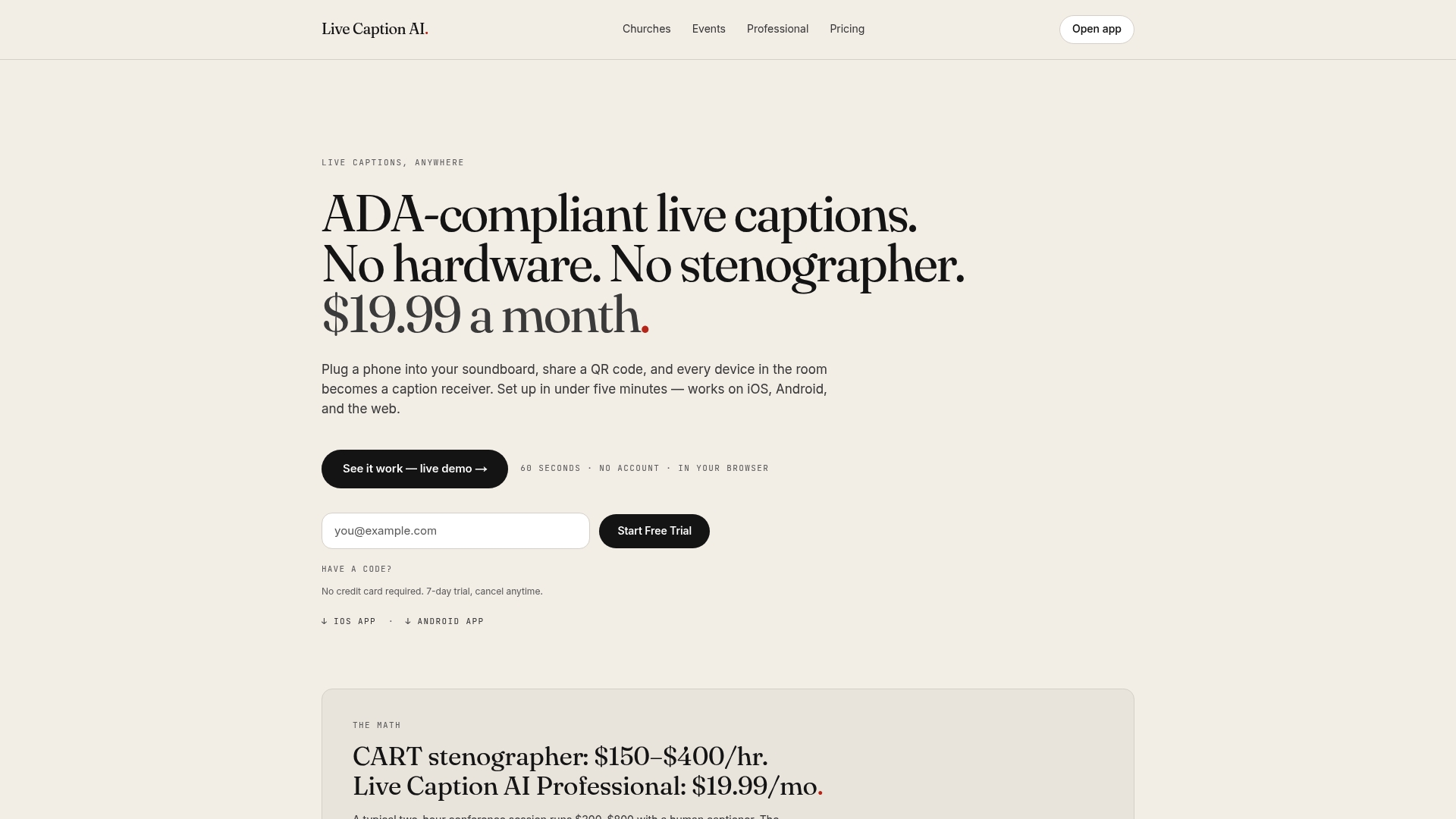
A simple way to test it: start with the Professional plan at $19.99 a month, run it in a single course for a few weeks, export the transcripts, and ask students for feedback before deciding whether to scale it campus-wide. Check current plans and pricing to compare the Free and Business tiers against your department’s needs. Live Caption AI supports your institution’s ADA effective-communication efforts, but it’s one part of that process, not a substitute for the accommodation workflow around it.
FAQ
What is meant by live captions?
Live captions are a real-time text display of spoken words, shown on a screen or device as someone talks, rather than added afterward to a recording. In lecture settings, they let students read along with the instructor’s speech as it happens.
Can ChatGPT transcribe lectures?
General-purpose AI chat tools aren’t built for real-time, low-latency transcription of live speech. For live lecture captioning, a dedicated speech-to-text captioning app or a CART service fits the use case better, since both are designed for continuous real-time audio input.
How much does live captioning cost?
Costs vary by method, with automated captioning tools often running on a monthly subscription and human CART captioners billing per hour, which rises with session length and editing needs. Live Caption AI’s Professional plan is $19.99 a month with unlimited captioning, while a Free tier is also available for basic use.
What is the difference between Live Transcribe and live captioning?
Live Transcribe is a specific mobile app built for personal, one-on-one transcription on a single device, while live captioning more broadly refers to any real-time text display method, including QR-based viewer apps, CART, and platform-native captions. The right choice depends on whether you need a personal tool or a classroom-wide broadcast solution.
How do I make my lectures more caption-friendly?
Speak clearly and at a steady pace, avoid stacking jargon without context, and pause briefly between dense technical points rather than talking continuously. Keeping your microphone close and minimizing background noise also reduces the errors that trip up automated captioning.
Sources
- Ada
- Effects of captions, transcripts and reminders on learning and perceptions of lecture capture | PMC