October 4, 2026 · 14 min read
Clinics: When Medical Live Captions Meet ADA and Accuracy Needs
Clinic checklist for deploying medical live captions: meet ADA requirements, test medical-term accuracy, secure PHI, and know when to escalate to a human...

Yes. Live captions can provide effective, real-time communication access in many medical settings when they’re configured for medical vocabulary, privacy, and the ADA interactive process. Three things matter most: accuracy on safety-critical terms, a documented process for choosing the right aid with each patient, and careful handling of protected health information. Get those right and captions become a practical, everyday accessibility tool, not just a stopgap.
TL;DR:
Custom medical vocabulary models and quick sound checks are essential to improve caption accuracy in clinical settings.
Cloud-based captioning raises privacy concerns, but session-only modes and encryption can mitigate PHI exposure.
Automated captions are suitable for routine visits, while human oversight remains critical for complex or high-stakes conversations.
Vendors should support speaker attribution, low latency, and clear data retention policies to meet clinical needs effectively.
Staff training on activation, custom term management, and escalation procedures ensures captions are used optimally and compliantly.
Table of Contents
-
Step-by-step pilot and rollout for clinics and telehealth programs
-
Integration with electronic health record systems for documentation
-
Training and staff education for using live captions effectively
What medical live captions are and where they help most
Live captions turn spoken words into on-screen text in real time, usually through automatic speech recognition (ASR); implementing web accessibility best practices benefits both users and search visibility. That’s different from CART (Communication Access Realtime Translation), which uses a trained human captioner, and from basic ASR captions, which run entirely through software. On-device captioning keeps audio local and tends to be faster to set up. Cloud-based captioning processes audio remotely, which can improve accuracy for specialized vocabulary but adds a data-handling step clinics need to manage.
Live captions show up across several clinical scenarios:
-
In-person exam rooms, especially for patients who are deaf, hard of hearing, or lip-reading through a mask
-
Telehealth and video visits, where audio quality and distance make hearing harder
-
Patient education sessions and group classes
-
Waiting-room displays and medical conferences
They help deaf and hard-of-hearing patients, people recovering from procedures that affect hearing, and non-native speakers who follow written text more easily than fast spoken English.
Accuracy: what WER and MC-WER actually tell you
Caption accuracy is usually measured with Word Error Rate (WER), the percentage of words transcribed incorrectly. For medical use, Medical Concept WER (MC-WER) matters more: it isolates errors in clinical terms like drug names, dosages, and diagnoses, where a single mistake can change the meaning of what a patient hears.
A mixed methods pilot study published in JMIR Rehabilitation tested automated speech recognition captions across simulated clinical encounters and found word error rates in a range consistent with prior benchmarks, with most participants rating the captions nondistracting and easy to follow. That’s a meaningful signal: patients trusted the captions even when accuracy wasn’t perfect, but the same study noted that complex medical terminology remained the main limitation for replacing human captioners in high-stakes conversations.
A few mitigations consistently improve results: loading medical vocabulary models suited to the specialty, adding custom terms for drug names or procedures specific to a practice, using a quality microphone close to the speaker, and turning on speaker diarization so patients can tell who’s talking. For informed consent or a serious diagnosis, pairing automated captions with human oversight or a CART provider closes the accuracy gap that automated systems still have.

Pro Tip: Run a quick sound check before every session: a clear microphone placed near the clinician often does more for accuracy than any software setting.
ADA and HHS rules on effective communication
Under the ADA, covered healthcare entities must ensure effective communication with patients who are deaf, hard of hearing, or have other communication disabilities, and that obligation extends to telehealth visits, not just in-person care. Providers cannot require patients to bring their own interpreter or captioner. HHS guidance on telehealth nondiscrimination reinforces this, noting that telehealth platforms may need to support real-time captioning to meet federal obligations.
Meeting that standard means running an interactive process with each patient: asking what aid works for them, documenting the choice, and confirming it actually works in practice. ADA guidance on effective communication lists real-time captioning, or CART, among the recognized auxiliary aids, alongside qualified interpreters and video remote interpreting (VRI).
Some situations call for a human captioner or interpreter rather than automated captions alone:
-
Informed consent conversations, where every word carries legal and medical weight
-
Complex or distressing diagnoses
-
Encounters involving unfamiliar accents, rapid speech, or heavy background noise
How to evaluate and vet live captioning for clinical use
A short checklist keeps the decision grounded in what actually matters for patient care, not just price or marketing claims.
-
Confirm the vendor supports a medical vocabulary model and lets you add custom terms for your specialty’s drug names and procedures.
-
Ask about latency: captions delayed more than a second or two disrupt the flow of a conversation.
-
Request the vendor’s transcript retention policy and whether sessions can run without storing audio or text.
-
Ask whether a Business Associate Agreement (BAA) is available if any patient data will touch cloud infrastructure.
-
Check whether the system supports speaker attribution, so patients can follow who’s speaking.
-
Walk through how patients receive captions: an app download, a dedicated device, or a QR code scanned on their own phone.
-
Confirm the captioning tool integrates with your telehealth platform without adding extra steps for the patient.
-
Define a fallback: what happens when accuracy drops mid-session, and who can escalate to a human captioner.
Pro Tip: Ask any vendor for their typical latency and medical WER numbers in writing. A vendor that can’t answer either question hasn’t tested their product in a clinical setting.
Privacy and HIPAA considerations for caption services
Where the audio goes changes the privacy picture. On-device captioning that never sends audio off the phone or tablet carries less PHI exposure by design. Cloud-based captioning processes speech on remote servers, which can improve accuracy but means PHI leaves the room, even briefly, and needs proper safeguards.
Questions worth asking any vendor before a rollout:
-
Is a BAA available, and does it cover the specific captioning feature you’d use?
-
What’s the data retention policy for transcripts and audio, and can it be set to zero?
-
Is the connection encrypted end to end, and is there a session-only mode that discards everything after the visit?
-
Can staff disable transcript saving entirely for sensitive encounters?
Clinics can reduce exposure further with session-only QR receivers that patients scan and then disconnect from, local displays that never route through outside servers, and a written policy on recording and storage that staff and patients both understand before the visit starts. For more on privacy-forward deployment patterns, see our patient communication captions guide.
Step-by-step pilot and rollout for clinics and telehealth programs
A short, structured pilot beats rolling captions out clinic-wide on day one.
-
Identify two or three common appointment types to pilot, such as a routine follow-up and a telehealth visit, and get patient consent to test captions during the visit.
-
Set clear success metrics before you start: acceptable WER, patient comfort ratings, and how often staff needed to fall back to another aid.
-
Configure custom terms for your specialty, test the microphone and camera setup, and simulate a few scenarios with staff before testing with real patients.
-
Collect feedback directly from deaf and hard-of-hearing patients, not just staff impressions, and log any medical-term errors you catch.
-
Once the pilot clears your targets, train staff on activation, scheduling workflow changes, and when to escalate to an interpreter or CART provider.
Pro Tip: Keep a simple log of every caption error during the pilot. Patterns in that log tell you exactly which custom terms to add next.
How Live Caption AI maps to clinical needs
Several practical features line up with the checklist above. QR-code device receivers let patients join a captioned session on their own phone, which addresses the device-access question without new hardware. Medical, Worship, and Finance vocabulary models, plus your own Custom Terms, target the medical-term accuracy gap that generic speech-to-text tools miss. Session audio is never stored, which speaks directly to the privacy concerns clinics raise during vendor review.
-
Device access: any phone becomes a caption receiver through a QR code, no app or hardware required.
-
Terminology: medical vocabulary models plus custom terms reduce errors on specialty-specific words.
-
Privacy: session audio is never stored, supporting a session-only approach to sensitive visits.
-
Languages: translation into one of 29 languages per session supports non-native English speakers.
For a closer look at available plans, visit our pricing page or the professional settings page.
Integration with electronic health record systems for documentation
Captions and transcripts can support documentation, but they aren’t a replacement for clinical notes entered into an EHR. Most caption tools generate a text transcript of the session, which staff can export and attach to the visit record manually in systems that don’t offer a direct integration. Some platforms support exportable transcripts specifically so they can be dropped into existing documentation workflows without retyping.
Direct, automated EHR integration is still uneven across the captioning market. Before assuming a tool will write straight into a patient’s chart, ask the vendor exactly what “integration” means: a manual export, an API connection, or a built-in plugin for a specific EHR platform. Clinics using smaller or newer captioning tools should plan for a manual export step rather than assume automatic syncing.

When a transcript does get added to a chart, treat it the way you’d treat any other patient communication record: note the date, the aid used, and whether the patient confirmed understanding. That documentation also supports the ADA’s interactive process requirement, since it shows which aid was offered and chosen for that specific visit.
Staff workflow matters here as much as the software. A caption transcript that sits in a separate app, disconnected from the EHR, often gets skipped during busy visits. Building a simple export-and-attach step into the existing documentation routine, even a basic copy-paste into the visit notes field, keeps the record complete without adding a new system for staff to learn.
Training and staff education for using live captions effectively
Captions only work as well as the staff running them. A short training session covering three things goes a long way: how to activate captions before the patient arrives, how to add or adjust custom terms for that day’s appointment type, and what to do if accuracy drops mid-visit.
Front-desk staff need to know how to offer captions as part of scheduling, not as an afterthought once the patient is already in the room. That means asking about communication preferences at booking, the same way a clinic would ask about mobility needs or language preference, and noting the choice in the chart ahead of time.
Clinical staff benefit from a quick primer on speaking clearly for captioning accuracy: facing the microphone, avoiding cross-talk, and pausing briefly after complex terms like drug names or dosages. These habits cost nothing and measurably improve caption accuracy, especially for ASR systems without a human reviewer.
Finally, every staff member who might use captions should know the escalation path: who to call when a patient needs a CART provider or interpreter instead, and how quickly that can happen. Writing this into a one-page reference sheet, posted near check-in or saved to a shared drive, keeps the process consistent even as staff turn over.
Limitations and challenges across medical specialties
Not every specialty faces the same captioning challenges. Fast-paced emergency settings strain any ASR system: overlapping speech, alarms, and urgent tone all increase error rates, and a missed word in that setting carries more risk than in a routine follow-up. Mental health visits raise a different concern: patients may be sharing sensitive information verbally, and visible captions on a shared screen can feel exposing if privacy isn’t handled carefully.
Pediatric visits often involve a parent, child, and clinician speaking at once, which tests speaker diarization features more heavily than a one-on-one adult visit. Surgical consults and informed consent conversations carry the highest stakes for accuracy, since a single misheard dosage or procedure name can have real consequences, which is exactly why ADA guidance and clinical best practice both point toward human oversight or CART for these conversations rather than automated captions alone.
Telehealth introduces its own layer of difficulty: home internet connections, background noise, and lower-quality built-in microphones all reduce caption accuracy compared to a controlled exam-room setting. Rural telehealth visits, in particular, may face bandwidth constraints that affect both video and caption delivery at once.
None of this rules out captions in these settings. It means matching the tool to the stakes: automated captions for routine visits and structured check-ins, human-backed options for anything involving consent, complex diagnoses, or safety-critical instructions.
When to standardize captions and when to call a human
Captions work best as the default for routine visits: follow-ups, check-ins, group education. Making them standard, not an opt-in extra, normalizes accessibility instead of singling patients out. Save human captioners or interpreters for informed consent, serious diagnoses, and anything where a missed word changes the outcome.
Clinician training matters more than people expect. A captioning tool run by a rushed, untrained team doesn’t get interpreted correctly, and the interactive process the ADA describes only works when staff actually ask patients what they need.
— Ryan
Start a short captioning pilot with Live Caption AI
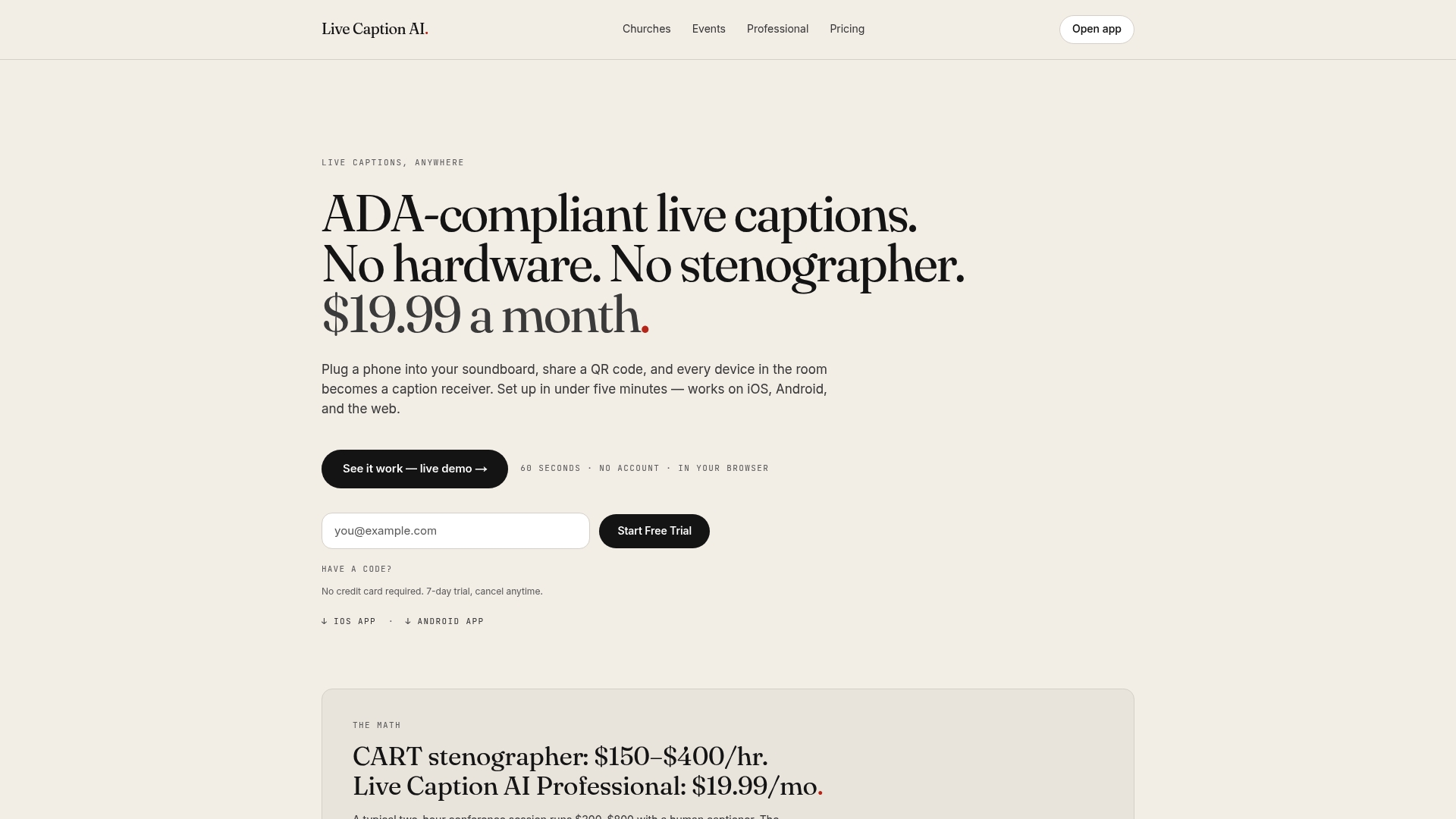
Live captions on every phone in the room fit directly into the checklist above: QR-code receivers solve device access, medical vocabulary models plus Custom Terms cut down on specialty-term errors, and session audio is never stored, which matters for privacy-conscious visits.
-
Run a focused two-week pilot on your most common appointment types.
-
Load custom terms for your specialty before the first session.
-
Test session-only mode on a visit involving sensitive information.
Check current plans and credit options on our pricing page.
This article is general information, not a substitute for advice from a qualified doctor. Consult a qualified healthcare professional about your own circumstances before acting on anything here.
FAQ
What is the difference between Live Transcribe and live captioning?
Live Transcribe is a specific app that converts speech to text primarily for personal, on-device use. Live captioning is the broader category, covering everything from app-based transcription to CART and specialized medical captioning tools built for clinical accuracy and privacy needs.
What are some good captions for medical content?
The most reliable medical captions come from tools with dedicated medical vocabulary models and the ability to add custom terms for drug names and procedures. A pilot study in JMIR Rehabilitation found automated captions rated highly usable even with word error rates between 12.7% and 22.8%, so accuracy mitigations matter more than any single app choice.
How much does live captioning cost?
Pricing varies by vendor and feature set, including custom vocabulary, translation, and privacy options. Live Caption AI lists a Professional plan at $19.99 per month and a Business plan from $199 per month on its pricing page, alongside a free tier for basic on-device captions.
How do I enable the live caption?
Enabling live captions usually means activating the feature within the captioning app or device settings before the session starts, then sharing access with participants, often through a QR code scanned on their own phone. Staff should confirm the correct vocabulary model and any custom terms are loaded before the patient arrives.
Does the ADA require healthcare providers to offer live captions?
The ADA requires effective communication, and real-time captioning is one of several recognized auxiliary aids, alongside interpreters and video remote interpreting. Providers must engage in an interactive process to determine which aid works for each patient rather than offering a single default option to everyone.