November 8, 2026 · 13 min read
Section 1557 Language Access: What Providers Must Do
What Section 1557 requires for patients with limited English proficiency: covered entities, qualified interpreters, AI translation rules and where captions fit.

Section 1557 of the Affordable Care Act requires covered health programs to take reasonable steps to give people with limited English proficiency (LEP) meaningful access to their services. That means free, accurate, timely language assistance, delivered by qualified interpreters and translators when interpretation or translation is needed. This guide explains who is covered, what counts as a qualified interpreter, how the rules treat machine translation, and where live captions can help without replacing what the rule requires.
TL;DR
- Covered entities must take reasonable steps to give each person with LEP meaningful access, and the assistance must be free, accurate and timely.
- When interpretation is required, you must offer a qualified interpreter. When translation is required, you must use a qualified translator.
- Machine translation is not banned, but a qualified human must review it when accuracy is essential or the content is critical to a patient’s rights, benefits or access.
- Live Caption AI is an AI captioning tool. It doesn’t sign BAAs, so it isn’t for patient health information. It fits public-facing sessions, staff training and community events.
- The language access parts of the 2024 rule remain in effect after the October 2025 court ruling, which vacated only the gender-identity provisions.
Table of Contents
- What Section 1557 requires for language access
- Who is covered
- Qualified interpreters, translators and who can’t interpret
- Where AI translation fits, and where it doesn’t
- How Section 1557 and Title VI fit together
- What is the legal status of the 2024 rule?
- Policies every covered entity should have
- Language access and health equity
- Where Live Caption AI fits
- Our view: widen access without overreaching
- Try it on your next community session
- FAQ
- Sources
What Section 1557 requires for language access
Section 1557 prohibits discrimination on the basis of race, color, national origin, sex, age or disability in certain health programs. Under HHS’s reading, failing to give meaningful access to people with LEP is a form of national origin discrimination. The HHS fact sheet on LEP protections says the 2024 final rule requires covered entities to take reasonable steps to provide meaningful access to each LEP individual who is eligible to be served or likely to be encountered in their programs.
The operative text is 45 CFR § 92.201. It covers each person with LEP who is eligible to be served or likely to be directly affected by the program, and that includes companions with LEP.
Three features define the duty:
- Free of charge. Patients never pay for the language assistance.
- Accurate and timely. Delayed or sloppy help doesn’t count.
- Private and independent. Services must protect the privacy and independent decision-making of the person, according to the HHS OCR Dear Colleague Letter.
“Reasonable steps” in practice
The 2020 four-factor analysis was removed. The 2024 rule replaced it with a standard that looks at the nature and importance of the service and the communication at issue, as a law firm summary of the changes explains. A discharge conversation about medication carries more weight than directions to the cafeteria, so the steps you take should scale with the stakes.
The same OCR letter adds a point that trips up many front desks: don’t assume that because someone speaks some English, they are proficient enough for the service at hand. It also notes that cultural competency, including dialects, expressions and regionalisms, is a key factor in accurate interpretation and translation.
Patients can also decline. Under 45 CFR § 92.201(h), as published in the 2025 CFR edition, nothing requires an individual with LEP to accept language assistance. Your job is to offer it.
Who is covered
The National Health Law Program explainer lists the covered entities. They include:
- Hospitals, clinics, clinicians’ offices, nursing homes and mental health centers that receive federal financial assistance
- State, county and local agencies, including Medicaid and CHIP agencies and public health departments
- Insurers and managed care organizations that receive federal funds
- Refugee resettlement agencies
- Federally administered programs such as Medicare and Indian Health Service operations, plus the federally facilitated marketplace, state marketplaces and qualified health plans
If you take Medicaid or Medicare payments, assume you are covered and confirm with your compliance counsel.
Qualified interpreters, translators and who can’t interpret
This is the part of the rule that shapes daily operations. According to the HHS letter, a qualified interpreter:
- Has demonstrated proficiency in spoken English and at least one other spoken language (two non-English languages for relay interpretation)
- Interprets effectively, accurately and impartially, preserving the original statement
- Follows generally accepted interpreter ethics, including confidentiality
When interpretation is required, you must offer a qualified interpreter. When translation is required, you must use a qualified translator. The 2025 CFR text also sets limits on shortcuts. You must not:
- Require the patient to bring or pay for an interpreter
- Rely on an unqualified adult to interpret, except briefly in an emergency, or when the patient requests it privately, a qualified interpreter is present and the request is documented
- Rely on a minor child to interpret, except briefly in an emergency
- Rely on staff who aren’t qualified interpreters, translators or qualified bilingual staff
Video remote interpreting
Video remote interpreting (VRI) must provide real-time, full-motion video and audio over a dedicated high-speed connection, a sharply delineated image, clear audible voice transmission and adequate user training. A shaky tablet on a rolling cart doesn’t meet that bar.
Where AI translation fits, and where it doesn’t
The rule doesn’t ban machine translation. Under 45 CFR § 92.201©(3), a qualified human translator must review machine-translated content when the text is critical to a person’s rights, benefits or meaningful access, when accuracy is essential, or when the source contains complex, non-literal or technical language.
A National Law Review analysis of AI in healthcare translation notes that many healthcare documents will meet at least one of those criteria. For those documents, AI translation without human review might not be compliant. The Dentons summary adds that when machine translation is used where review isn’t required, patients should be warned that it may contain errors.
There is also an emergency allowance. A JD Supra summary of the OCR letter says a translator may not be able to proofread a machine-generated translation until the emergency has passed, but must review it as soon as practicable.
What does this mean for your team? Sort your communication into two bins:
- Patient-specific, high-stakes content. Consent, diagnoses, treatment instructions, billing disputes, discharge papers. Use qualified interpreters and translators.
- General and public-facing content. Health education talks, community meetings, staff trainings, open houses. Here live captions and translation can widen the audience, and you still keep qualified interpreters available for individual patient needs.
Our own guide on choosing between a human interpreter and AI translation walks through a risk screen for that sorting.
How Section 1557 and Title VI fit together
Title VI of the Civil Rights Act and Section 1557 both prohibit intentional and unintentional discrimination against people with LEP. The NHLP’s 2024 explainer lists the prohibited acts: denying service, providing different service, separate treatment, restricting enjoyment of benefits, treating people differently in eligibility decisions and denying the chance to participate. Section 1557 applies directly to federally administered health programs and to entities created under Title I of the ACA, such as marketplaces and qualified health plans.
In short, many providers sit under Title VI already. Section 1557 adds explicit requirements around qualified interpreters, machine translation and notices.
What is the legal status of the 2024 rule?
The 2024 final rule was published May 6, 2024, and took effect July 5, 2024. On October 22, 2025, a federal district court in Mississippi vacated the portions that treated sex discrimination as including gender-identity discrimination, according to the Civil Rights Litigation Clearinghouse. The remainder of the rule stays in effect, and that includes the language access provisions discussed here.
The notice of availability of language assistance (45 CFR § 92.11) had a compliance deadline of July 5, 2025, as a National Law Review summary reported. Check HHS for any later changes before you update your policies.
Policies every covered entity should have
The final rule asks for more than interpreters on call. According to the NHLP, covered entities must:
- Designate a Section 1557 coordinator and grievance procedures (for entities with 15 or more employees)
- Adopt a nondiscrimination policy, language access procedures, effective communication procedures and reasonable modification procedures
- Train relevant employees
- Disseminate a Notice of Nondiscrimination
The NHLP also points to the Agency for Healthcare Research and Quality guide, which recommends assessing language preferences, telling patients about services, using only acceptable services, planning ahead and providing written materials in patients’ languages.
A simple starting checklist:
- Record each patient’s preferred language at intake.
- Post the notice of availability where patients will see it.
- Contract with qualified interpreters and translators, including after-hours coverage.
- Document when a patient declines assistance or requests a family interpreter.
- Train front desk, nursing and billing staff on the rules above.
Our Section 1557 language access guide covers the planning side in more detail.
Language access and health equity
The stakes are practical. HHS OCR says it has repeatedly found noncompliance with language access requirements and has prioritized the work because it ties directly to health equity, patient safety and effective communication, as reported by the NYC Dental Society. The same piece cites census data showing about 68 million people in the U.S. speak a language other than English at home.
An Urban Institute brief found that one in four Spanish-speaking Hispanic adults have difficulty finding language-concordant providers. Most studies it reviewed found a positive association between language concordance or interpretation and care and outcomes.
Families feel this most in pediatrics. A parent weighing whether a child’s talking is on track, for example after reading a guide on how to recognize speech delays, needs to discuss concerns with a clinician in their own language. That is the kind of conversation where a qualified interpreter belongs.

Where Live Caption AI fits
Live Caption AI is a live captioning and translation app. The speaker runs it on a phone or laptop. Attendees scan a QR code and read captions on their own phones. No app. No account. No hardware to rent.
It is an AI tool, not a certified or human-reviewed service, and it doesn’t make an organization compliant with Section 1557 or the ADA on its own. It doesn’t sign BAAs, so it isn’t for patient health information. Here is where it helps a health organization:
- Community health talks and open houses. Captions appear on every phone in the room. Translation goes into one of 29 languages per session, and viewers can switch between the original and the translation.
- Staff meetings and trainings. The Medical vocabulary model is built to handle clinical terms, and you can add up to 100 Custom Terms (names, places, drug and program names) before going live.
- Public webinars and board meetings. Save transcripts as TXT, SRT, JSON or PDF, and get AI summaries.
Session audio is never stored. For clinic-facing context, see our posts on medical live captions and accuracy needs and QR delivery with domain models.
Keep your qualified interpreters for individual patient encounters. Use live captions to widen access to everything else.
Our view: widen access without overreaching
Most clinics we talk to have the same problem. They have a handful of interpreter hours and far more language needs than hours. So the easy, public-facing sessions get nothing.
We built Live Caption AI for those sessions. Put captions on every phone in the room with a QR code, add the names and terms your staff use, and let viewers read in their own language. No hardware. No stenographer. No audio stored.
We’re also clear about what it is. It’s AI captioning. It doesn’t sign BAAs, so it isn’t for patient health information, and it doesn’t replace the qualified interpreters Section 1557 requires for patient encounters. Used for the right sessions, it frees your interpreter budget for the conversations that carry the most weight.
Ryan
Try it on your next community session
The Professional plan is $19.99 a month with unlimited captioning. There is also a Free plan, and a Business plan from $199 a month. Review the plans and pricing, or see how the professional settings page describes the tool.
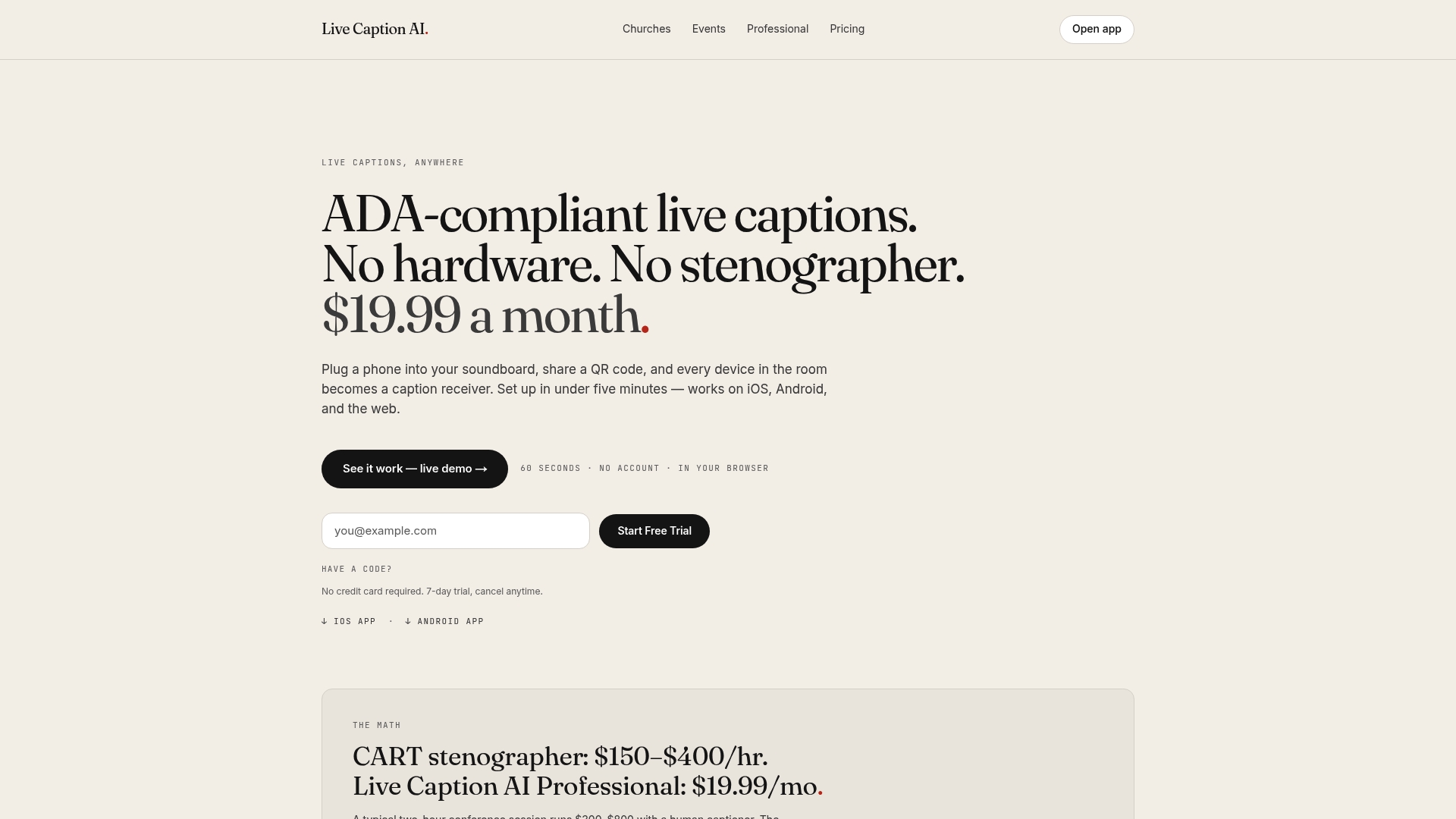
Live Caption AI puts live captions on every phone in the room, with a Medical vocabulary model and translation into one of 29 languages. It doesn’t sign BAAs, so it isn’t for patient health information.
FAQ
Does Section 1557 require language assistance?
Yes. Covered entities must take reasonable steps to give meaningful access to each person with LEP who is eligible to be served or likely to be directly affected by their programs. The assistance must be free, accurate and timely.
Can a family member interpret for a patient?
Generally no. A covered entity can’t rely on an unqualified adult except briefly in an emergency, or when the patient privately requests it with a qualified interpreter present and the request is documented. Minor children can only be used briefly in an emergency.
Can AI translation meet Section 1557?
The regulation doesn’t prohibit machine translation. It requires qualified human review when the text is critical to rights, benefits or access, when accuracy is essential, or when the language is technical or non-literal. Many healthcare documents meet those criteria, so plan for review.
Is the language access rule still in effect?
Yes. A federal court vacated only the gender-identity provisions in October 2025. The remainder of the 2024 rule, including the language access provisions, remains in effect. Check HHS for current guidance.
Sources
- HHS: Section 1557 and meaningful access for individuals with LEP
- HHS OCR Dear Colleague Letter on language access provisions
- eCFR: 45 CFR 92.201
- CFR 2025 edition, 45 CFR Part 92
- National Health Law Program explainer, 2025 update
- National Health Law Program explainer, 2024
- Summary of recent changes to Section 1557
- Civil Rights Litigation Clearinghouse: Tennessee v. Becerra
- National Law Review: Ten takeaways on Section 1557
- National Law Review: AI in healthcare translation
- JD Supra: AI in healthcare translation and interpretive services
- NYC Dental Society: OCR letter on patient language access rights
- Urban Institute: language-concordant health care providers
- How to recognize speech delays