September 26, 2026 · 12 min read
U.S. Providers: Meet Section 1557 Language Access by July 5, 2026
How U.S. providers meet Section 1557 language access: post required notices, name a coordinator, use qualified interpreters, and log every...

Yes. Section 1557 requires covered health programs to provide meaningful, free language assistance to people with limited English proficiency. The HHS Office for Civil Rights enforces this through 45 CFR Part 92. Your first move: post the required notice, line up qualified interpreters, and start logging every language access request you handle.
TL;DR:
Covered entities must post clear, multilingual notices at all patient entry points, including online platforms, to inform about free language assistance options.
Organizations should verify that all interpreters and translators are qualified, using methods like in-person, video, or audio modalities, with human review for critical medical communications.
Telehealth services and digital portals must ensure real-time interpretation maintains low latency and clear communication comparable to in-person visits.
Maintaining detailed logs of interpreter requests, translations, and staff training is essential for demonstrating compliance during OCR reviews.
Immediate actions such as posting notices and beginning interpreter request logs can be completed within weeks to establish a baseline for fulfilling legal obligations.
Table of Contents
-
Regulatory breakdown: Section 1557, the final rule, and what 45 CFR Part 92 requires
-
Who is covered and how to assess whether Section 1557 applies to your program
-
Notice of availability (§92.11): what to publish, languages, and placement
-
Telehealth, portals, and digital accessibility: ensuring meaningful access online
-
Policies, procedures, and the Section 1557 Coordinator: required documents and training
-
Documentation, monitoring, and internal audits: concrete records OCR will expect
Regulatory breakdown: Section 1557, the final rule, and what 45 CFR Part 92 requires
Section 1557 of the Affordable Care Act bans discrimination based on race, color, national origin, sex, age, or disability in health programs that get federal funding. The operational rules live in 45 CFR Part 92, the final rule OCR published, which took effect on July 5, 2024.
The regulation centers on “meaningful access.” That phrase does not mean a one-size-fits-all script. It means covered entities take reasonable steps to communicate effectively with limited English proficient (LEP) individuals, scaled to the entity’s size, resources, and the languages spoken in the communities they serve. A large hospital system carries a different obligation than a two-provider clinic, but both must act.
The final rule’s language access provisions spell out three non-negotiables. Language assistance must be free, not billed to the patient or deducted from any benefit. It must be timely, delivered when the person needs it, not after the appointment ends. And it must protect confidentiality while letting the patient make their own decisions, which is why family members and untrained bystanders are discouraged from interpreting sensitive medical or legal information.
Reasonable steps also cover auxiliary aids for people with disabilities, since the same notice and access framework applies to both language and disability accommodations under Part 92.

Who is covered and how to assess whether Section 1557 applies to your program
Section 1557 reaches further than most providers expect. Covered entities include any health program or activity that receives federal financial assistance from HHS, any program HHS itself administers, and health insurance marketplaces and issuers participating in them. In practice, that means hospitals accepting Medicare or Medicaid, community clinics with HRSA funding, insurers selling marketplace plans, and many physician practices billing federal payers.
Telehealth platforms and multi-state operations do not get a pass. If your organization delivers care across state lines or through a digital portal, the obligation follows the patient, not the location of your servers.
A short applicability memo is worth writing once. Document which federal funding streams your organization receives, which programs you operate, and your conclusion on coverage. Keep it with your compliance files. If OCR ever asks why you built your language access program the way you did, this memo is the first thing you hand over.
Notice of availability (§92.11): what to publish, languages, and placement
Under §92.11 of the eCFR, covered entities must proactively tell people that free language assistance and auxiliary aids exist. This is not a passive policy buried on page nine of a handbook. It has to be visible where people actually look.
The notice itself needs to state that free language assistance is available, explain how to request it, and appear in English plus the most commonly spoken non-English languages in the state or states where you operate. Organizations working across multiple states may need overlapping or combined language sets to cover every jurisdiction. You can find current top-language data through lep.gov and American Community Survey figures, and OCR publishes sample notice language you can adapt rather than draft from scratch.
Placement matters as much as content:
-
Physical entry points, front desks, and waiting rooms where patients first arrive.
-
Intake forms and consent paperwork, so the notice appears before any clinical conversation starts.
-
Patient portals and appointment scheduling pages, matching the in-person experience online.
-
Your main website, including anywhere a visitor might book care or ask a question.
Digital placement deserves the same attention as a printed sign. Guidance on making online notices accessible applies directly here: a notice that is technically posted but buried three clicks deep does not satisfy the intent of the rule.
Qualified interpreters and translators: definitions, acceptable modalities, and machine translation limits
“Qualified” has a specific meaning under the rule. A qualified interpreter demonstrates proficiency in both English and the target language, interprets accurately and impartially, and understands confidentiality obligations along with basic ethics around not injecting personal opinions into a medical or legal conversation. The same standard applies to translators working on written materials.
Acceptable modalities include in-person interpreting, video remote interpreting (VRI), and audio remote interpreting (ARI), provided the technology delivers clear, real-time communication. Temporary exceptions exist for genuine emergencies, such as when no qualified interpreter is immediately reachable and a life-threatening situation cannot wait. Once the emergency passes, the entity has to transition to a qualified interpreter as soon as feasible, not keep relying on an ad hoc solution out of convenience.
Machine translation has a place, but a limited one. It can speed up routine, low-stakes communication. For anything tied to consent, diagnosis, treatment instructions, or legal rights, the final rule’s guidance requires human review when accuracy is essential. Skipping that review on a discharge summary or a consent form is exactly the kind of gap OCR looks for.
Telehealth, portals, and digital accessibility: ensuring meaningful access online
The obligation does not shrink when care moves to a screen. HHS has confirmed that telehealth services and digital patient portals must offer the same language access as an in-person visit. If a patient would get a qualified interpreter in your waiting room, they need the equivalent during a video visit.
That creates real technical requirements. VRI and live captioning depend on bandwidth and latency: a laggy connection that garbles a sign language interpretation or delays captions by several seconds is not meaningful access, it is a failure with a technology excuse attached. Before signing with any vendor, ask about connection quality thresholds and get them written into the contract.
Procurement checklists should include:
-
Documented data retention policies that match your organization’s compliance requirements.
-
Audit logging so you can reconstruct what happened during any session under review.
-
Defined service levels for latency and accuracy, not vague marketing promises.
Policies, procedures, and the Section 1557 Coordinator: required documents and training
Written procedures turn the regulation into daily practice. At minimum, yours should cover:
-
How staff identify a patient’s language needs at first contact.
-
How to request an interpreter or translator, including after-hours procedures.
-
Which bilingual staff are authorized to interpret, and how their proficiency was verified.
-
An inventory of translated materials, updated as documents change.
Every covered entity needs a Section 1557 Coordinator, someone responsible for overseeing the program, publishing their own contact information so patients and staff know who to reach, tracking corrective actions, and acting as the liaison if OCR opens an inquiry.
Training should reach anyone who interacts with patients or beneficiaries directly, not just clinical staff. Front desk teams, schedulers, billing staff, and call center employees all need to know how to trigger language assistance. Annual refreshers, with records of who attended and when, give you something concrete to show if asked.
Pro Tip: Keep a one-page summary of your language access procedure at every front desk. It doubles as a quick staff reference and as evidence, during any review, that the policy is actually in use.
Documentation, monitoring, and internal audits: concrete records OCR will expect
OCR does not evaluate intentions, it evaluates records. Keep an interpreter request log showing date, language, wait time, and modality used. Maintain a translated document register noting who reviewed each translation and when. Retain training rosters and a short summary of any language access complaint or incident, along with how it was resolved.
Set a quarterly review cadence: check request logs for delays, confirm notices are still posted correctly, and verify your language inventory matches the languages your patient population actually speaks. Fix gaps on a defined timeline rather than an open-ended one.
Assemble these records into a single compliance binder, physical or digital, organized by category. If OCR ever requests documentation, or if you are negotiating a settlement, a binder you can hand over in an afternoon says more about your program than any policy statement.
Enforcement examples and common compliance failures
Recent OCR enforcement actions show a consistent pattern: investigations follow reports of missing timely interpreters or inadequate communication with patients, and the remedies are systemwide, not a single apology letter. Entities under agreement have had to overhaul policies, retrain staff, and accept ongoing monitoring.
The failures that trigger scrutiny tend to repeat themselves. No interpreter available within a reasonable window. VRI connections that drop or lag during a clinical conversation. Notices that were never posted, or were posted only in English. Each of these looks small in isolation, but OCR treats them as evidence of a program that exists on paper only.
Prioritize fixes based on what shows up most in enforcement history: fix notice gaps first since they are the cheapest to close, then verify interpreter response times, then stress test your VRI or captioning vendor under real clinical conditions rather than a demo environment.
Practical compliance checklist and tech considerations
Start with what you can finish this month: identify the languages your patients speak, post compliant notices, appoint a coordinator, inventory translated materials, train front-line staff, vet technology vendors, and start logging every interpreter request.
Meaningful access is a documented, individualized standard, not a fixed script, according to the final rule’s own language. What counts as reasonable depends on your organization’s size and the population you serve.
When evaluating any captioning or translation tool, check for:
-
Verified accuracy across the specific languages your patients use.
-
Low-latency performance under real clinical or courtroom conditions.
-
Exportable transcripts you can attach to your compliance records.
Technology extends your reach. It does not replace the qualified human review that consent forms, diagnoses, and legal notices require.
Pragmatic next steps for compliance teams
Post your notice this week. Log every interpreter request starting today. Pair any technology pilot with a human review protocol from day one, not as an afterthought once something goes wrong. Documentation built early is far easier than documentation reconstructed under pressure.
— Ryan
Where Live Caption AI fits in your language access stack
Live captioning solutions are available that provide ADA-compliant captions for medical, legal, and professional settings, including options that avoid unnecessary audio storage to meet privacy requirements. Some services allow audiences to join through a QR code on any phone without extra hardware, and sessions can be exported as transcripts to aid compliance documentation.
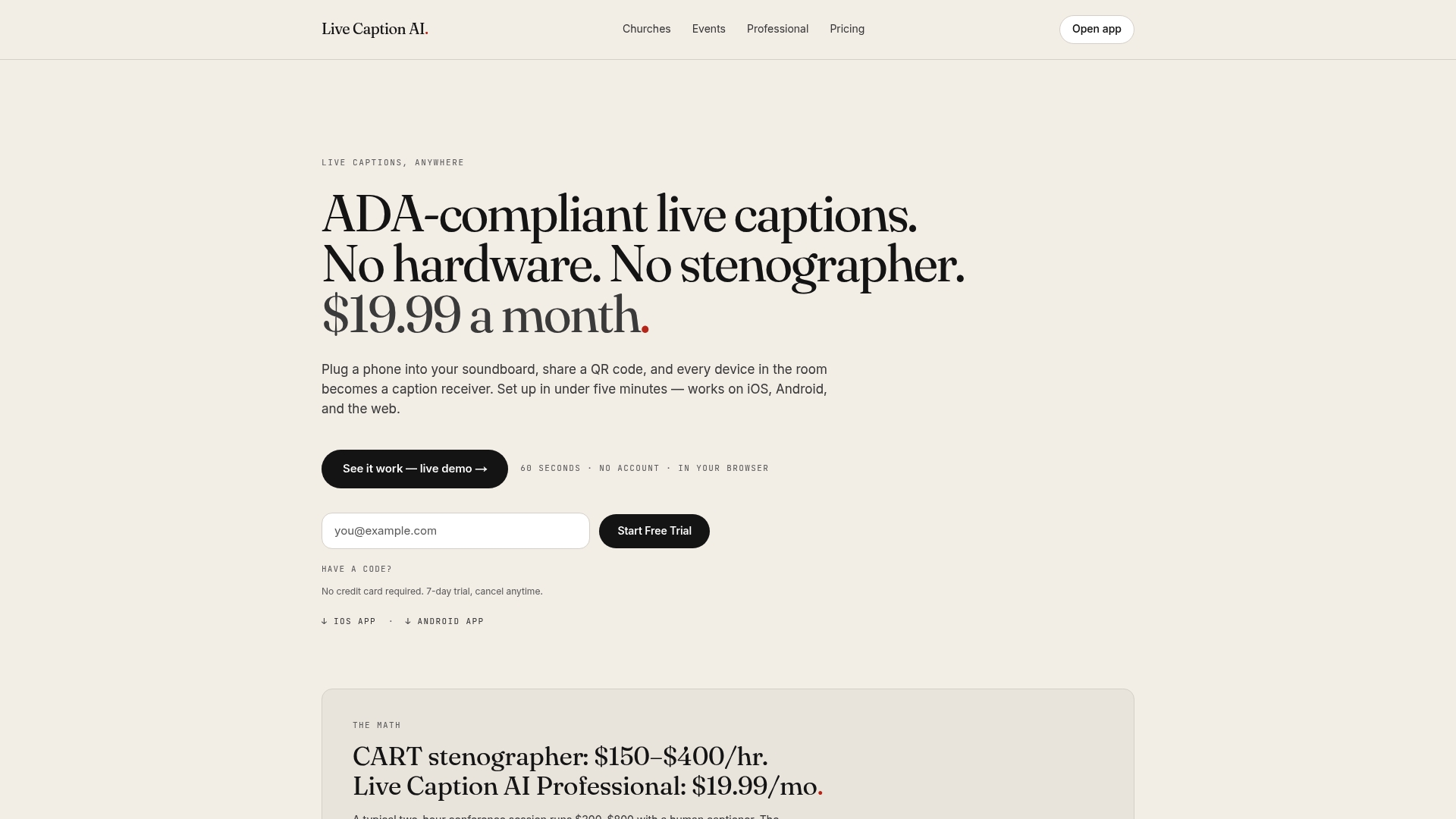
A sensible pilot approach is to run a live captioning tool in one clinic room or telehealth workflow to assess accuracy and latency, while maintaining human review for consent and treatment documents.
-
Captions compliant with relevant accessibility standards can be delivered across multiple languages without the need for dedicated hardware.
-
Access methods include QR codes allowing participants to join the session using their own devices.
-
Sessions may produce exportable transcripts useful for documentation and audit trails.
| Plan | Price | Fits |
|---|---|---|
| Free | Not published | Testing basic on-device captions |
| Professional | $19.99 per month | Single clinic or small practice pilots |
| Business | From $199 per month | Multi-location or enterprise deployment |
Compare tiers on the Live Caption AI pricing page or review deployment details on the professional captioning page before your next procurement meeting.
This article is general information, not a substitute for advice from a qualified lawyer. Consult a qualified legal professional about your own circumstances before acting on anything here.
FAQ
Does Section 1557 require language assistance?
Yes. Section 1557 and its implementing regulation, 45 CFR Part 92, require covered health programs to provide meaningful, free language assistance to limited English proficient individuals. This includes qualified interpreters, translated materials, and a public notice explaining how to request help.
What is the main purpose of the language access policy?
The policy exists to make sure patients can understand and participate in their own care regardless of what language they speak. It requires covered entities to take reasonable, individualized steps rather than apply a single fixed script to every situation.
Which law mandates language access for limited English proficiency patients in healthcare?
Section 1557 of the Affordable Care Act is the primary law, enforced through the Part 92 final rule and overseen by HHS OCR. It applies to recipients of federal health funding, HHS-administered programs, and marketplace insurers.
What language access requirements are outlined in Title VI of the Civil Rights Act?
Title VI bars national origin discrimination by recipients of federal funding, and language access obligations for health programs flow from that principle through Section 1557’s more detailed implementing rule. Section 1557 builds on Title VI’s foundation but adds the specific notice, interpreter, and documentation requirements covered here.