September 26, 2026 · 12 min read
Clinical Teams: Use QR Delivery and Domain Models for Patient Captions
Practical checklist for clinical teams to deploy patient communication captions safely: ADA/HIPAA checks, QR phone delivery, domain-trained models, and...

Live captions are a valid auxiliary aid for many patient encounters, but only when the patient chooses them and the deployment protects both privacy and clinical accuracy. Before turning captions on, do three things: ask the patient what they prefer, confirm the vendor’s privacy safeguards, and check accuracy for the terms that matter most. Captioning tools similar to Live Caption AI are worth evaluating against those standards, rather than relying on any vendor’s claims alone.
TL;DR:
- Live captions are suitable mainly for brief, straightforward interactions such as medication reviews or consent overviews, but not for complex or emotional discussions requiring nuance.
- Compliance depends on both ADA requests, which prioritize patient preferences without cost, and HIPAA, which demands careful vendor assessment and proper data security measures.
- Deployment is easiest via QR codes for immediate phone access, with workflow checks like microphone placement and privacy settings essential for consistent performance.
- Costs range from free or low-cost apps to hundreds of dollars per session for human services, emphasizing the importance of pilot testing accuracy, workflow impact, and vendor compliance before full implementation.
Table of Contents
- Quick decision checklist: when to turn captions on and when to offer an interpreter
- Accuracy and safety: what automated captions get right, where they fail, and how to reduce risk
- Integration and workflows: concrete deployment patterns for the exam room and telehealth
- Staff training, consent, and operations: minimal protocols to make captions reliable
- Cost and procurement: budgeting, pilot design, and vendor questions
- Lessons from piloting captions in clinical settings
- Example vendor to evaluate: Live Caption AI
- Sources
- FAQ
Quick decision checklist: when to turn captions on and when to offer an interpreter
Captions work well in specific, common clinical moments. They rarely replace an interpreter for patients whose primary language is American Sign Language or for conversations where nuance and back-and-forth clarification matter most.
- Telehealth visits, where the patient is already on a screen and a caption overlay adds no extra hardware.
- Consent conversations, where a visible transcript helps patients follow and later recall what was said.
- Masked or PPE encounters, where lip-reading isn’t possible and audio alone leaves gaps.
- Medication review, where patients benefit from seeing drug names and dosages spelled out as they’re spoken.
Captions fall short for patients who rely on ASL as a first language, since captions are a transliteration of English audio, not a translation into sign. They’re also a weaker fit for lengthy, emotionally complex discussions like end-of-life planning, where a qualified interpreter can convey tone and check understanding in real time. The ADA’s effective communication guidance is clear that the choice of aid should match how the patient normally communicates, and that means asking rather than assuming.
Pro Tip: Document the patient’s stated preference in the chart at intake, not after the appointment starts.
Two separate legal frameworks govern captioning in clinical settings, and they answer different questions. The ADA governs whether you must offer an aid at all. HIPAA governs how you protect patient data once you do.
Under ADA telehealth guidance, providers must ensure effective communication and give primary consideration to the patient’s requested aid, at no cost to the patient. That means if a patient asks for captions, that request carries real weight in your decision, not just your convenience.
HIPAA works differently. The HHS guidance on audio and telehealth confirms that HIPAA doesn’t mandate specific telehealth features. Instead, covered entities must evaluate each vendor and each deployment on its own terms, checking whether a business associate agreement is available and whether the technical setup actually prevents unauthorized access to protected health information. Compliance depends on the agreement you sign and how you configure the tool.
A practical vendor checklist:
- Is a business associate agreement available and will the vendor sign one?
- What is the vendor’s audio and transcript storage policy, and can storage be disabled?
- Are encryption and authentication enforced by default?
- Does the platform keep audit logs of who accessed a session?
- What is the vendor’s incident response process if PHI is exposed?
- Keep the signed BAA and technical specification on file as part of your procurement record.
Accuracy and safety: what automated captions get right, where they fail, and how to reduce risk
Automated captions have gotten good enough to be genuinely useful in clinical simulations, but they aren’t error-free, and the errors that matter most aren’t always the ones you’d expect.
A 2026 JMIR pilot study across 29 clinical scenario simulations found captions nondistracting for 86% of participants and easy to follow and trustworthy for 90%, with word error rates ranging from about 12.7% to 22.8% in those simulations, according to the JMIR pilot on medical caption technology. That’s a wide range, and it reflects how much accuracy depends on audio quality, accents, and terminology.

Medical terminology is where generic speech-to-text tends to struggle. Drug names, dosages, and clinical abbreviations are exactly the words a general-purpose model hasn’t seen enough of, which is why domain-trained models for clinical speech reduce errors compared with off-the-shelf tools, and why custom vocabulary lists per clinic matter.
Word error rate alone can understate the real risk, since one mistranscribed dosage matters more than several minor typos elsewhere in a transcript.
- Require a verbal read-back for any medication name, dosage, or allergy before ending the conversation.
- Turn on speaker labels so patients can tell the clinician’s words from their own.
- Keep a human CART fallback on standby for high-stakes conversations like new diagnoses or surgical consent.
Integration and workflows: concrete deployment patterns for the exam room and telehealth
The easiest way to get captions in front of a patient is to skip device provisioning altogether. A QR code displayed on a screen or printed card lets the patient scan it with their own phone and receive captions instantly, no app download, no clinic-owned hardware to sanitize between patients.
A short setup checklist before each session:
- Position the microphone close to the clinician, away from HVAC vents or hallway noise.
- Confirm network connectivity is stable before the patient arrives.
- Enable privacy mode or confirm the no-storage setting if the platform offers one.
- Have a fallback ready, either a phone-based backup or a human captioner, for technical failures.
- Load any custom clinic vocabulary (drug names, specialty terms) before the session starts.
For telehealth, captions can run as an overlay within the video platform or as a separate browser tab the patient keeps open alongside the call. In person, the QR-to-phone pattern works well because it puts the transcript in the patient’s hands rather than on a shared screen, which also helps with privacy in shared exam rooms.
Pro Tip: Label speakers by role (“Clinician” and “Patient”) rather than by name to keep transcripts useful without over-identifying anyone on a shared screen.
Staff training, consent, and operations: minimal protocols to make captions reliable
Captioning fails more often from a missed step than from a technical glitch. A short protocol prevents most of that.
- Front desk or medical assistant asks about communication preference at check-in and notes it in the chart.
- Clinician confirms the preference verbally before starting the encounter and activates captions if requested.
- A designated staff member (often the same clinician) glances at the transcript periodically to catch obvious errors.
- Documentation includes a line noting the aid used and that the patient’s preference was honored.
A simple script works: “Would live captions on your phone help during our conversation today?” That single question satisfies the primary consideration standard and takes five seconds.
- If the patient’s primary language is ASL, or the conversation involves complex risk disclosure, escalate to a qualified interpreter or human CART.
- If captions repeatedly garble names or dosages during a session, stop and switch to a fallback method rather than pushing through.
Cost and procurement: budgeting, pilot design, and vendor questions
Cost comparisons in this space are stark. Human CART services are typically billed per session and can run into the hundreds of dollars, while subscription captioning tools price by month rather than by encounter, and basic on-device captions on many phones are free but lack clinical vocabulary support or PHI safeguards.
Before signing anything, ask each vendor:
- Will you sign a business associate agreement, and under what terms?
- Is pricing per session, per seat, or a flat monthly subscription?
- What is the support response time if captions fail mid-encounter?
- Can we add clinic-specific vocabulary, and how long does that take?
Run a short pilot before committing. Track accuracy on a fixed list of high-risk terms, patient satisfaction from a one-question survey, added time per encounter, and whether front-line staff find the workflow more burden than benefit.
Lessons from piloting captions in clinical settings

The clinics that get the most out of captioning start small: one exam room, one clinician, two weeks. The failures I’ve seen traced back to skipped training, not bad technology, a clinician who didn’t know how to turn captions on, or a front desk that never asked patients what they wanted.
Measure two things from day one: accuracy on your clinic’s most-used terms and patient satisfaction with a one-line survey. Everything else follows from getting those two right, and from treating patient preference as the starting point rather than an afterthought.
— Ryan
Example vendor to evaluate: Live Caption AI
Live Caption AI is one example of a captioning tool built for medical, legal, and professional settings, and it’s worth evaluating against the same checklist covered above rather than taking any vendor’s claims at face value.
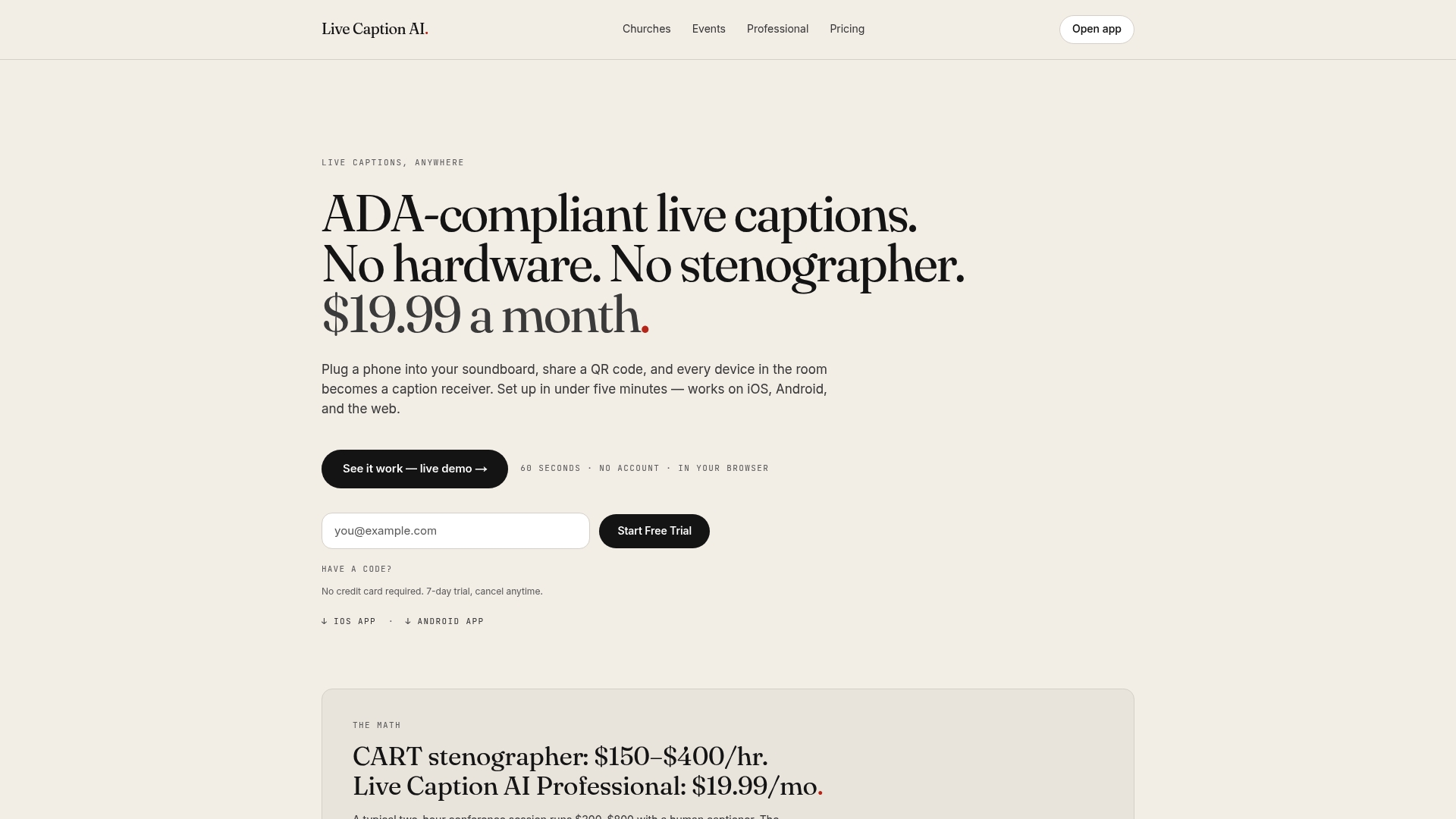
What to verify before you deploy: QR-code phone delivery that lets patients scan and receive captions without installing anything, domain-specific models aimed at specialized terminology, and deployment options designed to support HIPAA compliance, which still require confirmation of business associate agreements and storage policies directly with the vendor rather than assuming compliance from labels. Pricing includes a Free tier, a Professional plan at $19.99 per month, and a Business plan from $199 per month, all listed on the pricing page.
| What to check | Why it matters |
|---|---|
| QR-code phone delivery | Reduces device provisioning and lets patients use their own phone |
| Domain-specific vocabulary | Aims to reduce errors on clinical terms generic tools miss |
| BAA availability | Determines whether the deployment can meet HIPAA obligations |
| Storage or no-storage policy | Affects PHI exposure and audit requirements |
Review the professional and medical product details and confirm the technical specifics against your own compliance checklist before rolling out to a clinic.
This article is general information, not a substitute for advice from a qualified doctor. Consult a qualified healthcare professional about your own circumstances before acting on anything here.
Sources
- Hhs
- Assessing the Role of Medical Caption Technology to Support Physician-Patient Communication for Patients With Hearing Loss: Mixed Methods Pilot Study | JMIR Rehab Assistive Technol
FAQ
Are patient communication captions a recognized ADA auxiliary aid?
Yes, real-time captioning is listed among recognized auxiliary aids under ADA guidance, and providers must give primary consideration to the patient’s requested aid. The final choice should be made in consultation with the patient rather than decided unilaterally by staff.
Does HIPAA require captioning vendors to store no audio?
HIPAA does not mandate a specific storage policy, but covered entities must confirm through a business associate agreement that a vendor’s technical configuration protects PHI, which often means asking directly whether audio or transcripts are retained. Each deployment needs its own evaluation rather than relying on a vendor’s marketing claims.
How accurate are live captions in clinical settings?
A 2026 JMIR pilot found word error rates between roughly 12.7% and 22.8% across simulated clinical scenarios, with most participants rating captions easy to follow and trustworthy. Accuracy improves with domain-trained models and clinic-specific vocabulary lists for terms generic speech-to-text tools often miss.
Can captions replace an interpreter for consent conversations?
Captions can support recall and comprehension during informed consent, as shown in simulated consent encounters, but they don’t replace a qualified interpreter for patients whose primary language is ASL. The safest approach is to ask the patient’s preference and escalate to an interpreter for complex or high-stakes discussions.
What does a captioning pilot in a clinic typically cost?
Costs vary widely: human CART services are usually billed per session and can run into the hundreds of dollars, while subscription captioning tools price by month, such as Live Caption AI’s Professional plan at $19.99 per month. Budgeting should also account for setup time and staff training, not just the subscription fee itself.