October 6, 2026 · 15 min read
Deposition Live Captions: Legal Checklist and 15 Minute Setup
Legal teams: an operational checklist for deposition live captions. Prep audio and network, load case vocabulary and Custom Terms, send an accessibility...

AI live captions can make depositions easier to follow in real time, but they do not replace a certified transcript. Tools like Live Caption AI can satisfy ADA accessibility needs by streaming captions to every phone in the room, with live translation when the deposition includes non-English speakers. What they cannot do is produce the verbatim, certified record a court reporter provides.
TL;DR:
- AI live captions are useful for accessibility and comprehension but do not produce certified transcripts suitable for official court records.
- Preparing vocabulary models, Custom Terms, and ensuring high-quality audio can significantly reduce caption errors during depositions.
- Caption exports are for reference only and should not be treated as evidence or official documentation under legal standards.
- Certified reporters or CART captioners are necessary when an official, verifiable transcript is required for legal proceedings.
- Cost-effective tools like Live Caption AI turn phones into caption receivers using QR codes, offering a low-friction setup for accessible depositions.
Table of Contents
- What deposition live captions are (and are not)
- How live captions fit ADA and accessibility requirements
- Setting up reliable captions before the deposition starts
- Accuracy limits and how to reduce caption errors
- Privacy, export formats, and keeping records straight
- Live captions versus traditional stenography in depositions
- Common challenges and how to troubleshoot them during the deposition
- Legal considerations and whether live captions can be used in court
- Software and platforms commonly used for live deposition captions
- When AI captions are enough, and when they are not
- Using Live Caption AI for deposition accessibility
- FAQ
- Sources
What deposition live captions are (and are not)
For this guide, deposition live captions mean AI speech-to-text that streams to attendees’ own phones through a QR code, with one-language translation per session and exportable transcripts for quick reference. No app, no hardware, no stenographer in the room.
Live Caption AI’s feature set maps directly to that definition:
- Medical, Worship & Ministry, and Finance & Earnings vocabulary models, plus up to 100 Custom Terms for names and case-specific language.
- Translation into one of 29 languages per session, with viewers able to switch between the original and the translated feed.
- Exportable transcripts in TXT, SRT, JSON, or PDF, with session audio never stored.
That is accessibility captioning: a real-time aid for comprehension. It is a different function from CART (Communication Access Realtime Translation) or stenographic reporting, where a certified professional produces a verbatim record that can be certified for the court. The CART Captioner’s Manual describes CART as a communication aid in its own right, distinct from an official reporter’s certified transcript, which is a useful reminder that even human-provided captioning has layers of formality. AI captions sit a step below CART in fidelity and have no certification path at all.
How live captions fit ADA and accessibility requirements
Real-time captioning is one of the auxiliary aids named in ADA guidance on effective communication, alongside interpreters, notetakers, and assistive listening systems. The same guidance requires giving primary consideration to the individual’s preferred accommodation, meaning the choice is not entirely the organizer’s to make unilaterally.
Live captions for synchronized media also fall under WCAG 2.1 guidance on live captions, which notes that producing accurate captions in real time is inherently harder than captioning prerecorded content. That gap between intent and execution is exactly why depositions need a plan, not just a tool.
Before scheduling, confirm these points with the participant and all counsel:
- Ask the deaf, hard-of-hearing, or non-English-speaking participant which accommodation they prefer, and document the answer.
- Confirm the device and display each attendee will use to view captions.
- Settle on a source language and, if needed, a single target translation language for the session.
- Decide who can view the caption feed and who pays for the captioning service.
Pro Tip: Send a one-page accessibility plan to all parties 48 hours before the deposition so no one is surprised by the setup on the day.
Setting up reliable captions before the deposition starts
A deposition is not the place to discover a microphone problem. Treat setup as a short, repeatable checklist.
Audio first:
- Give the deponent and each attorney a dedicated, close-positioned microphone rather than a single room mic.
- Turn off speakerphone audio on any remote line; patch remote participants through a direct audio feed instead.
- Close windows and silence phones to cut ambient noise before the session starts.
Session configuration:
- Choose the vocabulary model that fits the matter (Medical for a malpractice case, for example) or load up to 100 Custom Terms for party names, case numbers, and technical jargon in advance.
- Set the source language and, if the deposition involves a non-English speaker, the one target translation language for that session.
- Generate the QR code early and test that it opens the caption feed on a phone with no app installation required.
Network and device checks:
- Confirm a stable internet connection, with a mobile hotspot as backup.
- Check that the venue’s WiFi or firewall does not block the captioning service.
- Verify each attendee’s phone can load the caption page without special permissions.
Operational roles: Assign one person, often a paralegal or court reporter’s assistant, as the dedicated tech lead. That person runs a two-minute caption test before swearing in the witness and has a plan for pausing and repeating testimony when audio is inaudible or garbled.
Pro Tip: Run the full setup at least 15 minutes before the deposition is scheduled to start, not the moment attendees arrive.
Accuracy limits and how to reduce caption errors
Automatic speech recognition accuracy depends heavily on audio quality and vocabulary, and error rates vary widely across systems and conditions, according to research on ASR accuracy and vocabulary. A deposition with overlapping objections, an unusual surname, or dense technical jargon is exactly the scenario where raw ASR output struggles most.
Common error modes in depositions:
- Overlapping speech when an attorney objects mid-answer, which can scramble or drop words in the caption feed.
- Misheard proper names, medical terms, or case-specific jargon that the base model has never seen.
- Dropped words during fast or mumbled speech, which matters more in legal testimony than in casual conversation.
A study on real-time manual correction of ASR captions found that correction brought average Word Error Rate down from 8.8% to 6.1%, showing that hybrid human-plus-AI workflows meaningfully improve fidelity over AI alone, though residual errors persisted even with correction.
Mitigation is mostly preparation: load the right vocabulary model, add Custom Terms for names and jargon before the session, give each speaker a dedicated close mic, and ask witnesses to pause between answers rather than talking over counsel. For depositions where higher fidelity matters, a human reviewing the export afterward closes most of the remaining gap.
Privacy, export formats, and keeping records straight
Caption exports come in a few common formats, each suited to a different use. TXT works for quick note-taking and search. SRT is built for syncing captions to a video recording. JSON suits teams piping transcripts into other software. PDF is the easiest to share with co-counsel who just want to read along.
Live Caption AI states that session audio is never stored, while transcripts can be exported and saved, with AI summaries included. That is a useful privacy posture for sensitive testimony, but it also means organizers, not the software, control what happens to the exported files afterward.
For legal teams, a short retention policy avoids confusion later:
- Decide who on the team can access exported transcripts and summaries.
- Set a retention window and a deletion date, rather than letting files sit indefinitely on someone’s laptop.
- Have counsel review any caption export before it is used informally in case preparation, since it is a reference tool, not evidence.
Live captions versus traditional stenography in depositions
The two serve different jobs. A stenographer produces a certified verbatim transcript that can be read into the record, cited in motions, and relied on by the court. AI live captions produce a real-time reading aid that helps participants follow along, translate on the fly, and take notes, but carries no certification.
Cost and setup are where AI captioning pulls ahead for the accessibility use case: no stenographer to book weeks in advance, no special hardware, just a QR code on each attendee’s own phone. Stenography requires scheduling a certified professional, often with lead time and a higher fee, but it delivers the one thing AI captions cannot: a transcript the court will accept as the official record.

The two are not interchangeable, and treating them as competitors misses the point. A deposition with a hard-of-hearing witness and a certified reporter present can use both: the reporter produces the record, and live captions give the witness or an interpreter a real-time way to follow testimony. The question is not which one to pick, but which job needs doing. If the deposition requires an official transcript for filing or trial use, a certified reporter is not optional. If the goal is making sure every participant can follow and refer back to what was said in the moment, live captions do that job well and at a fraction of the setup cost.
Common challenges and how to troubleshoot them during the deposition
Even a well-prepared setup runs into friction. The most frequent problems have straightforward fixes.
Captions lagging behind speech: Usually a network issue. Switch to the backup hotspot, or ask the tech lead to refresh the caption session rather than restarting the whole deposition.
Garbled names or technical terms: This points to a vocabulary gap. Pause briefly, add the term to Custom Terms if the platform allows mid-session updates, and have the speaker repeat the name once clearly for the record.
Attendees can’t load the QR code: Check that the venue WiFi isn’t blocking the captioning domain, and have a backup method, like a shared link sent by text, ready before the session starts.
Overlapping speech during objections: Build in a norm from the start: one speaker at a time, with a brief pause before the next person begins. This helps both the court reporter, if one is present, and the caption feed.
Remote participant audio is thin or distorted: Avoid routing remote attendees through a laptop’s built-in speaker and microphone. A direct dial-in or dedicated headset mic produces far cleaner audio for both stenography and captions.
Most of these problems trace back to the same root cause: audio quality. A five-minute test before the deposition begins, checking each microphone, the QR code, and the network, catches the majority of issues before they interrupt testimony.

Legal considerations and whether live captions can be used in court
AI-generated live captions are not a certified record, and courts do not treat them as one. The CART Captioner’s Manual draws this line even for human-provided CART services, which sit closer to a verbatim record than AI captions do: CART is a communication aid, not a substitute for an official reporter’s certified transcript.
That distinction matters for how legal teams use caption exports. A saved transcript or AI summary from a captioning session can be useful for internal case review, for refreshing an attorney’s memory of what was said, or for giving a hard-of-hearing team member a record to revisit. It is not something to cite as evidence or attach as an exhibit without a certified reporter’s transcript backing it up.
Whether a specific use of AI captions satisfies ADA obligations for a given proceeding depends on the individual’s accommodation needs and the organizer’s documented process for meeting them, not on the software alone. The ADA’s effective-communication guidance and the HHS Office for Civil Rights explanation both point to the same practice: ask the participant what they need, document the accommodation offered, and keep a certified reporter in the room when the proceeding requires an official record. Counsel should make that call, not the captioning vendor.
Software and platforms commonly used for live deposition captions
A few categories of tools show up in deposition settings. Built-in captions on video conferencing platforms offer free, basic real-time text during remote depositions, though they typically lack legal-specific vocabulary support and translation options. Dedicated transcription services aimed at media and content creators focus more on post-production editing than live, in-room accessibility. CART providers supply certified human captioners for the highest-fidelity accessibility need, at a cost and lead time that reflects the certification involved.
Purpose-built live captioning software like Live Caption AI sits in a different lane: no hardware to rent, no app for attendees to install, and a QR code that turns any phone into a caption receiver. For a deposition with a mix of attorneys, a witness, and possibly an interpreter, that low-friction setup matters more than it sounds, since nobody needs to troubleshoot an install five minutes before testimony starts. Our guide to real-time transcription services covers more deployment examples for legal and professional settings.
The right choice depends on what the deposition actually needs: free conferencing captions for a low-stakes internal call, a certified CART provider for a proceeding that demands verified fidelity, or a specialized live captioning tool when the goal is clear, fast, translatable access for every participant in the room.
When AI captions are enough, and when they are not
Teams reach for AI live captions in depositions because they are fast to set up and genuinely useful: a hard-of-hearing witness follows along in real time, a non-English speaker reads a translated feed, and everyone leaves with a rough transcript to jog their memory later. The trade-off is fidelity. AI captions are a comprehension aid, not a certified record, and that gap does not close with a better microphone.
Certified CART or a stenographer becomes necessary when the proceeding requires an official transcript, when testimony is high-stakes enough that every word needs to be verifiable, when several people talk over each other regularly, or when the matter is sealed and access needs tighter control than a shared QR code allows.
— Ryan
Using Live Caption AI for deposition accessibility
For the accessibility side of a deposition, we built Live Caption AI around one idea: live captions on every phone in the room. Live Caption AI turns any phone into a caption receiver through a QR code, no hardware, no stenographer. Medical, Worship, and Finance vocabulary models plus your own Custom Terms, translation into one of 29 languages per session, and session audio is never stored.
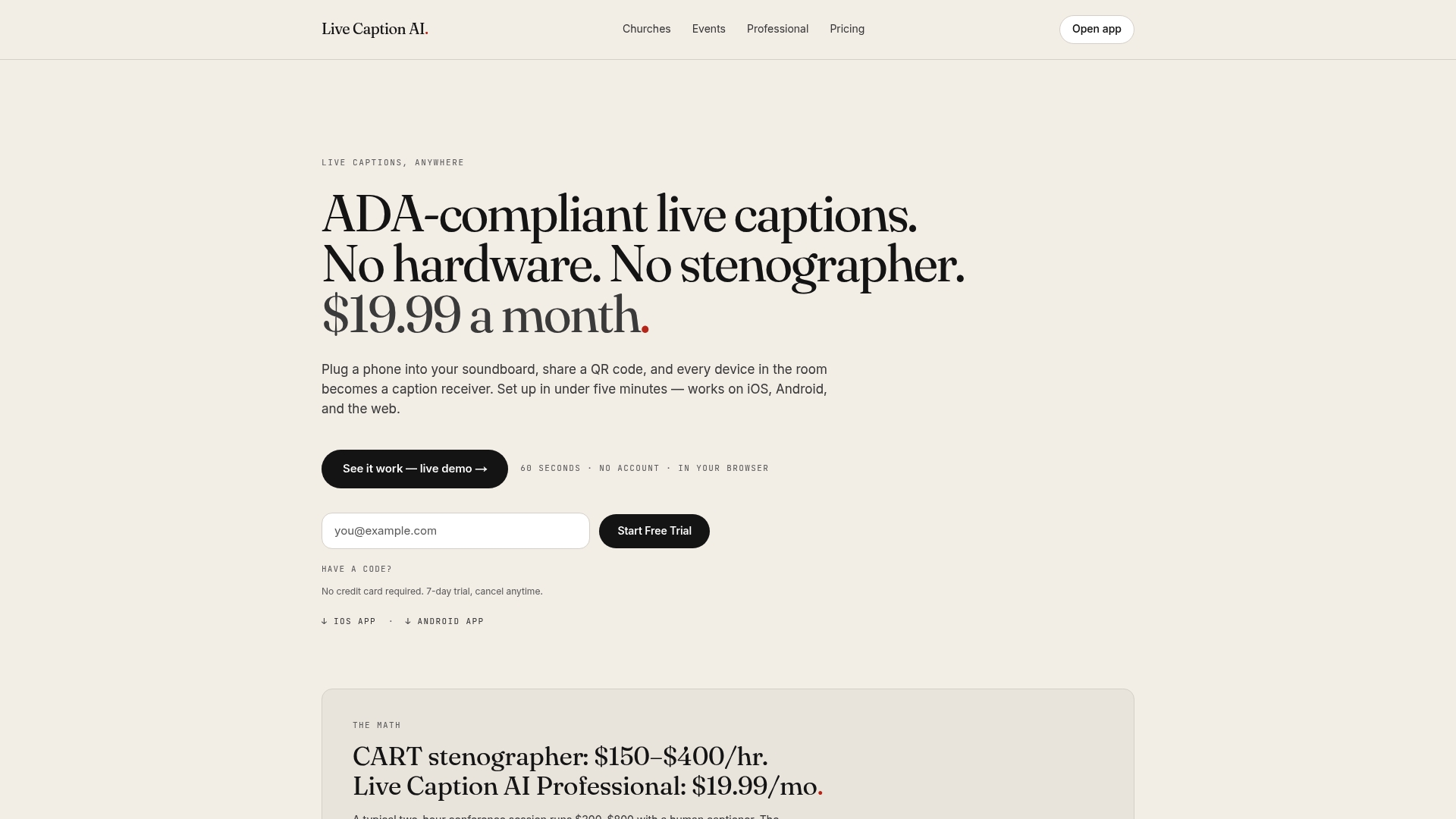
Where generic speech-to-text garbles case-specific names and jargon, our vocabulary models and up to 100 Custom Terms give depositions a fighting chance at clean captions from the first question. Attendees scan a code and read along on their own phone: no account, no install.
- Pick the vocabulary model that matches the matter, or add Custom Terms for names and jargon before the deposition starts.
- Choose one target language for live translation when a participant needs it.
- Export the session as TXT, SRT, JSON, or PDF when it’s over, with an AI summary included.
We recommend a short pilot session before relying on live captioning for a real deposition, and we recommend checking with counsel before treating any export as more than a reference tool. Our Professional plan page covers the features built for legal and professional settings, and our pricing page lists the Free, Professional, and Business tiers.
[ Explore Live Caption AI ]
FAQ
Can AI live captions be used as an official deposition transcript?
No. AI live captions are an accessibility and reference tool, not a certified record, and courts rely on a certified reporter’s verbatim transcript for official proceedings. Treat caption exports as notes, not evidence.
Does the ADA require live captioning for depositions?
The ADA lists real-time captioning among recognized auxiliary aids and requires giving primary consideration to the participant’s preferred accommodation, which may or may not be captioning. The specific requirement depends on the individual’s needs and the setting, so organizers should ask and document the choice rather than assume.
How accurate are AI live captions during a deposition?
Accuracy depends heavily on audio quality and vocabulary, and research on ASR systems shows error rates vary widely across conditions. Specialized vocabulary models, Custom Terms, and dedicated microphones for each speaker meaningfully reduce errors compared to a single room mic and a generic model.
What is the difference between live captions and CART in a deposition?
CART is a human-provided communication aid, while AI live captions are automated; the CART Captioner’s Manual describes CART itself as distinct from an official reporter’s certified transcript, meaning both sit below certified stenography in formal weight. AI captions are faster to set up and lower cost, while CART offers higher fidelity through a trained human captioner.
What does Live Caption AI cost for a legal team to try?
Live Caption AI offers a Free plan with no published price, a Professional plan at $19.99 a month, and a Business plan from $199 a month. Legal teams evaluating captioning for depositions can review plan details on the pricing page before committing.
Sources
- Ada
- Understanding WCAG 2.1: Captions (Live) | W3C
- The CART Captioner’s Manual | NCRA
- ASR accuracy varies with audio and vocabulary (arXiv preprint)
- Study on collaborative correction of AI captions (ACM)