October 29, 2026 · 12 min read
Court Reporter Shortage: Causes, Impact and What Helps
Why the US court reporter shortage exists, what the data shows, how it affects the record and access to justice, and what courts and teams can do now.

The United States has a court reporter shortage because more stenographers are leaving the profession than entering it. The workforce is aging, training programs have closed, and the pipeline is slow. The result: delayed proceedings, higher costs, and in some courts, hearings with no verbatim record at all. Below you get the numbers, the causes, the effects, and the realistic fixes. You also get a clear line on where AI captioning fits and where it does not.
TL;DR
- The shortage comes from retirements, fewer recruits, falling enrollment, and closed stenography programs.
- Federal data projects 0% job growth through 2035, yet about 1,800 openings a year as people retire or leave.
- In California, about 71.3% of family law, probate, and unlimited civil hearings ran without a verbatim record from April 2023 to March 2026.
- Courts are using signing bonuses, equipment allowances, and digital reporting to close the gap.
- Live Caption AI is not a court record tool and is not HIPAA-compliant. It helps with live communication access in meetings, classes, churches, and events.
Table of Contents
- Why there is a shortage of court reporters
- Are court reporters in high demand?
- How the shortage affects proceedings and access to justice
- What courts are doing about it
- Will AI replace court reporters?
- Our perspective: record and access are different jobs
- Where AI captioning fits, and where it does not
- Live Caption AI for the events your reporters should not have to cover
- FAQ
- Sources
Why there is a shortage of court reporters
No single cause explains it. Several pressures stack up.
The 2025 Court Reporting Industry Trends summary points to four drivers: an aging workforce and retirements, fewer people entering the field, declining stenography-school enrollment, and the closure of stenography programs. Each one feeds the next. Fewer schools means fewer graduates. Fewer graduates means fewer mentors and fewer visible careers. Fewer visible careers means fewer applicants.
This was forecast years ago
The problem is not new. The 2013–2014 Ducker industry outlook projected that demand would exceed supply by 2018. It cited retirements and declining enrollment and graduation rates. That report also indicated that perception problems hurt recruiting: little public awareness of the profession, and a social push toward four-year degrees.
The training path is long
Court reporting programs typically take two or three years and may lead to a certificate or an associate’s degree, according to the Bureau of Labor Statistics. Coursework covers English grammar, phonetics, legal procedures, and terminology. Certification typically requires written and skills tests.
The skills test is the bottleneck. In California, licensing typically takes three to four years, and 52.7% of candidates passed the skills portion of the last three state certification exams. Plenty of students start. Fewer finish.
Hiring is not a priority for many courts
An August 2025 National Center for State Courts report found that only 1% of survey respondents named hiring a top operational priority. That suggests a gap between what courts need and how they plan resources.
Are court reporters in high demand?
Yes and no. The data looks contradictory until you read it closely.
The BLS projects little or no change in employment, 0% growth, from 2025 to 2035. It also projects about 1,800 openings each year, mostly to replace people who retire or exit. So the job market is steady, not booming. Demand is for replacement, and replacement is not happening fast enough.
| Measure | Figure | Source |
|---|---|---|
| Projected employment change, 2025 to 2035 | 0% (little or no change) | BLS |
| Projected openings per year | About 1,800 | BLS |
| Median annual wage, May 2025 | $72,420 | BLS |
| Change in US stenographers over ten years | Down 21%, about 23,000 remain | 2025 industry trends summary |
| End users reporting scheduling difficulty | 76% | 2025 industry trends summary |
| End users citing higher costs | 55% | 2025 industry trends summary |
The BLS also notes that state and local government budgets may affect court reporter employment. Most court reporting jobs sit in public systems, so budget cycles matter.
What this means for a career
If you are weighing a court reporting career, the numbers point one way. Openings exist every year, pay is solid for a two-to-three-year program, and the profession is short of people. The hard part is finishing training and passing the skills exam. Technology is the open question, covered below.
How the shortage affects proceedings and access to justice
The shortage shows up in three places: schedules, costs, and the record itself.
Schedules. Depositions and hearings wait for an available reporter. In the 2025 industry study, 76% of end users reported scheduling difficulties.
Costs. 55% of end users in the same study cited increased costs. When supply is tight, rates rise.
The record. This is the serious one. California’s judicial branch reports that about 3,007,651 hearings, or 71.3%, in family law, probate, and unlimited civil matters proceeded without a verbatim record between April 2023 and March 2026. The same page says the state’s courts need at least 458 more full-time court reporters, and that the 1,101 court-employed reporters in 2026 fall well short of that.

Why does a missing record matter? Without a transcript, appeals become very hard. California’s Supreme Court has said the absence of a verbatim record will frequently be fatal to an appeal being decided on the merits. The burden falls hardest on people who cannot afford to hire a private reporter.
Some judicial leaders go further. The 2025 industry trends summary notes that officials in some states have called the shortage a “constitutional crisis” threatening due process.
What courts are doing about it
Responses fall into three groups.
- Pay and incentives. California courts have used signing bonuses of up to $50,000, student loan or equipment allowances, and retention bonuses, according to the state judicial branch. Hiring has increased, but the gap remains.
- Recruitment and training. Awareness campaigns and school partnerships target the perception problem the Ducker report described. These take years to pay off, given a training path of two to four years.
- Alternative capture methods. Digital reporting and electronic sound recording are growing. The 2025 industry trends summary says digital reporting has begun to ease some pressure and is emerging as a trusted capture method. Federal districts have also written these options into their plans. The District of South Dakota’s court reporter management plan provides for official reporters, electronic sound recording, and contract reporter services.
None of these is a quick fix. Together they slow the decline.
Will AI replace court reporters?
The BLS gives a measured answer. Technology may make transcription more efficient, and AI transcription is expected to dampen employment demand. But court reporters will still be needed to review and edit digitally produced documentation.
That matters for how you think about the shortage. The official record of a proceeding is a legal product. It needs a qualified person standing behind it. Automated speech-to-text can assist, but it does not replace certification, review, or the chain of custody courts require.
We want to be plain about our own place in this. Live Caption AI is an AI captioning tool. It is not certified, it is not human-reviewed, and it is not a court record. We do not position it for courtroom use, and it should not stand in for an official reporter.

Our perspective: record and access are different jobs
The shortage blends two needs that people often treat as one.
The first is the official record: a verbatim, certified transcript for appeals and legal use. Only qualified reporters and approved digital methods fill that role. We do not claim to.
The second is communication access: making sure people in the room can follow what is being said as it is said. A person who is deaf or hard of hearing, a participant who speaks another language, or anyone in a noisy hall needs live captions. A certified reporter often does that work too, which means every reporter pulled into a meeting, class, or event is one fewer available for the record.
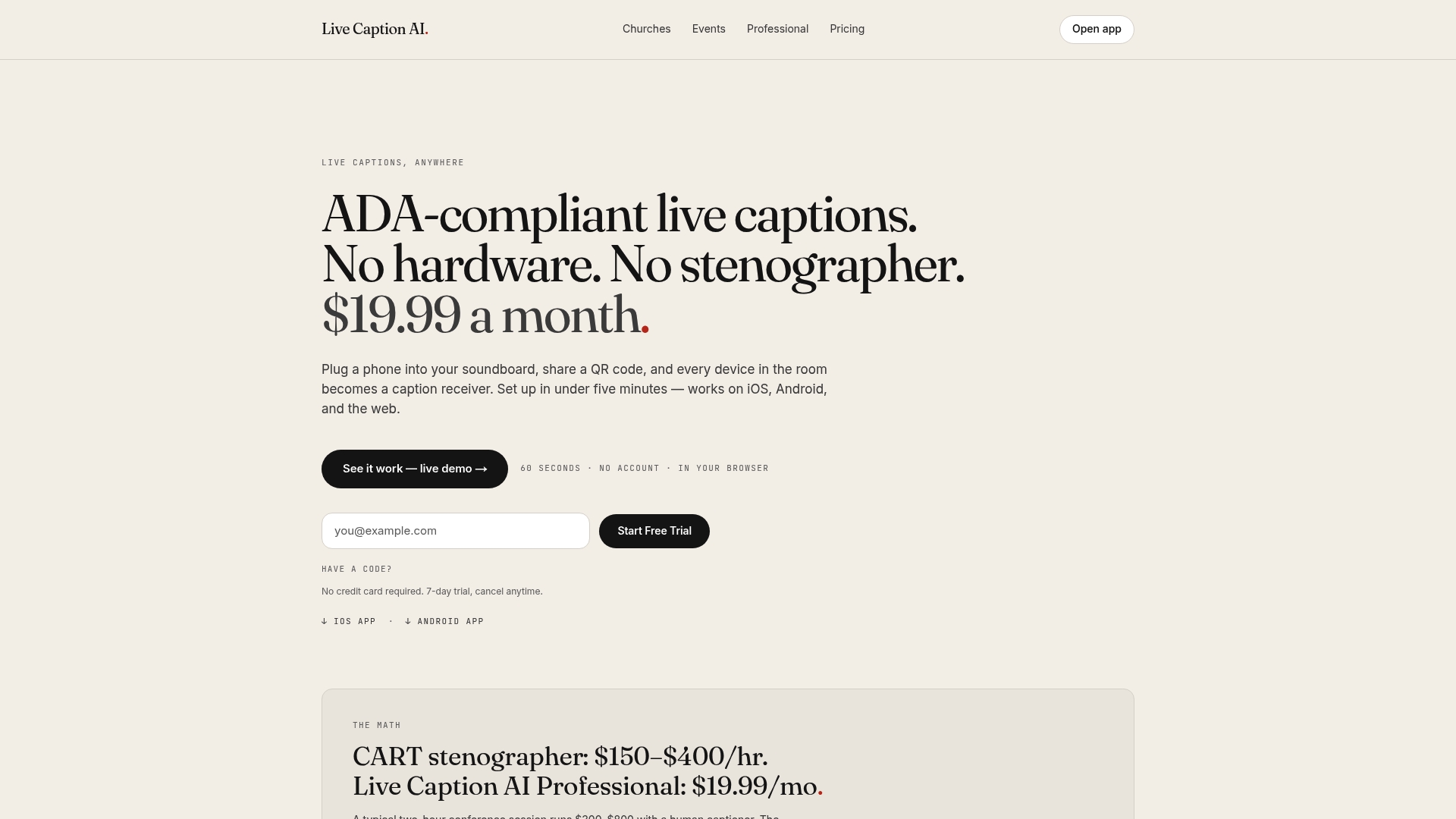
That is where we come in. Live Caption AI puts live captions on every phone in the room through a QR code. The speaker runs it on a phone or laptop. Attendees scan and read. No app to install. No account. No hardware to rent. No stenographer to book.
For the settings we serve, that frees scarce human reporters for work that truly needs them. Here is what we offer:
- Medical, Worship & Ministry, and Finance & Earnings vocabulary models.
- Up to 100 Custom Terms: names, places, and terms you type in before going live.
- Live translation into one of 29 languages per session.
- Transcripts exported as TXT, SRT, JSON, or PDF, plus AI summaries.
- Session audio is never stored.
An organization can use Live Caption AI as part of its ADA effective-communication plan. It does not make an organization ADA-compliant on its own. Accuracy depends on audio quality, and nobody reviews the output.
— Ryan
Where AI captioning fits, and where it does not
Use this as a quick sorting guide.
| Situation | Right tool |
|---|---|
| Trial, deposition, or any proceeding that needs an official verbatim record | A certified court reporter or a court-approved digital reporting method |
| Legal hearing where a participant needs a formal accommodation | Follow the court’s accommodation process. Request CART weeks ahead |
| Public meeting, town hall, or community forum | Live captions on attendees’ phones, as part of a broader access plan |
| Church service, class, conference, or workshop | Live captions plus translation, with a vocabulary model |
| Multilingual event | One source language and one target language per session |
Public meetings are a natural fit
Land use boards, planning sessions, and community hearings often have audiences who struggle to follow in real time. Guidance on accessible public meetings covers the technology that makes remote and in-person proceedings easier to follow, including live captions. Note that a public meeting’s official minutes or transcript are a separate matter from live access.
Practical tips for any captioned session
- Test your microphone before the session starts. Clean audio is the biggest accuracy lever.
- Load your Custom Terms first: speaker names, place names, project names.
- Pick the right vocabulary model for your setting.
- Display the QR code on a slide and on printed signs.
- Tell attendees that captions are AI-generated and not a verified transcript.
- Keep a human option available for anyone who needs a formal accommodation.
Live Caption AI for the events your reporters should not have to cover
If you run meetings, classes, services, or events and want captions without booking a person, start with the Professional plan at $19.99 a month with unlimited captioning. There is also a Free plan, and the Business plan starts at $199 per month. Translation credit packs are available as one-off purchases: 30 credits for $6.99, 60 for $11.99, and 120 for $19.99.
See how it works for medical, legal, and professional settings.
[ Explore Live Caption AI ]
FAQ
Why is there such a shortage of court reporters?
More reporters are retiring than entering the field. Stenography programs have closed, enrollment has fallen, and training takes years. The 2025 industry study counts about 23,000 stenographers, down 21% in a decade.
How much do court reporters make?
The BLS reports a median annual wage of $72,420 as of May 2025. Pay varies by state, employer, and whether the reporter works in a court or freelance. Some California courts have also offered signing bonuses of up to $50,000.
Will AI eventually replace court reporters?
AI is expected to dampen demand, according to the BLS, but people will still be needed to review and edit digitally produced documentation. Courts also depend on certified records, which unreviewed AI output does not provide. AI captioning is better suited to live access than to the official record.
Is the shortage affecting people’s right to appeal?
In California, yes. Without a verbatim record, an appeal is very hard to bring, and the state’s Supreme Court has said a missing record will frequently be fatal to deciding an appeal on the merits. The court system estimates 71.3% of certain civil hearings went unrecorded from April 2023 to March 2026.
No. Live Caption AI is not HIPAA-compliant, and it is not intended or certified for courtroom use or for creating an official record. It provides AI live captions for meetings, classes, churches, and events.
Sources
- Executive Summary: 2025 Court Reporting Industry Trends
- Shortage of Court Reporters in California, Judicial Branch of California
- Court Reporters and Simultaneous Captioners, Occupational Outlook Handbook, BLS
- Industry Outlook Report 2013–2014
- Preparing for future workforce needs, National Center for State Courts
- United States District Court, District of South Dakota, court reporter service management plan