September 24, 2026 · 15 min read
Organizations: Book Interpreters Two Weeks Out to Beat the Shortage
Practical steps for organizations to ease the interpreter shortage now: schedule rosters, raise pay, fund mentorships, and use Live Caption AI where suitable.

Yes: there is a persistent shortage of qualified ASL interpreters, and it’s creating measurable access gaps in healthcare, education, and legal settings right now. A significant share of practicing interpreters are over age 51, according to the 2025 Michigan Interpreter Needs Assessment, and the workforce isn’t growing fast enough to replace them. Organizations that wait for the market to fix itself will be the ones scrambling.
TL;DR:
- Most interpreters are over age 51, and retirement rates are exceeding new certifications, creating a shrinking, aging workforce nationwide.
- Rural and small metro areas face service deserts where a single interpreter may cover multiple counties, delaying emergency and legal assistance.
- Fixes like better scheduling, increasing pay, and developing pipelines are more effective than short-term solutions such as VRI or temporary hiring.
- Automated captioning tools like Live Caption AI support access but cannot replace qualified interpreters for high-stakes or legal situations.
- Addressing the shortage requires coordinated efforts in training, funding, scheduling, and retention to build a sustainable, qualified interpreter pipeline.
Table of Contents
- How Big Is the Interpreter Shortage, Really?
- What’s Actually Driving the Shortage of Interpreters?
- How Does the Interpreter Shortage Affect Healthcare, Schools, and Courts?
- What Can Organizations Do About the Interpreter Shortage Now?
- When Is VRI or Captioning Enough, and When Isn’t It?
- What Do the Research Reports Actually Say?
- What Does the Shortage Actually Cost the Deaf Community?
- Where Are Interpreter Shortages Worst, and Why?
- Is Interpreter Demand About to Change?
- What Actually Fixes This Long Term?
- What Should Organizations Prioritize First?
- Live Caption AI as a Complementary Access Tool
- Sources
- FAQ
How Big Is the Interpreter Shortage, Really?
The math doesn’t work, and it hasn’t for years. Certified interpreters number in the tens of thousands nationally, while the population of ASL users who need them for medical appointments, courtrooms, and classrooms runs many times higher. The Bureau of Labor Statistics projects only 2% employment growth for interpreters and translators between 2024 and 2034, with about 6,900 openings a year, and most of those openings exist because someone retired or left the field, not because new positions were created.
That gap isn’t spread evenly. Rural counties and smaller metro areas function as service deserts, where a single available interpreter might cover a 100-mile radius across three counties. In practice, that means a Deaf patient waits an extra hour in an emergency room, a student’s Individualized Education Program goes unstaffed for weeks, or a court hearing gets postponed because no qualified interpreter could be located in time.
By the numbers: A large proportion of interpreters surveyed for the Michigan assessment have worked in the field for a decade or more, and a notable portion are over age 51, a workforce profile that signals a wave of retirements without a matching pipeline of new entrants.
What’s Actually Driving the Shortage of Interpreters?
The shortage isn’t one problem. It’s four or five smaller ones stacked on top of each other.
The workforce is aging out faster than it’s being replenished. Interpreter training programs (ITPs) vary enormously in quality and structure. Some sequence language acquisition and interpreting instruction together, which means graduates sometimes leave without full fluency, a problem spoken-language interpreting programs rarely face in the same way. That inconsistency ripples straight into workforce readiness.
Pay compounds it. Interpreters often absorb unpaid travel time, get cancelled on last minute with no compensation, and work regional markets where posted rates don’t come close to matching the skill and liability involved. Burnout follows naturally.
- Retirement is outpacing new certifications in most states.
- ITPs lack standardized fluency benchmarks before graduation.
- Unpaid cancellations and travel push experienced interpreters out of freelance work.
- Some facilities default to Video Remote Interpreting (VRI) even when it’s clinically or legally inappropriate, or hire unqualified bilingual staff to save money.
Pro Tip: If your organization has started substituting VRI for in-person interpreters as a cost-saving default rather than a case-by-case decision, you’re not solving the shortage. You’re quietly lowering your own standard of care.
How Does the Interpreter Shortage Affect Healthcare, Schools, and Courts?
The consequences show up differently depending on the setting, but they share a common thread: when qualified interpreters aren’t available, the people making do are the ones with the least power to demand better.
- Healthcare. Consent forms get signed without full comprehension. Discharge instructions get miscommunicated. A 2023 emergency intake that should take 15 minutes stretches to 90 because the on-call interpreter is an hour away, and treatment gets delayed in the meantime. The ADA’s effective-communication rules require covered entities to provide interpretation at no cost to the patient when it’s necessary for effective communication, but the obligation doesn’t create the interpreter out of thin air.
- Education. IEP meetings get scheduled around interpreter availability instead of the student’s needs. Rural districts sometimes share one interpreter across multiple schools, meaning a Deaf student gets partial coverage in some classes and none in others.
- Legal and courts. Due process depends on accurate interpretation, and a shortage of interpreters with legal-specific endorsements creates real risk of mistrials, delayed hearings, or plea decisions made without full understanding. Interpreters play a documented role in bail and legal proceedings that goes well beyond translating words.
- Public services. Town halls, voting sites, and emergency briefings often skip interpretation entirely when none can be found, cutting Deaf residents out of civic participation at the exact moments it matters most.
What Can Organizations Do About the Interpreter Shortage Now?
Waiting for the workforce to fix itself isn’t a plan. Some fixes take years; others can start this quarter.
- Raise pay and reimburse travel time, especially for rural or after-hours assignments where interpreters currently lose money by saying yes.
- Build paid mentorship and supervised clinical hours for new ITP graduates instead of relying on unpaid observation, which locks out interpreters who can’t afford to work for free.
- Partner directly with local ITPs to create internship pipelines and standardized proficiency expectations before graduates enter high-stakes settings.
- Push for state interpreter workgroups and dedicated funding, following the model of states like Washington that formed legislative task forces to target regional shortages.
- Maintain a vetted roster of qualified interpreters booked in advance, rather than scrambling per appointment.
- Hold vendors and internal hiring accountable for actual qualification checks, not just self-reported fluency.
Pro Tip: Advance scheduling solves more of the shortage than most organizations realize. A vetted roster booked two weeks out beats a frantic same-day search almost every time, and it costs nothing but planning time.
The Michigan assessment is blunt about this: piecemeal fixes don’t work. Training, pay, mentorship, rosters, and enforcement have to move together, or gains in one area get eaten by losses in another.
When Is VRI or Captioning Enough, and When Isn’t It?
Video Remote Interpreting fills real gaps, but it fails in predictable ways: dropped connections, poor camera angles that cut off hands, and total unsuitability for DeafBlind consumers who need tactile or close-vision interpreting. It also struggles in fast-moving group conversations where context gets lost between screen and room.
Live captioning covers different ground. It’s not a replacement for interpretation, but it’s a legitimate supplement for spoken-content access, informational sessions, or overflow rooms where a human interpreter isn’t required for the specific interaction. ADA guidance lays out which situations call for a qualified interpreter and which allow other aids, and that distinction should drive the decision, not cost alone.
- Use a qualified in-person interpreter for diagnoses, legal proceedings, IEP meetings, and any consent-based conversation.
- Use captioning for lectures, town halls, or informational briefings where no back-and-forth negotiation of meaning is required.
- Document the reasoning behind the choice; ADA expectations favor organizations that can show they thought it through.
Automated ASL recognition still has real technical limits. USC research shows genuine progress but confirms current tools aren’t a reliable substitute for trained interpreters in complex settings.
What Do the Research Reports Actually Say?
Three sources anchor most of the current thinking on this shortage, and they agree more than they disagree.
The RIT research on ITP variability backs this up from the training side, documenting that many programs don’t require fluency before students start interpreting coursework, which produces graduates with uneven readiness. Meanwhile, BLS projections confirm the workforce math simply doesn’t support rapid closure of the gap through hiring alone. And ADA guidance makes clear that the legal obligation to provide access exists independent of whether an interpreter can actually be found, which is exactly where organizations get caught.
What Does the Shortage Actually Cost the Deaf Community?
Every missed or mismatched interpretation is a small failure of communication, and small failures compound. A patient who nods along to a discharge plan they didn’t fully understand is more likely to miss follow-up care. A student who gets partial interpretation during a lecture loses information other students received in full, week after week, and that gap widens over a school year.
This isn’t just inconvenience. It’s a quality-of-communication problem with downstream health, education, and legal consequences that hearing people rarely have to think about. When interpretation is delayed, rushed, or handled by someone underqualified, Deaf and hard-of-hearing people are the ones absorbing the risk: misdiagnoses, unclear legal rights, missed emergency instructions.
There’s also a trust cost that doesn’t show up in any workforce statistic. Deaf patients who’ve had bad interpretation experiences, or none at all, start avoiding care settings altogether, delaying doctor visits or skipping non-urgent appointments rather than risk another communication breakdown. That avoidance creates worse outcomes down the line, which then get misread as a “compliance” issue rather than what it actually is: a predictable response to years of inconsistent access.
The fix isn’t complicated in concept, even if it’s hard in practice. Consistent access to qualified interpretation, backed by clear organizational policy rather than case-by-case improvisation, is what rebuilds that trust. Anything less puts the burden of an interpreter shortage back onto the community least equipped to absorb it.
Where Are Interpreter Shortages Worst, and Why?
Geography decides more of this than most people expect. Urban areas with major hospital systems and universities tend to concentrate the available interpreter workforce, while rural counties, small school districts, and tribal communities often have none on staff and rely on interpreters driving in from hours away.
Demographics matter just as much. Interpreters certified in specialized areas, legal endorsements, medical specialization, or fluency in ASL variants used by Black Deaf communities and other cultural subgroups, are scarcer still. A general-practice interpreter isn’t necessarily equipped for a courtroom cross-examination or a psychiatric intake, and treating all interpreting work as interchangeable is part of how facilities end up with unqualified placements.
Income and insurance status widen the gap further. Deaf individuals in lower-income areas are less likely to have providers who’ve budgeted for interpreter costs, and safety-net clinics often have the thinnest interpreter access of any healthcare setting. Meanwhile, well-funded urban hospital systems can afford staff interpreters or premium VRI contracts that rural clinics simply can’t match.
Age intersects with all of this too. Older Deaf adults, particularly those who use ASL as a first language rather than English-based signing, face the steepest access barriers because they’re least likely to benefit from generic captioning or written communication as a workaround. The people with the fewest alternatives often live in the places with the fewest interpreters. That’s not a coincidence. It’s the direct result of where interpreter training programs are located and where interpreters choose, or can afford, to work after graduation.

Is Interpreter Demand About to Change?
Demand is shifting in ways that will outpace the current supply curve even further. An aging U.S. population means more Deaf seniors entering healthcare systems at higher rates, often for complex, ongoing conditions that require repeated interpreter access rather than a single appointment.
Legislative activity is adding pressure too. States are increasingly scrutinizing ADA compliance in hospitals, courts, and public agencies, and enforcement actions tend to spike interest in interpreter staffing right when qualified people are hardest to find. Telehealth’s continued growth creates a parallel demand spike, since virtual medical visits still require interpretation, often coordinated across three parties and two screens instead of one room.
Mental health treatment is another quiet driver. Awareness of Deaf mental health needs has grown, and demand for interpreters trained specifically in that specialization, who can navigate emotionally complex, high-nuance sessions, is rising faster than general-practice interpreter supply.
None of this suggests the shortage is a temporary blip that will correct itself. It suggests demand is diversifying into more specialized, higher-stakes categories exactly as the general workforce ages toward retirement. Organizations planning interpreter access strategy for a single, generic use case are already behind where demand is heading.
What Actually Fixes This Long Term?
Short-term patches, better scheduling, higher freelance rates, temporary VRI contracts, buy time. They don’t grow the workforce. Real sustainability requires treating interpreter supply as a pipeline problem that starts in high school, not a staffing problem that starts with a job posting.

That means investing in early ASL exposure and career-pathway programs that introduce interpreting as a viable profession before college, partnering with ITPs on tuition support tied to service commitments in underserved regions, and building loan-forgiveness style incentives for interpreters willing to work in rural or specialized settings for a set number of years.
It also means treating certification and continuing education as a shared cost, not an individual burden. Interpreters currently often pay out of pocket for the credentialing and specialized training that make them more useful to the organizations that rely on them. Employer-subsidized certification pathways change that math and make the profession more attractive to the fluent bilingual signers who might otherwise choose a different career entirely.
Retention deserves as much attention as recruitment. An interpreter who leaves after five years because of burnout or stagnant pay erases the training investment made in bringing them into the field. Structured mentorship, predictable scheduling, and clear paths to specialization keep experienced interpreters in the profession longer, which matters more than any single new-graduate cohort.
None of this closes the gap by next year. It’s the only path that closes it at all.
What Should Organizations Prioritize First?
Most organizations try to fix this shortage with a single tool, usually technology or a bigger budget line, when the real leverage is sequencing: fix scheduling and vetting before chasing new hires, because a roster problem is solvable this month and a workforce pipeline problem is not.
Start with an audit of where your organization currently fails to secure qualified interpretation, then fix the scheduling and vetting gaps before anything else. That single step exposes most of the real risk hiding in “we’ll figure it out when it comes up.”
— Ryan
Live Caption AI as a Complementary Access Tool
For the situations where a qualified interpreter genuinely isn’t required, informational sessions, overflow rooms, staff briefings, general announcements, Live Caption AI gives you a fast, affordable way to close the gap without pretending it replaces human interpretation where the ADA requires it.
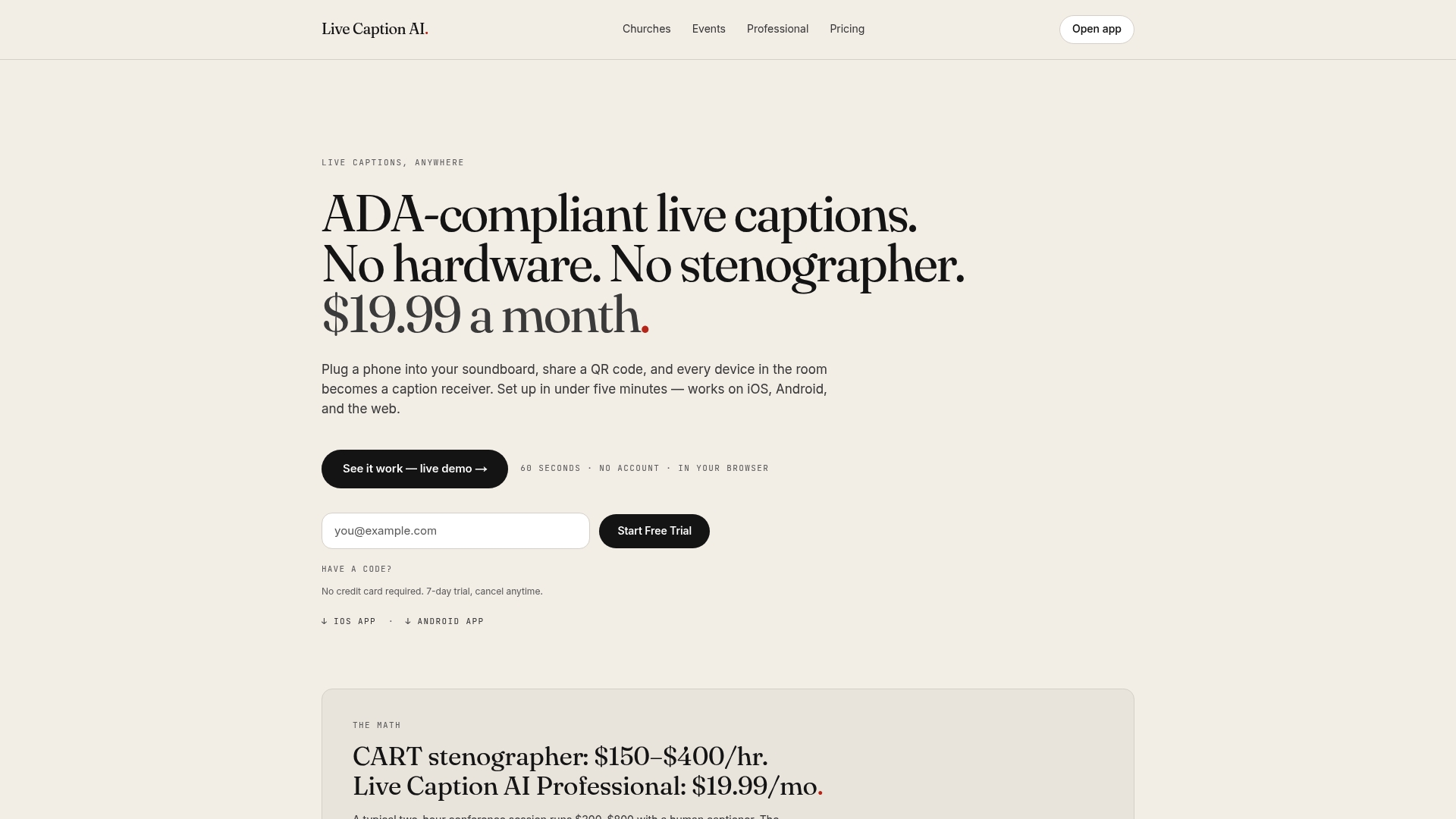
Live Caption AI transforms any phone into a caption receiver through a simple QR code, no hardware, no stenographer, and supports specialized terminology that generic speech-to-text tools tend to miss. A session that might otherwise run hundreds of dollars in stenographer fees runs through Live Caption AI’s Professional plan for a fixed monthly rate.
Use it as what it is: an adjunct for the settings where captioning satisfies communication access, not a substitute for a qualified interpreter where consent, diagnosis, or legal rights are on the line. Check the pricing page to see which plan fits your organization’s mix of events, from occasional meetings to daily clinical use, and start planning which sessions can shift to captioning this month.
Sources
- ADA: Effective communication resources
- 2025 Michigan Interpreter Needs Assessment (MINA) Data Report
- Bureau of Labor Statistics: Interpreters and translators
- Interpreter training program variability (RIT thesis)
FAQ
Is There a High Demand for ASL Interpreters?
Yes, demand consistently outpaces supply, especially in healthcare, education, and legal settings. The Bureau of Labor Statistics projects slow job growth through 2034, with most annual openings coming from retirements rather than new positions.
Will AI Replace ASL Interpreters?
No, not for the foreseeable future. Current research shows automated ASL recognition tools are improving but remain unreliable for the nuance, context, and legal accountability that human interpreters provide in high-stakes settings.
How Much Are ASL Interpreters Paid Per Hour?
Pay varies significantly by region, certification level, and setting, with rural and freelance interpreters often earning less relative to the unpaid travel time and cancellations they absorb. Regional data, like ZipRecruiter’s Michigan figures, shows rates that frequently fall short of what the skill and liability involved would justify.
What Does Live Caption AI Cost for Organizations Handling Captioning Needs?
Live Caption AI’s Professional plan runs 19.99 USD per month, with a Business plan starting from 199 USD per month for larger organizations, both detailed on the pricing page. A Free tier is also available for basic on-device captioning needs.
Did Recent Policy Changes Remove ASL Interpreters From Public Briefings?
Policy decisions around interpreter presence at public briefings have varied by jurisdiction and administration, and specifics change over time. Organizations should check current ADA guidance directly rather than relying on assumptions about any one briefing or event.