September 14, 2026 · 12 min read
Budget $300 to $2,500: 2026 U.S. Stenographer Cost & Live Caption
Plan 2026 U.S. stenographer budgets: typical fees ($300 to $2,500), example costs, negotiation steps, and a Live Caption alternative.

A single deposition with a certified stenographer typically runs $300 to $700, while full-day trial coverage climbs to $900 to $2,500 or more. Your total bill comes from three buckets: the appearance fee, the per-page transcript charge, and add-ons. Costs escalate quickly once you add realtime feeds, expedited delivery, or a multi-day trial schedule.
TL;DR:
- The average cost for a one- to two-hour deposition ranges from $300 to $700, excluding add-ons like realtime feeds or expedited delivery.
- Per-page transcript rates typically run between $3.00 and $7.50, depending on delivery speed and region, with higher rates for same-day or rush services.
- Costs increase significantly with multi-day trials, realtime reporting, or additional services like exhibit handling or synchronized video.
- Agency fees usually include a separate appearance fee and per-page charges, so clarify whether quotes cover both before booking to avoid surprises.
- Rates vary by location, with high-cost markets like New York City charging up to $7.50 per page and rural areas averaging around $3 to $5 per page.
Table of Contents
- How Much Does a Stenographer Cost Per Session?
- What’s Actually on a Stenographer’s Invoice?
- Does Stenographer Pricing Change by State or City?
- What Will a Deposition or Trial Actually Cost You?
- How Do You Lower Your Stenographer Bill?
- What I’ve Learned Vetting Reporter Quotes
- When Software Can Replace a Stenographer (And When It Can’t)
- Sources
- FAQ
How Much Does a Stenographer Cost Per Session?
The quickest way to sanity check any quote is to know the going rate for the session type you’re booking. Stenographer pricing scales with two things: how long the reporter sits in the room, and how fast you need the transcript in hand.
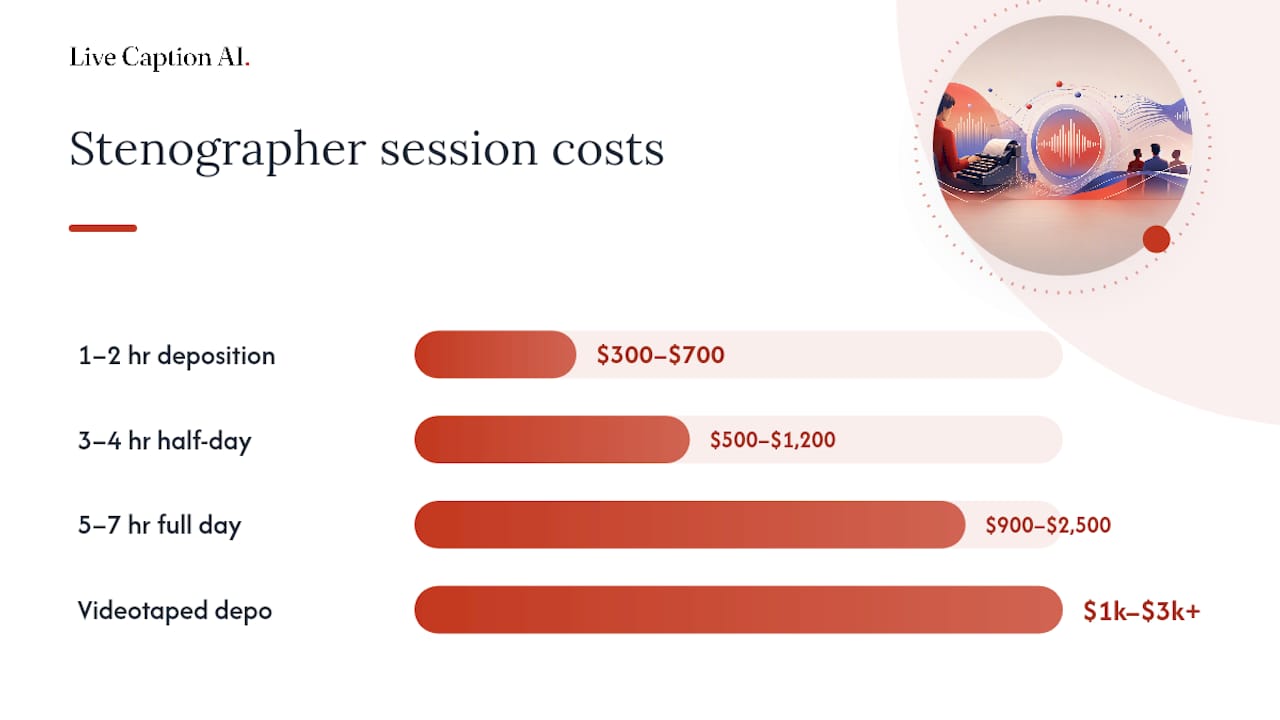
For a standard deposition or short hearing (one to two hours), expect an appearance fee plus per-page transcript costs, typically landing in the $300 to $700 range for standard turnaround. Half-day sessions (three to four hours) usually fall between $500 and $1,200, and full-day coverage (five to seven hours) runs $900 to $2,500. Multi-day trials multiply from there, and a videotaped deposition with a synced transcript can push $1,000 to $3,000 or higher per day.
Per-page transcript rates are the other half of the equation. Most court reporters charge $3.00 to $7.50 per page for standard delivery, with the exact number depending on your state, the reporter’s certification level, and whether the transcript needs same-day or next-day turnaround.
Here’s a quick reference for planning purposes:
- Standard delivery (7 to 10 business days): $3.00 to $5.00 per page
- Expedited delivery (2 to 3 business days): $5.00 to $7.50 per page
- Daily/overnight delivery (next business day): $7.50 to $10.00 per page
- Same-day delivery: $10.00 and up per page, often with a flat rush surcharge on top
Quick benchmark: Baseline depositions run $400 to $700 before add-ons, and realtime reporting alone adds another 20% to 50% on top of that base fee.
That realtime premium is worth flagging early. If your case needs an instant, searchable text feed during testimony rather than a transcript delivered days later, plan for a meaningfully higher bill from the first invoice you see. Reporters who offer realtime certification carry extra equipment and liability, and they price accordingly.
One more variable that trips up first-time buyers: appearance fees and per-page fees are billed separately, even when a single agency quotes them together. A reporter can show up, sit through a two-hour deposition, and still bill you a flat appearance fee even if the resulting transcript is only 40 pages. Always ask whether the quote you received includes both pieces, or just one.
What’s Actually on a Stenographer’s Invoice?
Stenographer fees break down into three layers, and understanding each one helps you spot padding before you sign a contract.
Appearance fees (also called per-diem fees) cover the reporter’s time showing up and working the session, regardless of how many transcript pages result. This is typically a flat rate, sometimes tiered by half-day versus full-day attendance. Per-page transcript charges cover the actual document production, billed per page of the finished transcript at the delivery-speed rate you choose. Add-ons cover everything else: realtime feeds, rough drafts, exhibit handling, and copy fees for additional parties who want their own transcript set.
The add-on list is where most surprise costs hide. Reporters and agencies commonly bill separately for:
- Realtime feed: live, unedited text streaming to your laptop during testimony
- Expedited or same-day transcript delivery: the rush-tier pricing covered above
- Rough drafts: an uncertified, unedited version delivered same-day for quick reference
- Video synchronization: timestamping video to transcript text, common in trial prep
- Exhibit handling and scanning: marking, copying, and digitizing physical exhibits
- Additional certified copies: per-page fees for extra parties who want their own set
Cancellation policies deserve attention too. Most agencies charge a cancellation fee if you cancel with less than 24 to 48 hours’ notice, sometimes the full appearance fee. Travel fees apply once a reporter has to drive beyond a standard radius, typically 25 to 50 miles, and after-hours or weekend sessions often carry a 25% to 50% surcharge on the base appearance rate.
Pro Tip: Ask for a written, itemized rate sheet before you book, not after. A reporter or agency willing to put every line item on paper up front is far less likely to surprise you with a $200 “handling fee” buried in the final invoice.
The billing structure itself isn’t a red flag. It’s standard across the industry, and most reputable agencies bundle these components in a predictable way. The problem is when an agency won’t show you the breakdown until after the session, which is exactly the scenario an itemized rate sheet prevents.
Does Stenographer Pricing Change by State or City?
Yes, and the swing is bigger than most people expect. Where you’re booking a reporter matters almost as much as what you’re booking them for.
High-cost metro markets like New York City and Washington, D.C. tend to run $6.00 to $7.50 per page, with appearance fees between $250 and $400. Mid-size cities land in a more moderate band, typically $4.00 to $6.00 per page. Rural and lower-cost markets often come in at $3.00 to $5.00 per page, with lighter appearance fees to match.
| Market type | Per-page rate | Appearance fee | Example |
|---|---|---|---|
| High-cost metro | $6.00–$7.50 | $250–$400 | New York City, Washington, D.C. |
| Mid-size city | $4.00–$6.00 | $200–$300 | Regional metro areas |
| Rural / low-cost | $3.00–$5.00 | $150–$250 | Smaller markets |
Two benchmarks are worth keeping in your back pocket when you’re evaluating a private quote. The federal Judicial Conference publishes per-page rate maximums for transcripts in federal court proceedings, and those figures function as a useful national ceiling reference even though most of your work will be in state court or private depositions. Some state agencies also publish their own contract schedules. California’s Office of Administrative Hearings, for instance, lists flat half-day and full-day appearance rates along with tiered per-page transcript prices for its contracted reporters.
You don’t need a state contract to use one.
What Will a Deposition or Trial Actually Cost You?
Worked examples make budgeting far less abstract than rate ranges alone. Here’s how the numbers play out for four common scenarios, based on typical page counts and standard delivery:
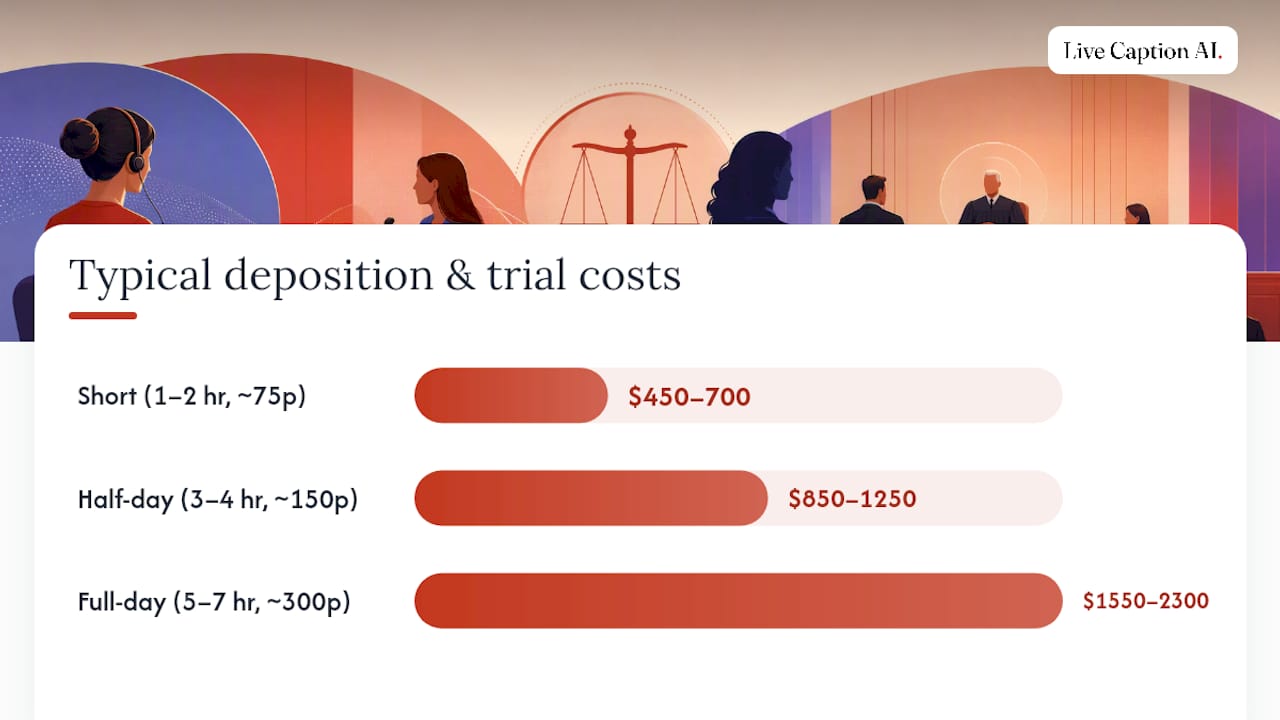
- Short deposition (1 to 2 hours, ~75 pages): Appearance fee ($150 to $250) plus 75 pages at $4.00 to $6.00 per page ($300 to $450) lands you around $450 to $700 total.
- Half-day session (3 to 4 hours, ~150 pages): Appearance fee ($250 to $350) plus 150 pages ($600 to $900) puts you at roughly $850 to $1,250.
- Full-day session (5 to 7 hours, ~300 pages): Appearance fee ($350 to $500) plus 300 pages ($1,200 to $1,800) totals $1,550 to $2,300.
- Multi-day trial: Multiply the full-day estimate by your expected number of days, then add realtime and video-sync costs if either applies.
Page count is the variable most people underestimate. A single, calm witness produces fewer pages per hour than a deposition with multiple speakers, frequent objections, or dense technical testimony, all of which slow the pace and inflate the transcript length. If you’re deposing an expert witness on a technical subject, budget for the higher end of the page-count range.
The formula that ties it all together:
Industry budget guidance recommends it specifically to absorb the unplanned costs that show up almost every time: an extra certified copy someone requests mid-case, a last-minute expedite request, or a session that runs longer than scheduled.
How Do You Lower Your Stenographer Bill?
Cost control starts before you ever book a reporter, not after the invoice arrives. A few tactics move the number meaningfully.
Default to standard delivery whenever your schedule allows it. Expedited turnaround is the single biggest lever on a stenographer invoice, and paying the rush premium for a transcript you don’t need for another three weeks is money left on the table. Reserve same-day or overnight delivery for genuine deadline pressure, like a motion due the next morning.
Weigh agency versus freelance reporters carefully. Agencies typically mark up rates 20% to 40% over what an independent freelancer charges, but that markup buys you scheduling reliability, backup coverage if your reporter gets sick, and errors-and-omissions insurance. For a routine deposition with flexible scheduling, a freelancer can save real money. For a trial where a no-show isn’t an option, the agency markup earns its keep.
Beyond that trade-off, a short negotiation checklist pays for itself on nearly every booking:
- Request an itemized rate sheet before confirming, not after the session
- Confirm cancellation terms and the notice window in writing
- Clarify who’s responsible for ordering additional copies, and at what rate
- Get three quotes, including at least one from a neighboring market
That last point matters more than it sounds. In areas with reporter shortages, checking rates in a neighboring state or region sometimes beats paying the local scarcity premium, especially for depositions that don’t require an in-person reporter physically present.
Pro Tip: Bundle services when you can. Booking the same reporter for multiple sessions in a single case, or committing to standard delivery across the board, gives you real leverage to negotiate a flat per-page rate instead of paying tiered pricing session by session.
What I’ve Learned Vetting Reporter Quotes
The biggest cost surprises in this industry rarely come from the base rate. They come from what’s missing off the initial quote. A reporter who quotes $4.50 a page but doesn’t mention the $75 exhibit handling fee, the weekend surcharge, or the 48-hour cancellation window isn’t lying to you. They’re just letting you find out the hard way.
My checklist before booking is short: get the rate sheet in writing, confirm who pays for extra copies, and ask what happens if the session runs long or gets canceled. Agencies that hand over a clean, itemized sheet without hesitation are, in my experience, the ones that don’t need to pad invoices later. That transparency is also why they tend to win repeat business from law firms that book reporters every month. If a reporter or agency is reluctant to put pricing on paper before the job, treat that as your answer.
— Ryan
When Software Can Replace a Stenographer (And When It Can’t)
Not every session needs a certified court reporter. If you’re running a client meeting, an internal hearing, a medical consultation, or any accessibility-focused event that doesn’t require an official certified transcript, paying hundreds of dollars for a stenographer is often more than the situation calls for.
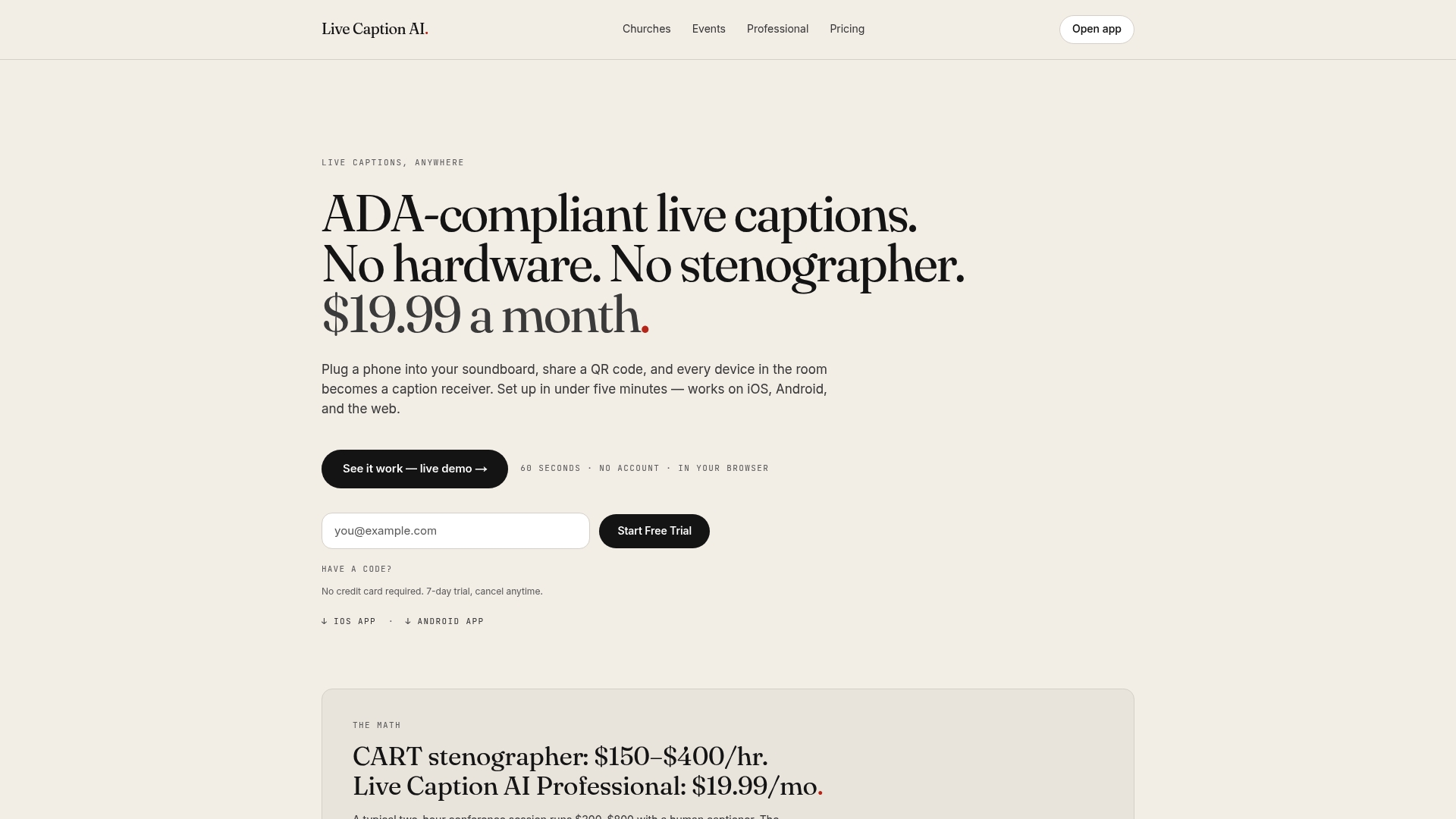
This solution turns any phone into a caption receiver through a simple QR code, offering ADA-compliant live captions in multiple languages without hardware rental or a booked reporter. Pricing information is available on the provider’s website.
The line to draw is simple. If you need an official court transcript, a certified original for the record, or testimony that must hold up under cross-examination, you still need a certified stenographer. If you need accessible, accurate captions for a meeting, a hearing that won’t be entered as an official record, or an event where attendees need real-time text in their own language, Live Caption AI’s professional plan covers that need at a fraction of the cost.
Sources
A few sources are worth bookmarking if you want to check any figure in this guide against your own market:
- How Much Does a Court Reporter Cost? (2026 Pricing Guide) | StenoScout
- Courtreporter
- Find Contract Information to Obtain OAH Court Reporter Services
Check your own state’s contracting or judicial administration page for schedules specific to your jurisdiction before finalizing a budget.
FAQ
How Much Does a Stenograph Machine Cost?
A stenotype machine for professional court reporting typically costs several thousand dollars new, which is one reason working reporters price their services to cover equipment, training, and certification overhead rather than just their time in the room.
Is Stenography a High-Demand Job?
Yes. Court reporting has faced a well-documented reporter shortage in many U.S. markets for years, and that scarcity is part of why rates in underserved regions can run higher than in areas with more reporters competing for work.
Is AI Replacing Court Stenographers?
Not for certified legal transcripts, where a human reporter’s certification and sworn accuracy are typically still required by courts. AI-powered captioning tools like Live Caption AI are increasingly used for non-certified needs like accessibility, meetings, and hearings that don’t require an official record.
How Hard Is It to Become a Stenographer?
Becoming a certified court reporter typically requires two to four years of specialized training to reach the speed and accuracy required for certification exams, which is part of why the profession commands the appearance and per-page fees discussed throughout this guide.