October 9, 2026 · 9 min read
Legal Hearing Captions: Request CART Weeks Ahead
Plan legal hearing captions early, distinguish CART from the official reporter, and prepare courtroom setup, privacy, and transcript delivery.

Legal hearing captions display spoken testimony as live or post-event text so participants and the record are accessible and searchable. For a live proceeding, the strongest option is real-time CART captioning or a proven live-captioning service, requested through the court’s access coordinator, court reporter office, or your captioning vendor well before the hearing date.
TL;DR:
- CART provides live access, but it is not the certified record; use the official transcript for appeals and keep reporter roles separate whenever possible.
- Contact the court access coordinator and captioning vendor as soon as the date is set; some appellate courts request six weeks’ notice.
- A dedicated microphone feed sent directly to the captioner reduces echo; test the exact setup the day before and assign a monitor.
- Load party names, citations, and exhibit labels before testimony, and set access and retention rules for saved captions, especially when testimony is sealed or sensitive.
- Choose SRT or VTT for synchronized video, TXT or PDF for review, and CSV or JSON when case tools need timestamps and metadata.
Table of Contents
- 1. Why captions matter in hearings, depositions, and trials
- 2. CART vs official court reporters vs offline captioning: know the difference
- 3. How to request and procure captions for a hearing or deposition
- 4. Setting up reliable live captions in the courtroom
- 5. Accuracy, legal vocabulary, and keeping testimony confidential
- 6. Deliverables: turning captions into usable case material
- 7. What years of courtroom captioning setups teach you
- Live Caption AI: a practical option for hearings and depositions
- FAQ
- Sources
1. Why captions matter in hearings, depositions, and trials
Captions exist to make spoken testimony accessible under the ADA’s effective communication standard, which lists real-time captioning (CART) and closed captioning among the recognized auxiliary aids for people who are deaf or have hearing loss. That standard requires the aid to fit the person and the proceeding, delivered in a timely way that protects privacy and independence.
Beyond compliance, captions solve practical problems in fast-moving testimony:
- Clarify rapid or overlapping speech that’s easy to mishear in real time.
- Create a searchable text layer attorneys can scan during breaks or for appeal prep.
- Let every participant, including remote parties, follow along on their own screen.
Courts use captions for on-the-record live feeds, participant laptops and phones, exhibit verification during testimony, and post-hearing archives teams revisit later.
2. CART vs official court reporters vs offline captioning: know the difference
These roles sound similar but serve different functions, and mixing them up can create problems for the record.
- CART (Communication Access Realtime Translation) provides real-time, readable text for accessibility, generated as someone speaks.
- Official court reporters produce the certified verbatim record under rules tied to 28 U.S.C. § 753, which governs how federal proceedings are recorded and transcribed.
- Offline captioning processes recorded audio after the fact, useful for archives but not for live accessibility needs.
The CART in the Courtroom Model Guidelines recommend keeping the CART or interpreter role separate from the official reporter role except when truly unavoidable, since conflating them can compromise both the accessibility function and record integrity. For anything going into an appeal, counsel should rely on the certified transcript, not the live CART feed, as the official record.
One detail worth flagging: NCRA guidance stresses that CART captioners work under an access mandate distinct from certified reporting, with separate training standards for each role.
3. How to request and procure captions for a hearing or deposition
Lead times matter more than most legal teams expect. Many courts ask for advance notice measured in weeks, not days, with some appellate matters requesting requests six weeks out.
- Contact the court’s Access or ADA coordinator, or the clerk’s office, as soon as a hearing date is set.
- Reach out to your captioning vendor or court reporter firm in parallel to confirm availability.
- Specify the scope: full hearing, deposition only, or specific witness segments.
- Define the display method: courtroom monitor, counsel table screens, or participant devices.
- Address confidentiality needs, especially for sealed or sensitive testimony.
- Confirm transcript delivery format and turnaround, plus billing terms, in writing before the date.
Pro Tip: Send your captioning request the same day you receive the hearing notice. Courts and vendors both move faster when they’re not scrambling on short notice.
4. Setting up reliable live captions in the courtroom
A clean audio feed is the single biggest factor in caption accuracy. Route a dedicated microphone feed to the captioner rather than relying on an in-room speaker, which introduces echo and garbles output.
- Send audio straight from the mic or mixer to the captioning system, not through a room speaker.
- Distribute captions to courtroom displays, counsel and bench monitors, and participant phones through a QR code or web link.
- Assign one person as caption monitor to watch for lapses during the hearing.
- Run a full tech test the day before, including the exact microphone and connection setup you’ll use live.
- Have a backup plan ready, such as a second device or an offline recording, in case the primary feed drops.
For hybrid hearings specifically, a practical ADA tech-check guide for event production walks through routing and testing steps that translate well to courtroom AV setups.
Pro Tip: Mute local speaker playback for any remote participant audio and route that feed directly to the captioner instead. Double-routing audio into both a conferencing system and a caption feed is a common cause of echo and dropped accuracy.
5. Accuracy, legal vocabulary, and keeping testimony confidential
Names, statutory citations, and exhibit labels trip up generic speech-to-text the most. Loading custom terms and names before the session, rather than correcting them live, preserves far more fidelity in the finished transcript.
- Build a custom term list for party names, case citations, and exhibit numbers before the hearing starts.
- Assign a monitor to flag and correct errors in real time for sensitive or high-stakes segments.
- Set a clear retention policy for saved captions and transcripts, including who can access them and for how long.
One safeguard to apply consistently: when CART runs alongside a certified reporter, disclose that the live caption display is not the certified record, and keep the certified transcript as the version of record for appeals.
6. Deliverables: turning captions into usable case material
Captions only help your case if they arrive in a format you can actually use. Expect a mix of file types depending on how the material will be used:
- SRT or VTT for syncing captions to video recordings of the hearing.
- TXT or PDF for readable transcripts attorneys can annotate or quote.
- CSV or JSON for metadata and timestamps that feed into case management tools.
Timestamps embedded at the moment each exhibit is accepted make it far easier for transcript editors to resolve disputes over exhibit timing later. When citing caption text in a brief, note clearly whether you’re quoting a certified transcript or a non-certified CART feed, since only the certified version carries evidentiary weight on appeal. Rough drafts typically turn around same-day or next-day, while certified transcripts take longer and follow a formal chain-of-custody process through the reporting firm.
7. What years of courtroom captioning setups teach you

Most caption failures trace back to audio routing, not the captioning technology itself. A double-routed feed, a forgotten custom term list, or a last-minute equipment swap causes more dropped words than any software limitation.
A caption monitor and a pre-hearing test catch nearly every one of these issues before the first witness is sworn in. It’s the fastest fix available, and it costs nothing but fifteen minutes the day before.
— Ryan
Live Caption AI: a practical option for hearings and depositions
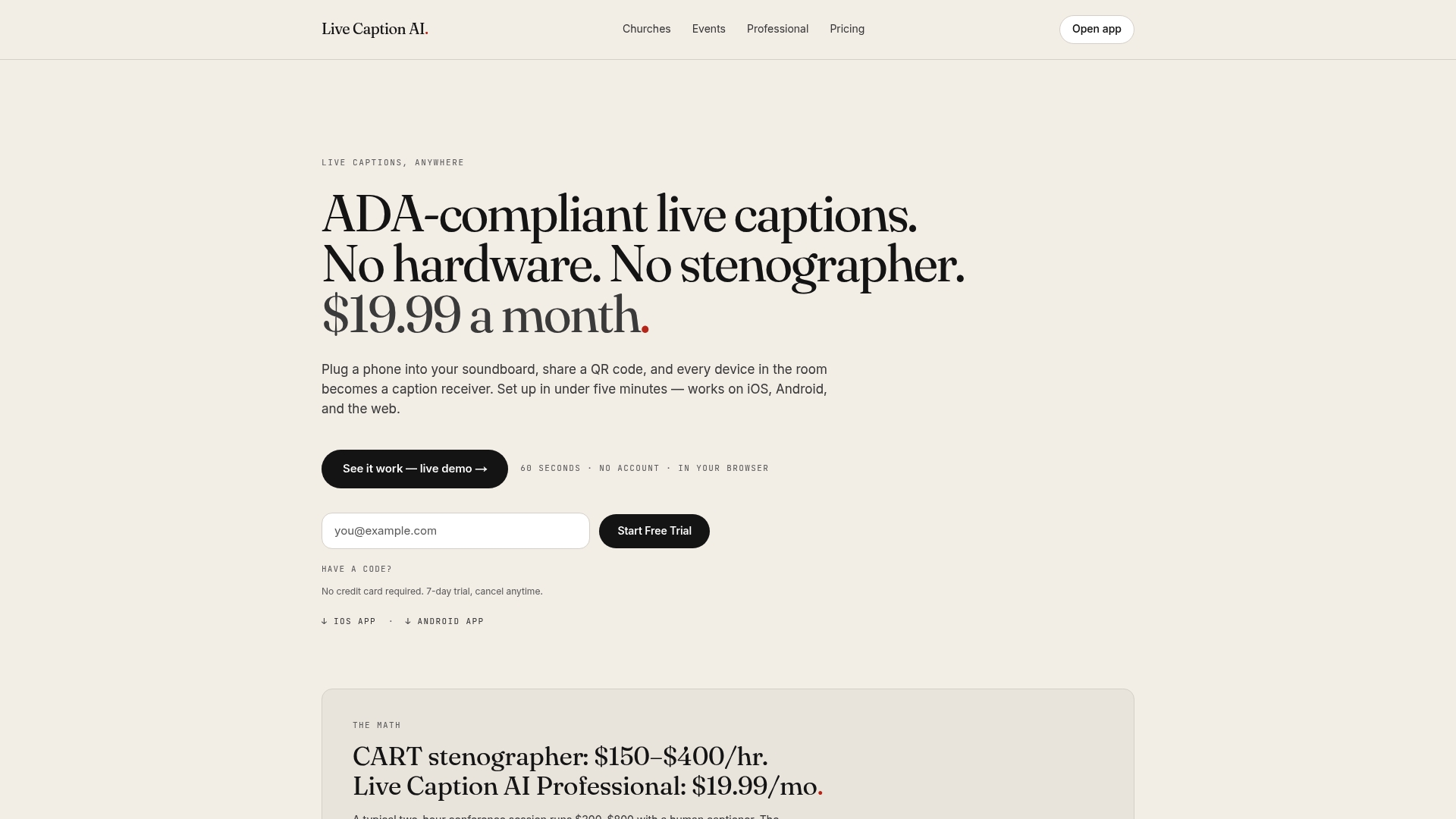
For hearings, depositions, and hybrid proceedings where setup time is short, we built Live Caption AI to get captions running fast without hardware rentals or a stenographer booking. Live Caption AI turns any phone into a caption receiver through a QR code, no hardware, no stenographer. Attendees and remote participants scan the code and read captions on their own phones, with no app to install.
Our Legal teams can load up to 100 Custom Terms before a session so party names, citations, and exhibit labels come through clearly instead of getting mangled by generic speech-to-text. We also offer Medical, Worship, and Finance vocabulary models plus your own Custom Terms, translation into one of 29 languages per session, and session audio is never stored. Transcripts export as TXT, SRT, JSON, or PDF when the hearing wraps, and the tool can support an organization’s broader ADA effective-communication plan alongside certified reporting, though it isn’t a certified or human-reviewed service on its own.
The Professional plan runs at a monthly rate as detailed on our pricing page, offering unlimited captioning.
This article is general information, not a substitute for advice from a qualified lawyer. Consult a qualified legal professional about your own circumstances before acting on anything here.

FAQ
Can you provide an example of a legal caption?
A legal caption typically renders spoken testimony as timestamped text, such as a witness answer appearing on screen as it’s spoken, with a timecode marking the moment for later reference. Formats vary by provider, but the text usually syncs line by line with the audio or video feed.
What are the legal requirements for closed captioning in hearings?
The ADA’s effective communication standard lists real-time captioning and closed captioning among the auxiliary aids courts can use to make proceedings accessible to people who are deaf or have hearing loss. The specific aid must fit the individual and the proceeding, and courts are expected to provide it in a timely way.
What is a caption on a legal document?
In a transcript or filing, a caption usually refers to the heading identifying the case name, court, and docket number, which is a different use of the term from live hearing captions that display spoken words as text. Context determines which meaning applies, so check how the term is used in the specific filing or proceeding.
Can people with hearing loss use closed captioning in court?
Yes. Real-time captioning (CART) and closed captioning are specifically named in ADA guidance as auxiliary aids for people who are deaf or have hearing loss, and courts are expected to provide them when needed for effective communication during a proceeding.
Sources
- Ada
- Communication Access Realtime Translation (CART) in the Courtroom: Model Guidelines
- Federal Court Reporting Program | United States Courts
- NCRA: CART role guidance and best practices