September 18, 2026 · 21 min read
Avoid ADA Claims: 7 U.S. Conference Milestones and QR Captions
A U.S. planner's legal playbook for conference ADA compliance. Map Title II and III duties to tasks, follow seven planning milestones, verify ramps and...
Under the ADA, conference organizers must guarantee equal access across physical, communication, and digital touchpoints, and that duty doesn’t disappear when you hire a venue or vendor. The Department of Justice, the U.S. Access Board, and the ADA itself set the legal floor. In practice, that floor covers four pillars: accessible physical space, communication access like captioning and interpreters, digital access for registration and livestreams, and contracts that spell out who handles what. Everything below explains what to verify, when to lock it in, and who pays.
TL;DR:
Conference organizers are responsible for verifying accessible entrances, ramps, restrooms, and seating, especially when working with temporary structures or vendors.
Digital accessibility requirements include WCAG 2.1 AA compliance for registration sites, livestreams, and downloadable materials, with contractual remediation clauses critical.
Communication access tools like CART, live AI captions, ASL interpreters, and assistive listening systems must be booked early, tested thoroughly, and placed where attendees can see them effectively.
Contracts with venues, vendors, and platforms should explicitly assign ADA responsibilities, maintenance, and remediation steps to prevent liability gaps.
Budget for accessibility as a fixed cost item, with typical violations including inaccessible ticketing, untested captions, blocked routes, and unreadable digital materials, all preventable with early planning.
Table of Contents
-
What Are the Legal Requirements for Conference ADA Compliance?
-
What Communication Access Do Conferences Need Under the ADA?
-
What Does ADA Compliance Cost, and What Are the Most Common Violations?
-
How Live Caption AI Fits Into Your Communication Access Plan
-
Get Communication Access Covered Without the Stenographer Bill
What Are the Legal Requirements for Conference ADA Compliance?
Two parts of the ADA govern most conferences, and knowing which one applies to your event changes who you can hold accountable. Title II covers state and local government entities, so a conference hosted by a public university or a city convention bureau falls under it. Title III covers private businesses open to the public, which means hotels, convention centers, and most professional associations answer to this title instead. Either way, the DOJ’s technical assistance manual makes clear that the standard is the same: people with disabilities get equal access to the goods, services, and activities you’re offering.
The DOJ’s guidance on event ticket sales spells this out concretely. Organizers must sell accessible seating under the same terms, pricing, and release timing as general admission, not as a separate, lesser tier available only by special request. The ADA’s ticket sales guidance treats this as a baseline access requirement, not a courtesy.
Here’s where planners get tripped up: hiring a venue or an AV company doesn’t transfer your legal responsibility to them. If your conference discriminates against an attendee with a disability, whether through a blocked ramp, a missing interpreter, or an inaccessible registration form, you’re on the hook as the organizer, even if a third party physically caused the problem. The venue may share liability under its own Title III obligations, but that’s a separate question from your responsibility to your attendees.
A few scenarios where the line gets blurry:
-
Third-party venue defects. The hotel’s ramp exceeds a 1:12 slope. You didn’t build it, but you chose the venue and are expected to have verified accessibility before signing.
-
Vendor-supplied technology. Your registration platform vendor’s site fails a screen reader test. You selected that platform, so you carry the burden of requiring fixes.
-
Exhibitor booths. An exhibitor builds a booth that narrows the aisle below accessible width. As the show organizer, you set and enforce the rules exhibitors must follow.
-
Subcontracted staffing. A temp agency provides ushers who aren’t trained to assist attendees with disabilities. Training gaps trace back to your event, not just the staffing firm.
Consult legal counsel early when your conference involves federal funding (which can trigger Section 508 alongside ADA), when a previous complaint or lawsuit touched your organization, or when you’re negotiating a multi-year venue contract that needs airtight accessibility language. Waiting until a complaint arrives is the expensive way to learn where your contract had gaps.
How Do You Verify Wheelchair Access at Conference Venues?
Site selection is where most accessibility failures start, because a venue can look accessible on a walkthrough brochure and fail badly in practice. Walk the space yourself before you sign anything, and don’t rely solely on a sales team’s assurances.
Physical accessibility checks should cover:
-
Accessible entrances and van-accessible parking within a reasonable path of travel
-
Ramp slopes at or below 1:12, per the Access Board’s ADA Accessibility Standards
-
Route widths wide enough for wheelchairs to pass through doorways, hallways, and between exhibit booths
-
Accessible restrooms on every floor your conference uses, not just near the main ballroom
-
A sufficient number of accessible guest rooms held in your room block, not added as an afterthought
-
Companion seating throughout the general seating area, not clustered in one corner
Temporary structures create their own risk. A ballroom that’s perfectly accessible on an ordinary day can become a barrier once you add staging, cable runs, and exhibit booths. Cables crossing walkways need ramped covers, not just tape. Booth aisles need to stay wide enough for two wheelchairs to pass, which usually means enforcing a minimum aisle width in your exhibitor manual rather than hoping vendors figure it out. Temporary event structures must include accessible entrances and ramps with a maximum slope of 1:12, and organizers are expected to identify and remove barriers wherever it’s readily achievable.
Here’s a practical sequence for verifying a venue before contract signing:
-
Request the venue’s written accessibility statement and any ADA equipment inventory (portable ramps, hearing loop systems, accessible lecterns).
-
Ask for current floor plans showing accessible routes, restroom locations, and elevator access between session rooms.
-
Schedule an in-person or video walkthrough focused specifically on accessibility, separate from the general site tour.
-
Confirm accessible guest room counts and companion-seating policy in writing, ideally as a contract exhibit.
-
Revisit the space the day before your event opens, after staging and exhibits are installed, since setup is exactly when barriers appear.
Pro Tip: Bring a tape measure and a printed copy of the Access Board’s slope and clearance specs to your site visit. Sales staff describe venues as “accessible” all the time without knowing the actual numbers, and a five-minute measurement can save you from a costly last-minute fix.
What Communication Access Do Conferences Need Under the ADA?
Communication access covers how attendees who are deaf, hard of hearing, blind, or low vision receive the same information as everyone else in the room, and it’s one of the most frequently under-budgeted parts of conference planning.
Four tools cover most situations:
-
CART (Communication Access Realtime Translation) produces a verbatim, human-stenographer text stream, typically the gold standard for legal proceedings, medical conferences, and sessions with dense technical vocabulary.
-
AI-generated live captions convert speech to text automatically and can run at a fraction of CART’s cost, making them practical for breakout sessions, panels, and hybrid streams where budgets don’t stretch to cover every room with a stenographer.
-
ASL interpretation serves attendees whose primary language is American Sign Language, since captions alone don’t meet that communication need.
-
Assistive listening systems amplify audio directly to hearing aids or receivers, useful in large rooms with echo or background noise even for attendees who don’t require interpretation.
Booking lead time matters more than most planners expect. Qualified ASL interpreters and CART providers in major markets get booked out weeks in advance, especially around conference-heavy seasons in spring and fall. A commonly recommended target is booking CART and interpreter services eight to twelve weeks ahead of the event, longer if your conference runs multiple concurrent tracks that each need coverage.
Testing matters as much as booking. For hybrid events, test the full audio and caption chain under realistic conditions, including overflow rooms and remote viewers, not just the main stage feed. Run a rehearsal with your actual speakers using their real slide decks, because caption accuracy drops fast when a system hasn’t been trained on your event’s specific jargon, acronyms, or speaker names.
Placement and visibility are practical details that get skipped. Captions displayed on a small side screen do little good for someone seated in row 40. For in-person sessions, place caption displays where they’re visible from most seating areas, and for hybrid sessions, make sure the caption overlay doesn’t cover slide content remote viewers need to read.
Budget check: Traditional CART services for a full conference day commonly run into several hundred dollars per room, per day, once you factor in stenographer travel and setup, which is exactly why many organizers now pair CART for keynotes and legal sessions with AI-based captioning for lower-stakes breakouts. Costs generally fall on the organizer as part of “auxiliary aids and services,” not on individual attendees who request them, though a contract can specify how those costs get split between the organizer and a co-hosting association.
Related reading on live transcription for conferences covers deployment specifics for multi-track events.
Does Your Event Website Need to Meet ADA Standards?
Yes, and this is one of the fastest-growing sources of accessibility complaints in the events industry. Courts increasingly treat websites and digital services as places of public accommodation under the ADA, which means your registration site, mobile app, and livestream platform carry real legal exposure, not just a “nice to have” accessibility goal. This judicial trend applies directly to organizers running online or in-person events, and it’s reshaping how conference platforms get built and audited.
WCAG 2.1 AA has become the practical baseline most legal counsel points to when advising event organizers, even though the ADA itself doesn’t name a specific technical standard for websites. A working checklist looks like this:
-
Registration forms that work fully with keyboard navigation, not just mouse or touch input
-
Sufficient color contrast between text and background across your event website and app
-
Alt text on every meaningful image, especially sponsor logos and speaker headshots used as clickable links
-
Captions or transcripts for any pre-recorded promotional or session video
-
Downloadable materials (agendas, slide decks, exhibitor maps) provided as accessible PDFs, not scanned images
-
A livestream platform that supports real-time captions without requiring a separate paid add-on the attendee has to configure themselves
Contract language matters here just as much as it does for physical venue access. When you’re negotiating with a registration platform, app developer, or livestream provider, require a written accessibility testing report before launch, and build in a defined remediation window, commonly 30 days, for any issues an audit turns up after the event goes live. Digital accessibility should be treated as part of public accommodation obligations, which means “we’ll fix it eventually” isn’t a contract term that protects you.
For federal or federally funded conferences, Section508 offers additional practical steps specifically for digital meeting tools, worth reviewing even if your event isn’t federally funded, since the practices transfer directly. A useful outside resource on the business case for getting this right is this breakdown of how web accessibility improves both inclusion and search visibility, which makes the point that accessible design and SEO performance tend to move together, not against each other.
Examples of accessible event registration pages are collected under website accessibility examples if you want a visual reference before briefing your developer.
Who Is Responsible for ADA Compliance in Vendor Contracts?
Contracts that never mention accessibility are the single biggest reason organizers end up holding liability they didn’t expect. Failing to assign ADA responsibilities in writing is a leading cause of accessibility gaps, because when nobody explicitly owns a task, everyone assumes someone else has it covered.
Build these elements into every venue, AV, and platform contract:
-
An accessibility warranty clause stating the venue or vendor’s facility and services currently comply with applicable ADA standards, with a representation you can point to if that turns out to be false.
-
A clear statement of who provides auxiliary aids and services, whether that’s CART, interpreters, or assistive listening equipment, so it doesn’t become a last-minute scramble.
-
Testing and acceptance criteria for any digital platform, requiring a written accessibility test result before you sign off on final payment.
-
Exhibitor rules embedded in your service manual, specifying minimum aisle widths, accessible booth heights, and a requirement that exhibitors certify their own booth compliance.
-
Cooperation and indemnity language addressing what happens if a vendor’s failure causes a complaint, including who bears legal costs.
Enforcing exhibitor compliance takes more than a line in the manual. Specify accessibility responsibilities directly in exhibit manuals and service orders, and require exhibitors to sign a compliance certification before move-in. Add a remediation clause that lets your operations team require a noncompliant booth to be adjusted before the show floor opens, not after attendees start complaining.
Bring in counsel when a contract involves a multi-year venue relationship, when you’re negotiating with a platform vendor whose standard terms disclaim all accessibility liability, or when a prior complaint has already put your organization on notice. A one-time legal review of your master contract template costs far less than litigating a single ADA claim after the fact.
Pro Tip: Keep a standing “accessibility rider” you attach to every vendor contract instead of rewriting these clauses from scratch each time. It saves negotiating time and makes sure nothing gets dropped when you’re rushing to sign a venue six months before your event.
What Is the ADA Compliance Timeline for Event Planning?
Accessible conference planning works best as a sequence of milestones tied to your event date, not a single checklist tackled the week before doors open.
-
9 to 12 months out: Assign a named accessibility coordinator, someone on your team whose job includes fielding accommodation requests and confirming vendor obligations. Draft your public accessibility statement for the event website.
-
6 to 9 months out: Finalize venue selection with a documented site walkthrough covering ramps, restrooms, and guest room holds. Begin registration platform development with accessibility testing built into the timeline, not bolted on at the end.
-
8 to 12 weeks out: Book CART providers and ASL interpreters, matching services to your session schedule so overlapping tracks each get coverage. This window aligns with commonly recommended booking timelines for accessibility services.
-
4 to 6 weeks out: Distribute an accommodation request form to registered attendees, giving them a clear channel to request interpreters, dietary accommodations, or seating needs ahead of time rather than at check-in.
-
2 to 3 weeks out: Run a digital audit of your final registration site, app, and any pre-loaded session materials against your WCAG checklist.
-
1 week out: Conduct an on-site walkthrough after staging and exhibits are installed, since setup is when temporary barriers appear most often.
-
Day of event: Have a contingency protocol ready, covering what staff do if an interpreter cancels, a caption feed drops, or a ramp gets blocked by a delivery cart.
Templates worth preparing in advance include an accommodation request intake form, an exhibitor accessibility certification, and a public-facing accessibility statement for your event page. Examples of accessibility statement templates are available under accessibility statement for events, which can save you from drafting one from a blank page.
What Does ADA Compliance Cost, and What Are the Most Common Violations?
Budgeting for accessibility gets easier once you separate it into predictable categories instead of treating it as one unpredictable lump sum.
-
Captioning and CART: Traditional stenographer-based CART commonly runs into the hundreds of dollars per session day; AI-based captioning options run substantially lower per session, making multi-track coverage financially realistic.
-
ASL interpreters: Rates vary by market and typically require a two-interpreter team for sessions longer than an hour, since interpreting is physically demanding work.
-
AV adaptations: Assistive listening system rental and accessible staging modifications add a smaller, largely fixed cost per venue.
-
Digital remediation: Fixing a noncompliant registration site after the fact costs meaningfully more than building it accessible from the start, since remediation means rebuilding rather than designing right the first time.
Treat every figure here as a planning range, not a quote. Actual costs shift with your market, session count, and how far in advance you book.
Statistic callout: Booking guidance across event-accessibility resources consistently points to securing CART and interpreter services eight to twelve weeks before the event as the window that avoids both price surges and availability shortfalls.
Five violations show up again and again across conference complaints:
-
Inaccessible ticket sales, where accessible seating requires a phone call while general seating sells online instantly. Fix: sell accessible tickets through the identical purchase path as everyone else.
-
Missing or untested captions, where captions exist on paper but fail during the actual session due to bad audio routing. Fix: run a full rehearsal with your real AV setup, not a generic demo.
-
Blocked accessible routes, where exhibit booths or signage narrow an aisle below accessible width after setup. Fix: walk the floor post setup, every time, before doors open.
-
No accommodation request process, leaving attendees to discover on arrival that nobody knew they needed an interpreter. Fix: publish an intake form weeks before the event.
-
Inaccessible digital materials, like scanned-image PDFs a screen reader can’t parse. Fix: require text-based, accessible PDF exports as a standard production step.
Enforcement risk comes from three directions: DOJ investigations following a formal complaint, private lawsuits filed by individual attendees or advocacy organizations, and settlements that often require both a monetary payment and a binding remediation plan for future events. Legal advice is worth the cost the moment you receive any formal complaint, demand letter, or notice of intent to sue, rather than after a lawsuit is filed.
How Live Caption AI Fits Into Your Communication Access Plan
Live Caption AI is a live captioning and translation tool that runs on attendees’ own phones through a QR code, without requiring dedicated caption hardware or a booked stenographer for every room. That matters most for multi-track conferences where covering every breakout session with traditional CART simply isn’t in the budget.
Live Caption AI works well in specific situations:
-
Breakout and concurrent sessions where hiring CART for every room isn’t financially realistic, but leaving those rooms uncaptioned isn’t acceptable either.
-
Multilingual audiences, since the platform supports real-time translation alongside captioning, useful for international attendees or bilingual conference tracks.
-
Domain-heavy content, where the platform’s domain-specific accuracy is built to catch specialized terminology that generic speech-to-text tools tend to miss.
-
For sensitive tracks, note that session audio is never stored — but there is no HIPAA deployment and no BAA, so sessions involving patient information need a different vendor.
It has limits worth naming honestly. Attendees who require ASL interpretation still need a qualified human interpreter; captions don’t substitute for sign language access. And for legal proceedings or extremely high-stakes verbatim records, human CART stenographers remain the standard many organizations expect.
Before relying on any captioning tool for a live session, test it under real conditions. Run it with your actual speakers, their real slide decks, and any acronym-heavy vocabulary specific to your field, checking accuracy and caption visibility from several seating positions, not just the front row. Do this again for your hybrid stream separately, since overflow rooms and remote viewers can expose latency issues a single in-room test won’t catch. More deployment notes live under assistive captioning technology and live captions for events.
An Editorial Take on Where Planners Get Tripped Up
Contracts matter more than checklists. Most accessibility failures I’ve seen dissected in complaint reports trace back to a contract that never named who was responsible, not to a lack of good intentions. Fix that first.
Testing beats assuming. A venue that photographs beautifully can still have a 1:15 ramp nobody measured, or a caption feed that works in rehearsal and drops the moment the room fills with two hundred phones on the same WiFi.
Digital access isn’t optional anymore. The legal trend toward treating registration sites and livestreams as public accommodations means a broken alt-text policy is now a compliance issue, not a design nitpick.
Budget for accessibility the same way you budget for catering: as a fixed line item decided months out, not a leftover you hope covers what’s needed. Planners who treat CART, interpreters, and digital audits as core costs from the start avoid the panicked, marked-up pricing that comes from booking two weeks before doors open. If you want to keep learning past this guide, national ADA-focused conferences remain one of the better ways to stay current as standards and case law keep shifting.
— Ryan
Get Communication Access Covered Without the Stenographer Bill
Traditional CART coverage for every breakout room adds up fast, often running into the hundreds of dollars per session once you count stenographer travel and setup. Live Caption AI takes a different approach: attendees scan a QR code and get live captions or translated text directly on their own phone, no rented hardware, no booking a stenographer for every concurrent track.
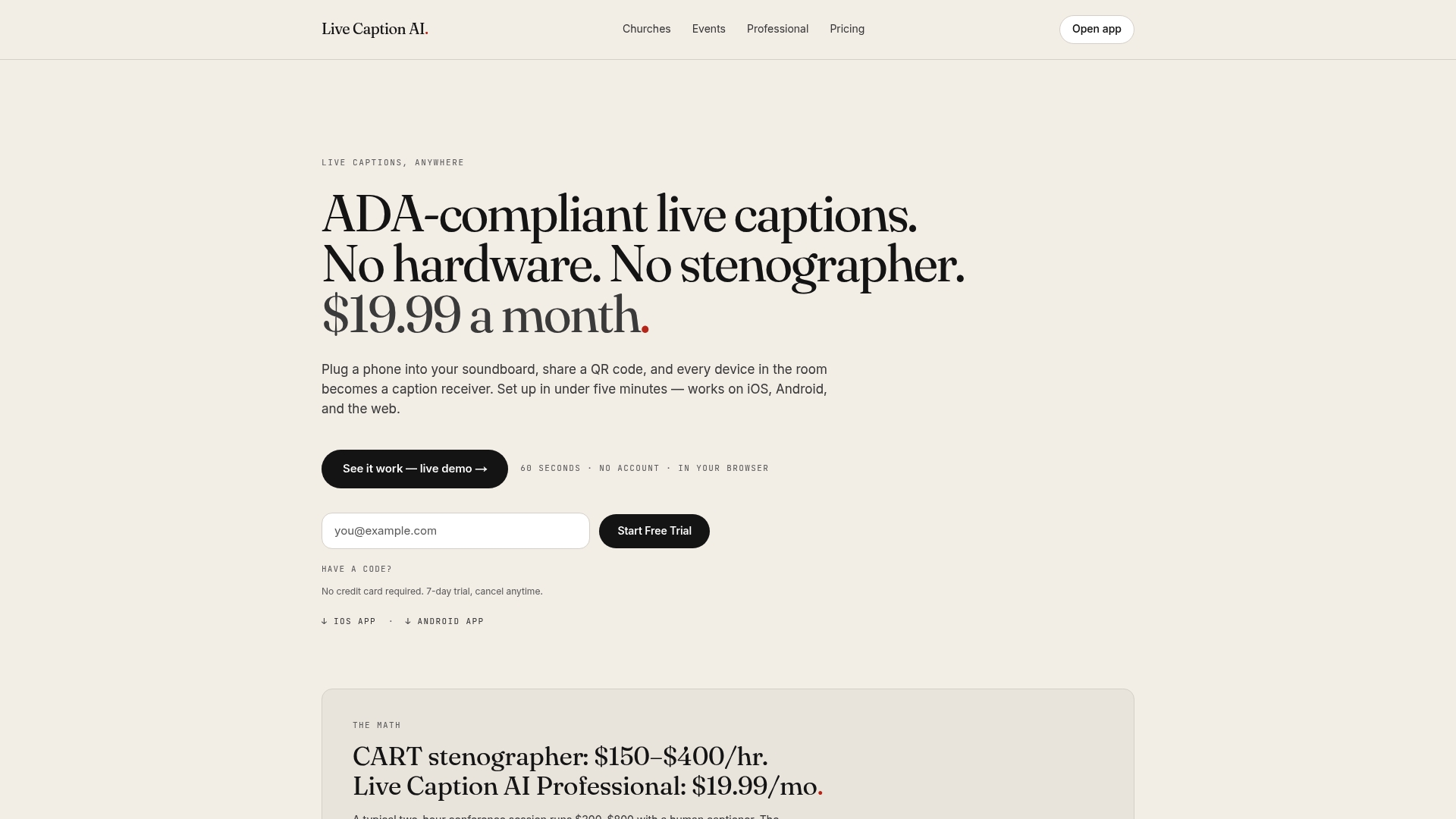
The Professional plan runs $19.99 a month, a fraction of what a single day of traditional stenography costs for one room, and it scales to cover multiple sessions without multiplying your vendor invoices. For medical, legal, or other specialized conference tracks, the Medical vocabulary model and Custom Terms help with specialised terminology those fields require. If your event needs multilingual support, 8 hours of translation is included in your monthly subscription, with extra translation credit packs are available separately; current pricing is listed on Live Caption AI’s website. Check the Business plan if you’re covering a large multi-track conference, or start with the Professional tier and test it on your next breakout session before your full event.
Sources
For primary legal guidance, start with the DOJ’s ADA ticket sales guidance and the Access Board’s ADA Accessibility Standards for technical specifications on ramps, clearances, and restroom design. The Accessible Meetings, Events & Conferences Guide covers temporary structure requirements in detail, and Section508.gov’s accessible meetings guidance is useful for federally funded events and digital-meeting practices. Complex contract disputes or prior complaints warrant a consultation with legal counsel experienced in ADA compliance rather than relying on guides alone.
This article is general information, not a substitute for advice from a qualified lawyer. Consult a qualified legal professional about your own circumstances before acting on anything here.
FAQ
Is ADA Compliance Mandatory for Conferences?
Yes. Any conference open to the public, held by a government entity, private business, or nonprofit association, must provide equal access under Title II or Title III of the ADA. This isn’t optional based on budget or venue size; it’s a legal requirement enforced through DOJ investigations and private lawsuits.
What Are the Five Most Common ADA Violations at Conferences?
The most frequent failures are inaccessible ticket sales that require a phone call instead of online purchase, captions that exist on paper but fail during the actual session, exhibit booths or signage that block accessible aisles after setup, no formal process for attendees to request accommodations in advance, and digital materials like scanned PDFs that screen readers can’t parse.
How Far in Advance Should You Book CART or ASL Interpreters?
Book CART providers and ASL interpreters eight to twelve weeks before your event, longer for multi-track conferences needing simultaneous coverage across several rooms. Qualified providers in most markets get booked out well ahead of major conference seasons, and last-minute requests often mean paying rush rates or going without coverage.
Who Pays for ADA Accommodations at Conferences?
The organizer typically covers the cost of auxiliary aids and services like captioning, interpreters, and accessible seating, since these are treated as part of the cost of doing business under the ADA rather than a fee passed to individual attendees. Contracts between organizers and co-hosting associations can specify how those costs get split, but attendees requesting accommodations shouldn’t be charged extra for them.
What Accessibility Conferences Are Scheduled for 2026?
The National ADA Symposium remains one of the primary professional development events for ADA coordinators and event planners, held annually and covering both legal updates and practical implementation guidance. Checking directly with the organizing center gives you the most current 2026 dates and registration details.
Can Live Caption AI Replace a Human ASL Interpreter?
No. Live Caption AI provides live captions and real-time translation through attendees’ phones, which supports communication access for many attendees, but it doesn’t replace a qualified ASL interpreter for attendees whose primary language is American Sign Language. Both tools often work together at the same conference, covering different accommodation needs.