October 10, 2026 · 15 min read
Event Translation Costs: $19.99 a Month as a U.S. Budget Anchor
Compare subscriptions, credit packs, and per minute rates to budget U.S. event translation costs and use Live Caption AI’s $19.99 plan as a benchmark.

Most event translation software runs within a typical price range with a subscription, or costs a modest amount per event if you buy credit packs instead. Your actual number depends on session length, how many languages you translate into, and whether you need specialized vocabulary support. For budgeting purposes, our own Professional plan at $19.99 a month is a useful U.S. anchor point for what unlimited captioning should cost.
TL;DR:
- Subscriptions usually cost less for weekly events, while credit packs suit quarterly use; compare per minute vendors using session length plus setup or minimum fees.
- A session generally handles one target language; serving several languages at once requires parallel sessions or later subtitles, and each simultaneous room adds another stream.
- Kaltura recommends ordering captions at least 15 minutes ahead and starting early; budget about 30 minutes of AV coordination per session for testing.
- AI captions can support an ADA communication plan but do not guarantee compliance; certified human captioners are still appropriate for high stakes events or requested accommodations.
Table of Contents
- Common pricing approaches and what each one costs
- Feature and setup choices that change the invoice
- How to evaluate which pricing model saves you money
- Sample budgets by event type
- Checklist to control and lower your event translation cost
- Live Caption AI as a practical, cost-focused option
- ADA and effective communication: where software fits in
- AI translation versus human interpreters: comparing the real cost
- Hidden fees and extra costs to watch for
- Discounts, trials, and bundles that change your total cost
- What matters more than the lowest sticker price
- Get started: try Live Caption AI for your next event
- FAQ
- Sources
Common pricing approaches and what each one costs
Software for live captions and translation usually comes in three billing shapes, and knowing which one fits your event calendar is the fastest way to avoid overpaying.
Monthly subscriptions work best if you run events regularly. You pay one flat fee and get captioning (and often translation) whenever you need it, with no per-event math. A low-cost tier typically covers unlimited captioning for a single organizer, while higher tiers add team seats, specialized vocabulary models, or higher language limits.
Credit packs suit organizers running occasional events. You buy a block of credits upfront and draw them down per session. On our own pricing page, 30 credits run $6.99, 60 credits run $11.99, and 120 credits run $19.99, which works out to a lower per-credit cost as the pack size grows. The right question isn’t “how much does the pack cost,” it’s “how many credits does my typical event actually use,” since a two-hour conference session burns through credits faster than a 20-minute staff meeting.
Per-minute or per-stream pricing shows up more with traditional AV vendors and human-staffed services, where you’re billed by the minute of coverage or by the number of simultaneous streams. To compare this fairly against a subscription or credit pack, normalize everything to a per-event figure: take your expected session length, multiply by the per-minute rate, and add any setup or minimum-booking fees.
A quick way to frame the comparison, especially if you also manage event logistics, is to consider using project management tools for event planners alongside your captioning approach:
- Subscription: best when you host events weekly or monthly and want predictable costs.
- Credit packs: best for a handful of events a year where you don’t want a recurring charge.
- Per-minute/per-stream: best for a single large, unpredictable event where you need to pay only for what you use.
Feature and setup choices that change the invoice
The headline plan price is rarely the whole story. A few choices move your total spend up or down before you even hit “start.”
Live translation typically covers one source language and one target language per session. Need to serve attendees in three languages at once? That usually means running parallel sessions or producing post-event subtitles, both of which add cost and coordination time rather than simply “adding a language” to one feed.
Specialized vocabulary support (medical terminology, worship and ministry language, finance and earnings jargon) and custom term lists improve accuracy on names, acronyms, and jargon that generic speech-to-text tends to garble. This sometimes pushes organizers toward a higher plan tier, but it can also save money downstream by cutting the time staff spend correcting transcripts after the fact.
Setup work costs time even when the software itself is cheap. According to Kaltura’s event guidance, captions should be ordered at least 15 minutes before an event starts, with streaming beginning a few minutes early to make sure coverage is complete from the first word. That same guidance notes sessions generally need a minimum length (around 10 minutes) and can run as long as 8 hours, with scheduled or auto-start modes and optional pre- and post-session buffers affecting how much prep the AV team needs to do.
- Audio routing from the venue’s sound system to the captioning device takes real setup time.
- Terminology lists and custom terms need to be entered before the event, not during it.
- Early-start buffers protect against missed captions in the first few minutes.
Pro Tip: Run a full technical dry run with the exact microphone, device, and venue audio path you’ll use live. Most caption failures trace back to an audio routing problem nobody tested in advance.
How to evaluate which pricing model saves you money
The cheapest option on paper isn’t always the cheapest in practice. Here’s a simple way to compare models honestly.
- Estimate your annual event count. Count how many sessions you’ll need captions or translation for over the next 12 months.
- Calculate your subscription’s effective per-event cost. Divide the monthly fee by the number of events you’d run in that month; a $19.99 plan used for 10 events a month costs about $2 per event.
- Calculate your credit pack’s per-event cost. Divide the pack price by how many credits a typical session consumes, then compare that to the subscription number.
- Factor in marginal fees. Add any charges for extra languages, specialized models, or exports that aren’t included in the base price.
- Pick the model that matches your volume. Frequent, recurring events favor subscriptions; occasional events favor credit packs; a single unpredictable large event favors per-event or per-minute pricing.
If you’re running one event a quarter, credits likely beat a subscription. If you’re captioning every weekly meeting or service, a flat monthly plan almost always wins.
Sample budgets by event type
These scenarios assume one target translation language and standard setup, with a specialized vocabulary model added where it matters.
- Small team meeting (30 minutes, no translation): A base subscription or a handful of credits covers this easily, often under $5 in marginal cost once you’re on a monthly plan.
- Webinar (60 minutes, one translation language): Expect a modest credit draw or a fraction of a subscription month, plus 15 to 20 minutes of staff setup time for audio checks and terminology entry.
- One-room conference day (6 to 8 hours, one translation language, specialized model): This is where credit packs get expensive fast compared to a subscription; a monthly plan with unlimited captioning tends to be the better value here.
- Multi-track conference (multiple rooms, parallel sessions): Costs scale with the number of simultaneous streams, since each room needs its own captioning session, and setup time multiplies with each additional track.
In every scenario, budget staff time for pre-event testing as a real line item, not an afterthought. Thirty minutes of AV coordination per session is a reasonable planning figure for most venues.
Checklist to control and lower your event translation cost
A few habits keep your invoice predictable and your captions usable.
Before the event:
- Test your audio path end to end with the actual microphone and device you’ll use live.
- Enter custom terminology and names ahead of time so the first few minutes aren’t garbled.
- Build in an early-start buffer, following Kaltura’s recommendation to begin streaming a few minutes before you actually need coverage.
- Limit each session to one translation target language to avoid unnecessary parallel processing.
During the event:
- Keep an eye on audio quality; a dropped mic or crosstalk degrades captions faster than any software setting.
- Lean on custom terms rather than correcting transcripts afterward.
For your budget:
- Batch recurring events onto a single subscription instead of buying credits repeatedly.
- Export only the transcript formats you’ll actually use.
- Use a free tier for rehearsals so you’re not spending credits on practice runs.
Pro Tip: A five-minute rehearsal on a free tier catches most terminology and audio issues before they cost you credits on the real event.
Live Caption AI as a practical, cost-focused option
Live Caption AI turns any phone into a caption receiver through a QR code, no hardware, no stenographer. Attendees just scan and read, with no app to install. We use vocabulary models for medical, worship, and finance contexts, and allow Custom Terms to improve accuracy on specialized language, and offer live translation into one of 29 languages per session. Transcripts export as TXT, SRT, JSON, or PDF, and session audio is never stored. The Professional plan runs $19.99 a month for unlimited captioning. We’re not a HIPAA-certified or human-reviewed service, and we don’t integrate with conferencing platforms like Zoom or Teams, so plan your workflow around those boundaries.
ADA and effective communication: where software fits in
Under the Americans with Disabilities Act, public-facing organizations generally need to provide effective communication for attendees who are deaf or hard of hearing, and live captioning is a common way to meet that expectation. Software-based captioning can be a practical part of an ADA effective-communication plan, especially for organizations that need coverage across many small events rather than booking a certified captioner for each one.
That said, AI captioning is not the same thing as a legal guarantee of compliance. An AI tool does not make an organization ADA-compliant by itself, since effective communication depends on accuracy, reliability, and the specific needs of the attendees in the room. For a one-time keynote with a known deaf attendee who requests a specific accommodation, a certified human captioner may still be the right call. For recurring weekly services, classes, or meetings where budget and scale matter more, software captioning extends coverage to situations where a dedicated captioner was never going to be booked in the first place.
The practical approach: treat captioning software as one tool in a broader accessibility plan, test it with your actual audio setup before relying on it, and keep a process for handling accommodation requests that need more than automated captions can offer.
AI translation versus human interpreters: comparing the real cost
The honest comparison isn’t just dollar for dollar, it’s cost against what each option actually delivers. Human interpreters and stenographers charge by the hour or by the event, often with minimum booking windows, travel costs, and advance scheduling requirements. That makes them predictable for a single high-stakes event but expensive to scale across dozens of smaller sessions.
AI-based captioning and translation software shifts the cost structure entirely: you pay a flat subscription or a small per-event credit draw, and the same tool covers your Tuesday staff meeting and your Saturday service without rebooking anyone. The tradeoff is that software reflects what it hears, so audio quality, speaker clarity, and terminology prep matter more than they do with a trained human interpreter who can infer context.
For choosing between human interpreters and AI translation, the deciding factor usually comes down to volume and stakes. A single legal proceeding or a nationally broadcast event may justify the cost of certified human interpretation. A weekly service, a recurring internal meeting, or a conference with a dozen breakout sessions is where the per-event economics of software captioning pull far ahead, simply because booking a human interpreter for every one of those sessions was never realistic in the first place.

Hidden fees and extra costs to watch for
The quoted plan price is rarely your full bill. A few line items are easy to miss until they show up on an invoice.
Extra language support beyond your plan’s default target can mean running a second session or a separate translation pass, each with its own time and cost. Specialized vocabulary models sometimes sit behind a higher plan tier rather than being available at every level. Transcript exports in multiple formats, or high volumes of exports, can also push you toward a higher tier if your base plan caps them.
Setup and staff time are the most commonly underestimated cost. Per Kaltura’s operational guidance, captions need to be ordered ahead of the event and streaming started early, which means someone on your team needs to own that task every single time. If that falls to an AV contractor instead of in-house staff, their time is a real cost even if the software itself is cheap.
Minimum session length requirements and maximum duration caps can also force you into a higher plan or an extra booking if your event runs longer than expected. Building a buffer into both your schedule and your budget avoids last-minute upgrades at a worse rate than you’d have gotten planning ahead.
Discounts, trials, and bundles that change your total cost
Free trials are the easiest way to validate a tool before committing budget to it. Testing on a free tier during a low-stakes rehearsal, rather than paying for credits on a practice run, costs nothing and tells you whether the audio setup and terminology list actually work before the real event.
Credit packs effectively function as a bulk discount: on our own pricing, the per-credit cost drops as the pack size increases, from 30 credits at $6.99 up to 120 credits at $19.99. If you know you have several events coming up but not enough to justify a full subscription, buying the larger pack upfront is usually cheaper per event than buying smaller packs repeatedly.

Subscriptions themselves act as a bundling discount for frequent users: a flat $19.99 monthly fee for unlimited Professional-tier captioning beats buying credits one event at a time once you cross a handful of sessions per month. The math favors switching models as your event volume grows, so it’s worth revisiting your choice every few months rather than locking into one approach indefinitely.
What matters more than the lowest sticker price
Cost matters, but the organizers who get burned aren’t the ones who paid a little more. They’re the ones who skipped the audio test and found out live that their venue’s sound system doesn’t route cleanly to a phone mic. Prioritize a trial run and terminology prep over chasing the absolute cheapest plan.
Budget for a small operational buffer, not just the software line item. Effective communication depends on preparation as much as price.
— Ryan
Get started: try Live Caption AI for your next event
Start on our Free tier to test audio and terminology with a real session before you commit to anything. When you’re ready for recurring events, the Professional plan covers unlimited captioning for a predictable monthly cost.
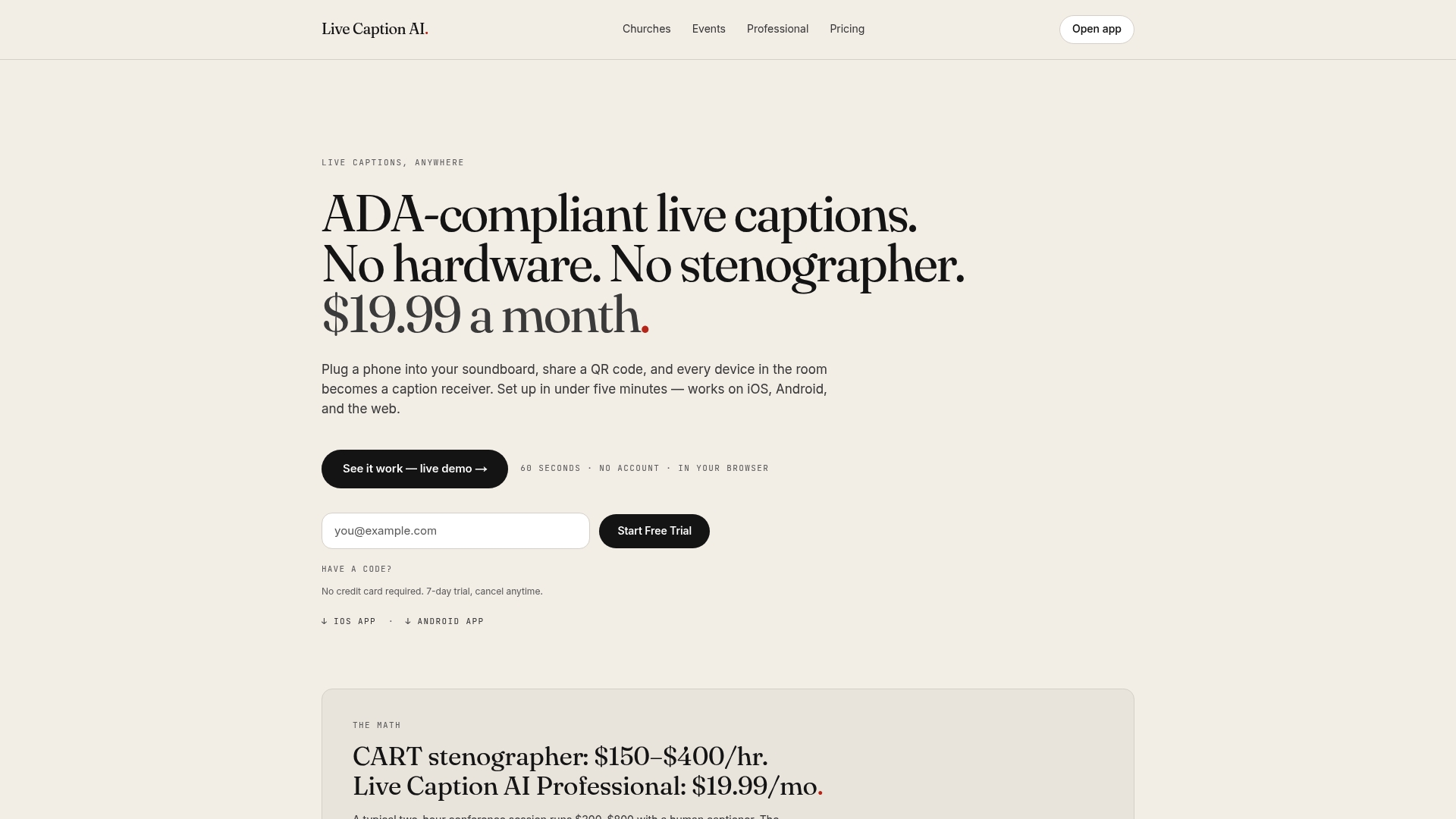
| Plan | Price | Best for |
|---|---|---|
| Free | No published price | Testing and rehearsals |
| Professional | $19.99 per month | Recurring events, unlimited captioning |
| Business | From $199 per month | Teams needing broader coverage |
Live Caption AI turns any phone into a caption receiver through a QR code, no hardware, no stenographer. Medical, Worship, and Finance vocabulary models plus your own Custom Terms, translation into one of 29 languages per session, and session audio is never stored. Check plan details on our pricing page or see what’s included in the Professional plan.
FAQ
How much does event translation software typically cost?
Most organizers pay starting at $20 a month on a subscription, or up to roughly $20 per event using credit packs, depending on session length and features. Our own Professional plan is $19.99 a month for unlimited captioning as a U.S. budgeting reference point.
Is a subscription or a credit pack cheaper for event translation?
It depends on how often you run events. A monthly subscription usually costs less per event if you host sessions weekly or monthly, while credit packs are more economical for occasional, one-off events.
Does live translation software make an event ADA-compliant?
Captioning software can be part of an effective-communication plan under the ADA, but AI captioning alone does not guarantee legal compliance. Accuracy, reliability, and the needs of specific attendees still need to be accounted for separately.
What setup steps affect the final cost of live captioning?
Ordering captions ahead of time, routing venue audio correctly, and entering terminology in advance all take staff time that factors into total cost. Kaltura’s guidance recommends ordering captions at least 15 minutes before the event and starting streaming early to avoid gaps.
Can I try event captioning software before paying?
Yes, testing on a free tier during a rehearsal lets you check audio quality and terminology accuracy before spending on credits or a paid plan. This avoids wasting a paid session on troubleshooting.