October 12, 2026 · 10 min read
Translation Captioning Costs for Events: $60 Before Labor
Estimate translation captioning costs with rates, staff labor, and setup amortization. See the $60 event example; Live Caption AI stores no session audio.

Plan on a variable cost per hour for AI live captioning with single-target live translation, depending on the pricing model you pick: subscription, per-minute, or credit packs. The biggest cost driver isn’t the caption engine itself, it’s whether you’re paying for unlimited access or metering every minute. Our quick formula: vendor rate times session minutes, plus setup amortization, plus internal labor, gets you a realistic first-pass number fast.
TL;DR:
- Choose per minute billing or credit packs for occasional events, but compare subscriptions against actual annual minutes for recurring programs.
- Check translation limits before booking: a one target language cap can require separate sessions, while per language billing can multiply vendor fees.
- Budget beyond vendor fees for setup, staff operation and corrections, and venue audio upgrades; spread one time glossary and training costs across expected sessions.
- ADA guidance lists real time captioning among possible aids, but effectiveness depends on the person and setting, so evaluate whether AI only service is sufficient.
- For an event lasting three hours, $0.40 per minute yields $72 in vendor fees; setup and coordinator labor bring the example budget to roughly $272.
Table of Contents
- Typical Pricing Models and How to Turn Vendor Rates Into Event Line Items
- Cost Components Beyond the Vendor Invoice
- Worked Budgeting Example and Copyable Worksheet Fields
- How to Choose the Right Approach for Cost and Accessibility Outcomes
- Lessons From Budgeting for Real Deployments
- Where Live Caption AI Fits Your Budget
- FAQ
- Sources
Typical Pricing Models and How to Turn Vendor Rates Into Event Line Items
Most captioning and translation vendors sell access one of three ways, and each one fits a different event pattern.
Subscription plans work best for organizations running frequent sessions: weekly services, recurring classes, regular webinars. You pay a flat monthly rate and caption as much as the plan allows, so the per-event cost drops the more you use it.
Per-minute or per-hour billing suits one-off events. You pay only for what you use, which keeps costs predictable for a single conference or a quarterly town hall but gets expensive fast if your event runs long or you add sessions.
Credit packs sit in between. They work well for irregular translation needs, like a handful of multilingual sessions scattered across the year, where a full subscription would sit unused most months.
Translation billing adds its own wrinkle. Some vendors charge per target language, so a session with three language groups costs three times as much. Others cap each session at one source language and one target language, which keeps pricing simple but means multilingual audiences need separate sessions or staggered scheduling.
To turn any of these into an event line item:
- Identify your pricing model (subscription, per-minute, or credit pack).
- Multiply the vendor’s rate by expected session minutes to get a raw vendor cost.
- If translation is billed separately, add that fee per target language or per session.
- Compare the total against a flat monthly plan to see which model wins at your actual usage level.
A two-hour event on a per-minute plan at $0.50 per minute runs $60 in vendor fees alone. The same event under an unlimited monthly plan might cost nothing extra once you’re already subscribed, which is why matching the model to your event calendar matters more than chasing the lowest headline rate.
Cost Components Beyond the Vendor Invoice
The subscription or per-minute fee is rarely your full cost. Internal labor and setup work quietly outweigh the software line in many budgets.
- Internal labor: staff time for onboarding, running the live session, and correcting captions afterward. Estimate it as staff hourly rate times time spent per session, then multiply by your session count.
- One-time setup: building a custom glossary, running a pilot session, and training whoever operates the captioning software. Spread this cost across your expected number of sessions rather than charging it all to the first event.
- Operational and AV costs: better microphones or a bandwidth upgrade matter most in large rooms or venues with unreliable Wi-Fi, where poor audio input degrades caption accuracy regardless of the software.
- Accessibility obligations: ADA guidance on effective communication lists real-time captioning among the aids organizations may need to provide for people who are deaf or have hearing loss, and that obligation can shape what level of captioning quality you need to budget for, not just whether you caption at all.
Scaling up multiplies the non-invoice costs faster than the invoice itself. Adding a second language or doubling your event frequency doesn’t just add vendor fees, it adds coordinator time, more glossary entries to maintain, and more correction passes.
Pro Tip: Track actual minutes spent on caption corrections for your first two or three events before committing to a subscription tier. That measured rate is a better budgeting input than any vendor’s estimate.
Worked Budgeting Example and Copyable Worksheet Fields
Here’s a step-by-step way to build your own number instead of guessing.
- Compute vendor cost. Pick your pricing model and multiply the rate by session minutes. A 90-minute session on a per-minute plan at $0.40 per minute runs $36 in vendor fees.
- Amortize setup. If glossary building and training cost $300 total and you expect 12 sessions this year, that’s $25 per session.
- Add internal labor and AV. A coordinator spending 30 minutes per session at a $25 hourly rate adds $12.50. A rented microphone kit at $20 per event adds another line.
- Add translation fees and device considerations. If your vendor caps sessions at one target language and you need two languages, you’ll need two sessions or two vendor instances, which doubles that portion of the cost.
Scenario one: occasional single-day event. One three-hour conference session, per-minute billing at $0.40 per minute, no translation needed: $72 in vendor fees, plus a one-time $150 setup cost with no amortization since it’s a single event, plus two hours of coordinator time at $25 an hour. Total: roughly $272.
Scenario two: recurring monthly series. Twelve monthly one-hour sessions on a subscription plan covers unlimited captioning for a flat fee, with setup amortized across all twelve sessions and translation included for one language. The monthly cost stays flat regardless of how many minutes you actually caption, which is the advantage of volume over metering.

How to Choose the Right Approach for Cost and Accessibility Outcomes
Matching your pricing model to your actual usage pattern avoids both overpaying for unused capacity and getting hit with surprise per-minute overages.
- One-off events usually favor per-minute or credit-pack pricing; recurring programs almost always come out cheaper on a subscription.
- Decide if AI-only captioning is enough for your audience and setting, or whether a human-reviewed or CART-style service is warranted for higher-stakes communication, since ADA guidance notes that effectiveness for the specific person and context factors into what’s required.
- Specialized vocabulary support matters more than it looks. A vendor with built-in models for your field cuts the correction labor that otherwise eats your internal-labor line every single session.
- Check translation limits before you commit. A single target language per session is fine for a bilingual audience but forces extra sessions or scheduling tricks for a three- or four-language crowd.
- Negotiate on volume and inclusions. Ask whether glossary setup or training sessions are bundled into a contract, and whether a higher-volume commitment unlocks a lower per-session rate.
Lessons From Budgeting for Real Deployments
The biggest mistake we see in event budgets is treating glossary and vocabulary setup as optional. Organizations that invest in custom terms before their first live session consistently see fewer corrections and lower coordinator time in every session after, which is where the real savings show up over a year of use, not in the sticker price of the software.
Privacy also belongs in the budget conversation, not just the legal one. A platform that never stores session audio simplifies privacy reviews for organizations handling sensitive conversations, which saves real staff hours during procurement.
Single-target translation limits deserve program-level planning rather than a last-minute scramble. If your audience spans three languages, decide early whether you’re running separate sessions, staggering content, or accepting that one session covers your largest language group first.
— Ryan
Where Live Caption AI Fits Your Budget
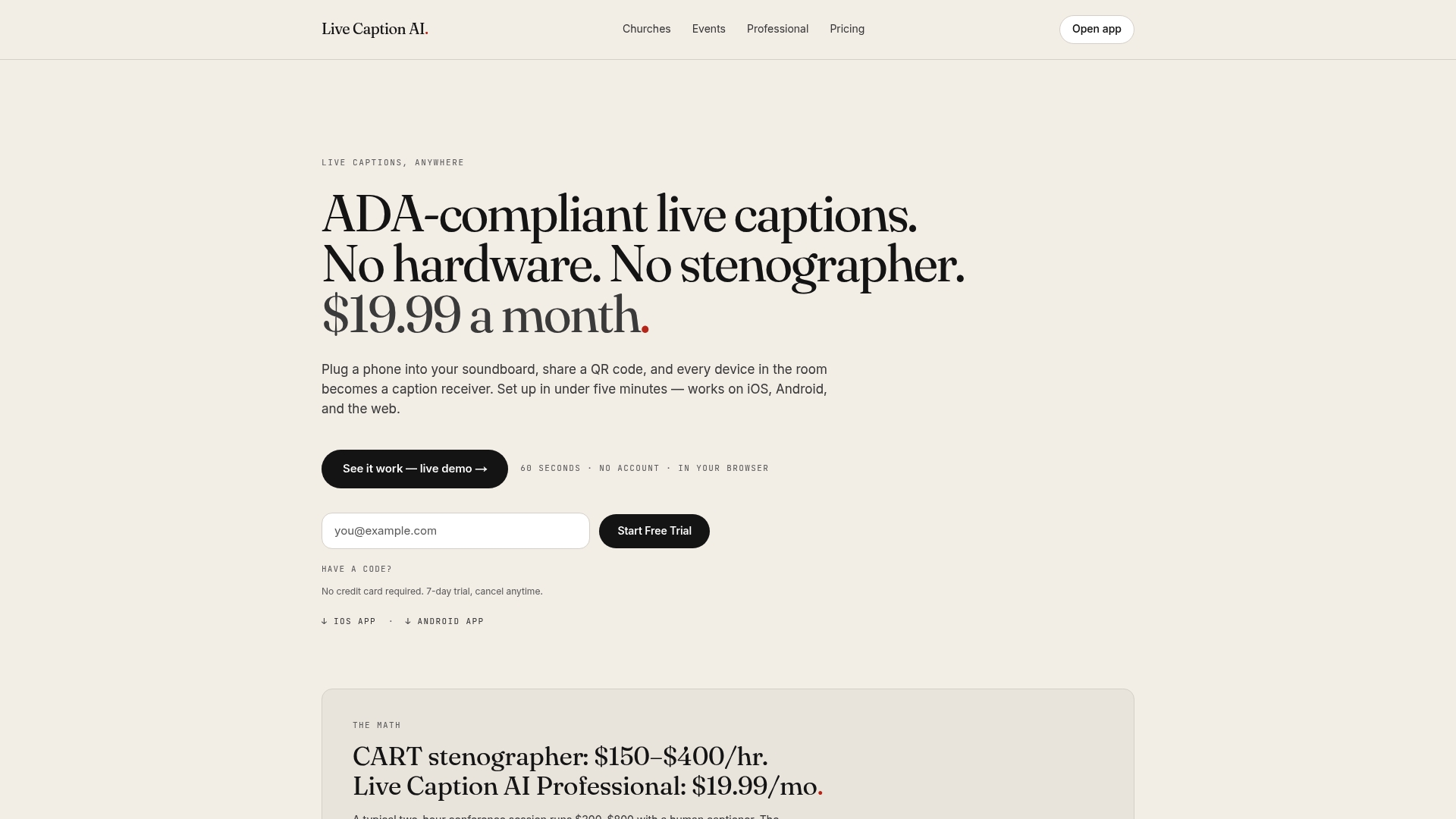
We built Live Caption AI around the same budgeting logic in this guide: match your plan to your actual usage instead of overpaying for capacity you won’t touch.
- Our Free, Professional, and Business plans scale with how often you run sessions, with credit packs available for occasional translation needs.
- Attendees join by scanning a QR code on their own phones, no app, no account, no hardware rental.
- Vocabulary models for Medical, Worship & Ministry, and Finance & Earnings, plus up to 100 Custom Terms, cut the correction labor that drives up internal costs over time.
- Live translation covers one of 29 languages per session, transcripts export when you need a record, and session audio is never stored.
Live Caption AI turns any phone into a caption receiver through a QR code, no hardware, no stenographer. Medical, Worship, and Finance vocabulary models plus your own Custom Terms, translation into one of 29 languages per session, and session audio is never stored.
Check our Professional plan to estimate vendor cost for your own worksheet, or start on the free tier to test the workflow before your next event.
FAQ
What does live captioning typically cost per hour?
AI live captioning with single-target translation costs vary depending on whether you’re billed by subscription, per-minute, or credit pack. Subscription plans lower the per-hour cost the more frequently you caption, while per-minute billing suits a single occasional event.
Is AI captioning cheaper than hiring a stenographer?
AI captioning generally costs less than booking a human stenographer or CART provider, since it removes travel, scheduling, and hourly professional fees from the budget. The trade-off is that AI captioning is not human-reviewed, so accuracy on specialized terms depends on vocabulary models and custom terms rather than a trained stenographer’s judgment.
Do I need live captioning to meet ADA requirements?
ADA guidance lists real-time captioning among the effective communication aids organizations may need to provide, but the specific requirement depends on the setting, audience, and whether captioning is effective for the person involved. Reviewing the ADA’s effective communication guidance for your situation is the right first step before assuming any single tool satisfies the obligation.
What hidden costs should I budget for beyond the software fee?
Internal labor for setup, live operation, and caption correction is the most commonly underestimated cost, along with one-time glossary building and any AV upgrades like better microphones. Amortizing setup costs across your expected number of sessions gives a more realistic per-event number than treating the vendor invoice as the full cost.
Can one captioning session support multiple languages?
Many captioning and translation tools, including single-session translation features, cap each session at one target language, so multilingual audiences often need separate sessions or staggered scheduling. Planning this at the program level, rather than per event, avoids surprise costs when your audience spans more than two languages.