September 21, 2026 · 10 min read
Festival Stage Captions That Meet ADA and Skip Stenographers
Make festival stage captions that meet ADA guidance. Route direct mixer audio, use human monitored ASR or hybrid, deliver captions to phones via QR, and...
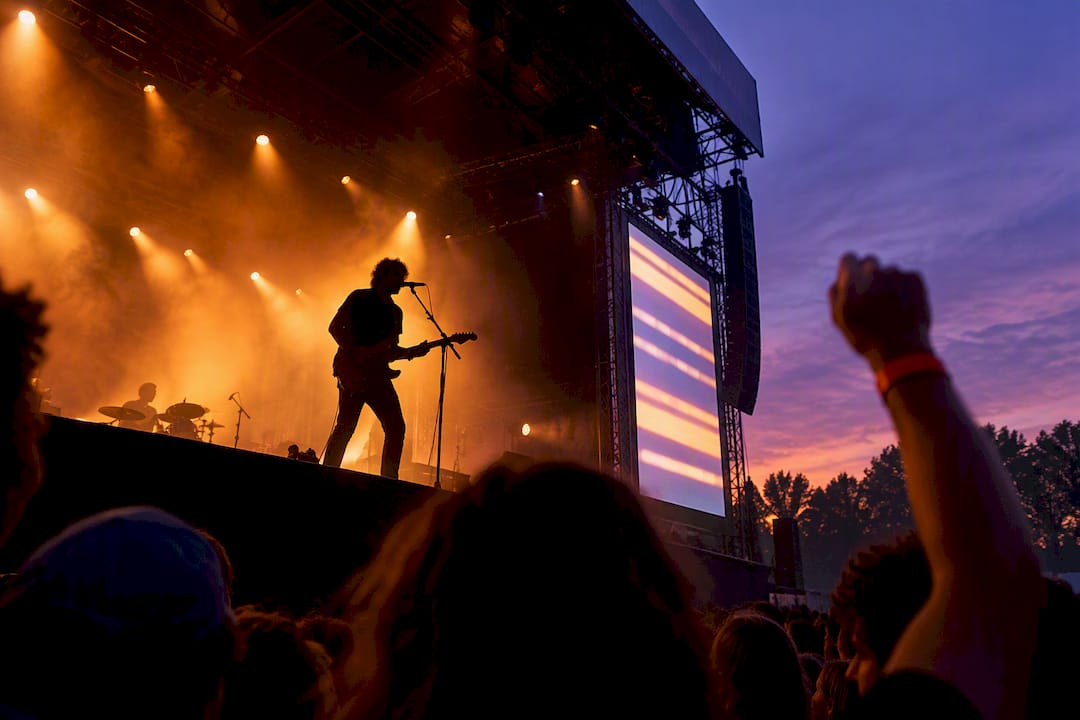
For reliable festival stage captions, run a human-monitored ASR or hybrid workflow fed by direct audio lines, hold latency to 2 to 3 seconds, and treat accuracy as non-negotiable. Phone-based, QR-delivered captions provide a practical audience-facing caption delivery approach. None of it works without rehearsals booked weeks ahead, not the night before doors open.
TL;DR:
- Using direct audio feeds from the stage mixer is essential for accurate captions, and routing must be tested thoroughly before the event.
- Hybrid captioning combines automated transcription with human correction to ensure higher accuracy, especially for music lyrics and slang.
- Caption display options should include large, high-contrast text on screen or mobile QR codes for attendee phones, with bandwidth planning for multiple stages.
- Captioning must meet legal standards for effective communication, requiring accuracy, synchronization, and proper placement, especially for ADA compliance.
- Pre-event rehearsals, including full run-throughs with setlists and backup plans, are critical to prevent caption failures during the festival.
Table of Contents
- What Goes on Your Festival Stage Captions Checklist?
- ASR, Human CART, or Hybrid: Which Fits Your Stage?
- How Do You Route Audio and Display Captions Reliably?
- What Does ADA and NAD Guidance Actually Require?
- How Do You Test and Backstop Captions Before Show Day?
- Where Live Caption AI Fits, and Where It Doesn’t
- Ready to Test Festival Stage Captions on Your Own Stage?
- Sources
- FAQ
What Goes on Your Festival Stage Captions Checklist?
Caption planning starts the same week you lock your stage schedule, not the week before gates open. Bring your AV lead, accessibility coordinator, and caption provider into the same conversation early, because each one needs lead time the others don’t.
Here’s the sequence that keeps festival stage captions from becoming a last-minute scramble:
- Confirm scope, four to six weeks out. Decide which stages get captions, whether every set qualifies or just headliners, and who owns the decision if budget gets tight.
- Collect setlists and vocabulary. Ask artists, panelists, and comedians for setlists, script notes, or slang lists. Feed these into your ASR or hand them to human captioners.
- Confirm audio routing with the mixer. Get written sign-off that stage patches will deliver a direct feed, not a room mic.
- Decide display and delivery. Pick LED screens, a mobile viewer via QR code, or both, per stage.
- Publish accommodation info. List available aids on your website and at guest services two weeks before the event, per the ADATA event-planning guide, so attendees who need interpreters or CART can request them ahead of time.
- Lock vendors and rehearsal slots, minimum one week out. No exceptions.
ASR, Human CART, or Hybrid: Which Fits Your Stage?
Automatic speech recognition (ASR) transcribes speech with software alone. Human CART (Communication Access Realtime Translation) uses a trained stenographer or captioner typing live. Hybrid setups pair software transcription with a human monitor who corrects errors in real time.
Each has a different failure point:
- ASR is fast and cheap but stumbles on lyrics, backing vocals, and crowd noise. It also produces the kind of raw errors that fail the effective-communication standard when left unmonitored, according to the National Deaf Center.
- Human CART delivers the highest accuracy for spoken content like panels, keynotes, and comedy sets, but costs more and requires staffing rotation.
- Hybrid blends both: ASR handles the raw transcription load while a human corrects names, slang, and mangled lyrics before captions hit the screen.
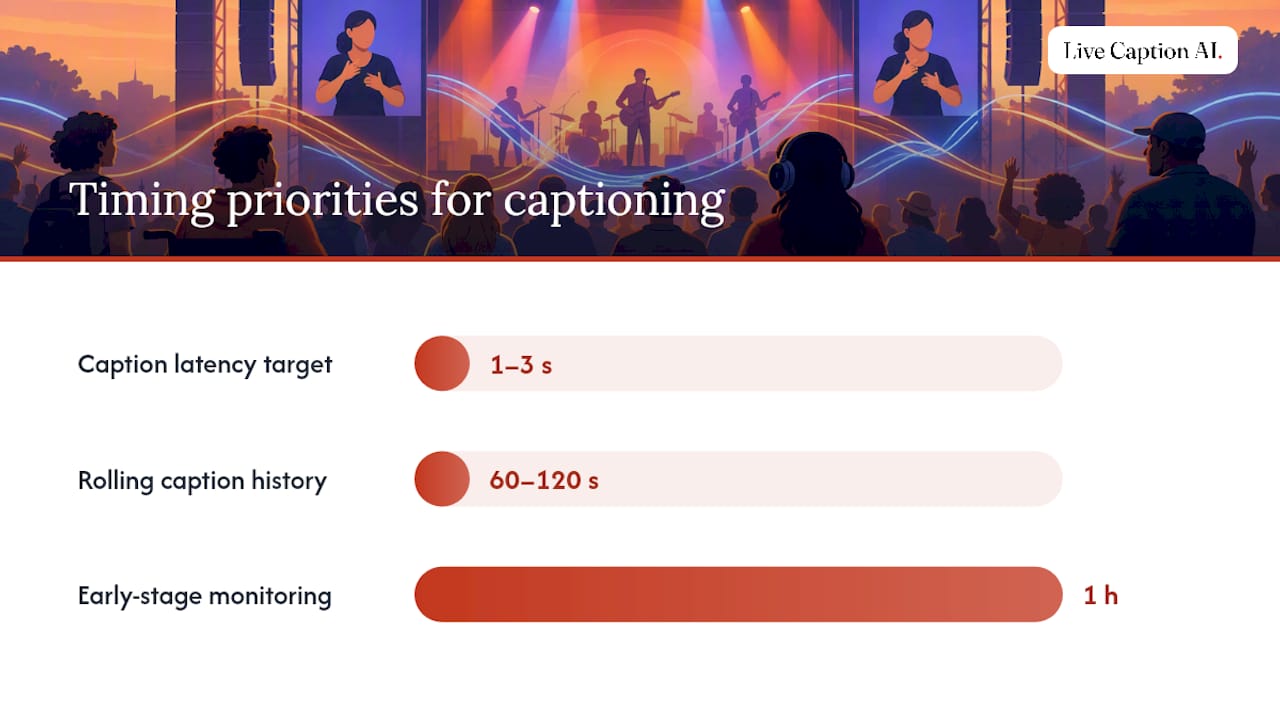
For music sets, Descript recommends 1 to 2 seconds of latency for vocals when possible, with 1 to 3 seconds as a workable ceiling. Spoken-word content should stay under 2 seconds. Human captioners working full festival days should rotate every 20 to 30 minutes, based on staffing practices documented by live-event captioning teams, since fatigue shows up fast in accuracy scores.
Pro Tip: Give your captioner or ASR system the setlist and artist name spellings before doors open, not during soundcheck. Five minutes of prep prevents an hour of garbled captions.
How Do You Route Audio and Display Captions Reliably?
Feed your caption engine directly from the stage mixer, not a room mic. A multitrack line-level feed from each stage’s board isolates vocals from crowd noise and stage bleed, which is the single biggest accuracy lever you control before the show even starts.
Distribution then splits into three practical paths:
- LED screens or projector overlays mounted near the stage for walk-up visibility.
- Mobile viewer pages via QR code, letting any attendee’s phone become a caption receiver without app downloads or hardware rentals.
- Streamed caption tracks using WebVTT or SRT formats for anyone watching remotely, an approach several festival streaming setups now build in by default, per Ticket Fairy’s accessibility coverage.
Serve mobile viewers over HTTPS and test against common phone browsers before the gates open. Open-source implementations like EMF Camp’s camptions project show a workable architecture: stage audio capture feeds a transcription engine, which pushes captions out over WebSocket or SSE to display pages and phone viewers simultaneously. That pattern scales across multiple stages without needing a dedicated server for each one.
For legibility, keep font size large enough to read from 30 feet, use high-contrast text on a dark background, and position captions where they don’t block the performer or block sightlines to the stage. Plan bandwidth per stage separately. A single Wi-Fi network serving four stages worth of caption viewers will choke during a headline set.
What Does ADA and NAD Guidance Actually Require?
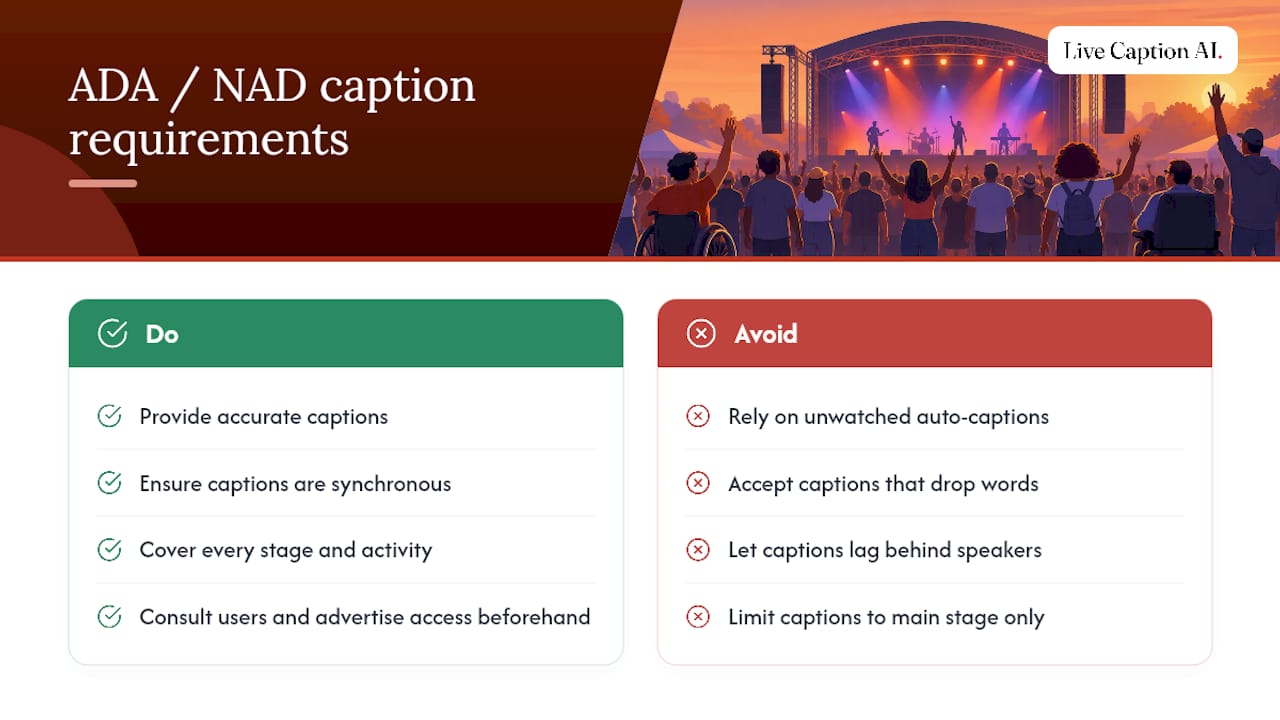
Captioning at festivals falls under auxiliary aids and services, and the legal test that matters is effective communication, not just the presence of some captioning. The NAD’s accessibility guide for festivals and concerts states plainly what that standard demands.
Auxiliary aids and services must be accurate, synchronous, complete, and appropriately positioned. Computer-generated captions run without human monitoring often fall short of that standard.
Raw ASR output, unwatched, frequently drops words, garbles names, and lags behind the speaker. That’s why the National Deaf Center recommends monitored, professional-grade captioning over unattended automation, especially for headline sets and safety announcements.
NAD guidance also stresses equal access across every stage and activity, not just your main stage. A silent-disco tent or a comedy stage tucked in a side field carries the same effective-communication obligation as your headliner slot. Where possible, consult the attendees who’ll actually use the captions and advertise available accommodations before the event, not just at the info booth once people arrive.
How Do You Test and Backstop Captions Before Show Day?
A caption system that hasn’t been rehearsed with a live band is a system you’re testing for the first time in front of ten thousand people. Run the full check before that happens:
- Do a complete run-through with captions live, checking latency and sync against the actual audio, aiming for that 1 to 3 second window in musical sets.
- Seed the ASR or captioner with setlists, lexicons, and any custom vocabulary specific to the artist or panel, a step that measurably cuts mis-transcriptions of names and slang.
- Test on real device profiles, not just the laptop running the encoder. Load the mobile viewer on the same phone models your staff carries.
- Assign redundancy. Preload a backup transcript, keep a local stenographer on standby, and know exactly who switches to a simplified overlay if the feed drops.
Running dual audio feeds into independent caption engines, with a short rolling caption history of 60 to 120 seconds, lets a viewer reconnect without losing context if their connection blips, an approach EMF Camp’s caption architecture uses for exactly this reason. Early rehearsal time is what makes all of this catchable before showtime, not after, a point event accessibility planning guidance repeats for good reason.
Pro Tip: Assign one specific staff member per stage whose only job during the first hour of doors is watching the caption feed. Problems caught in hour one get fixed. Problems caught during the headliner get complaints.
Where Live Caption AI Fits, and Where It Doesn’t
This service turns any attendee’s phone into a caption receiver through a QR code, with no hardware rentals and no stenographer booking required.
A mobile-first delivery model can be effective for multi-stage festivals needing multilingual captions distributed across multiple viewing points simultaneously. A human captioner is often preferable for dense spoken content, like a keynote panel or comedy headliner, where nuance and inside references matter more than raw transcription speed. Pairing both is often the smarter call than picking one exclusively.
— Ryan
Ready to Test Festival Stage Captions on Your Own Stage?
This approach can skip stenographer booking fees and hardware rental costs entirely. Your caption receiver is a phone, delivered through a QR code, live in about five minutes per stage.
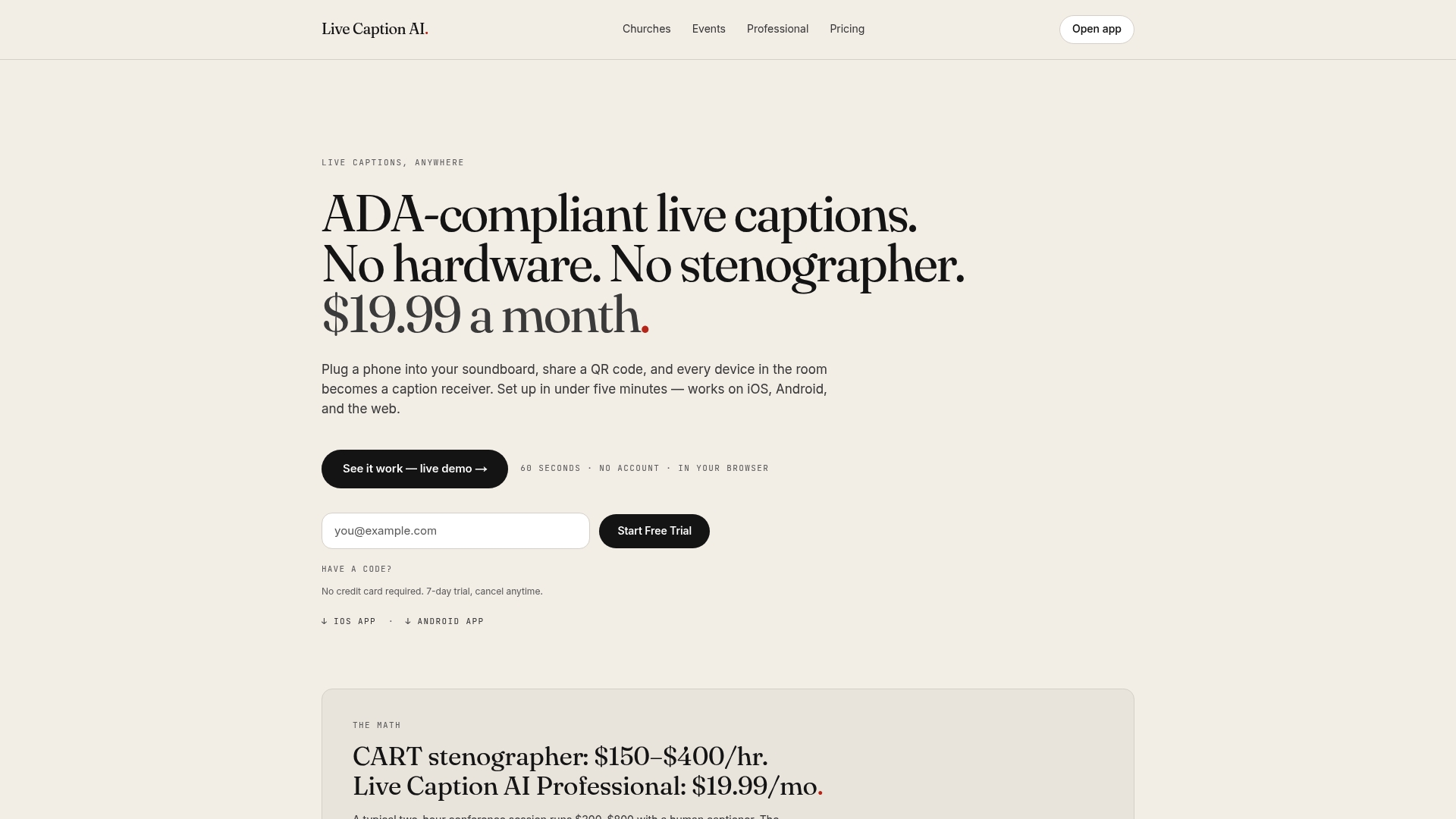
The Professional plan runs $19.99 a month and unlocks cloud-based captioning with domain-specific accuracy for your setlists and stage terminology. Festivals running multiple stages or needing broader device support can look at the Business plan, starting from $199 a month. Both plans offer a pricing model that may be more cost-effective than per-session stenographer bookings, without requiring dedicated hardware. Check current plan details on the Live Caption AI pricing page and run a trial stage during your next rehearsal to see how it holds up before your actual show day.
Sources
- Festivals and concerts accessibility guide — NAD
- Planning guide for making temporary events accessible — ADATA
- Descript
FAQ
Is Live Captioning Legally Required at Festivals?
Festivals generally must provide auxiliary aids like captioning when needed for effective communication, per the NAD’s accessibility guidance. Whether it’s required for your specific event depends on venue type, funding, and attendee requests, so check with an accessibility professional for your situation.
What Latency Should Festival Stage Captions Target?
Aim for under 2 seconds for spoken content like panels and keynotes, and 1 to 3 seconds for musical performances where lyrics and timing matter more. Tighter latency generally means better sync but can strain accuracy if the system rushes the transcription.
Can Raw AI Captioning Alone Meet Accessibility Standards?
Usually not on its own. The National Deaf Center notes that unmonitored automated captions often fail the effective-communication test, which is why a human-monitored or hybrid setup is the safer production choice.
How Much Does Festival-Ready Captioning Software Cost?
Live Caption AI’s Professional plan runs $19.99 a month, with a Business plan starting from $199 a month for larger, multi-stage deployments. Both replace the per-event cost of hiring stenographers for each stage.
Do Attendees Need an App to View Festival Captions?
No. Captions are delivered by turning any attendee’s phone into a viewer through a QR code, requiring no app download or extra hardware. This makes multi-stage, multilingual delivery far simpler to scale than fixed LED displays alone.