September 23, 2026 · 11 min read
ADA Compliant Event Captions Using Cloud Live Transcription via QR
Test the clean...

Cloud live transcription means captions generated in the cloud and delivered straight to attendees’ phones, browsers, or venue screens, usually through a QR code, instead of dedicated hardware or an on-site stenographer. It’s built for organizers who need ADA-compliant, real-time captions and often translation, without renting equipment. Event organizers, churches, medical practices, legal teams, and AV companies use it because it scales from a 20-person meeting to a 2,000-seat sanctuary with the same setup. Done right, it can satisfy your auxiliary-aid obligations under the ADA while giving every attendee, not just those who requested accommodation, a better way to follow along.
Table of Contents
- How Cloud Live Transcription Works: From Microphone to Screen
- What ADA and WCAG Actually Require From Your Captions
- A Checklist for Choosing a Cloud Live Transcription Vendor
- Run-of-Show Steps for Reliable Live Captions
- Deployment Notes for Churches, Conferences, Medical, Legal, and AV Teams
- Fixing Caption Problems Before Anyone Notices
- Where Live Caption AI Fits Into This Picture
- Get Compliant Captions Running Before Your Next Event
- Sources
- FAQ
How Cloud Live Transcription Works: From Microphone to Screen
The process starts with automatic speech recognition (ASR) running on cloud servers, often layered with domain-tuned models that recognize medical, legal, or liturgical vocabulary that generic speech-to-text tools miss.
Delivery happens a few ways:
- A QR code links attendees to a live browser caption page on their own device.
- Captions embed directly into a livestream or video player for remote viewers.
- Text pushes to projection screens or LED walls for in-room audiences.
Audio quality determines caption quality more than any algorithm does. A clean auxiliary feed, routed directly from the mixing board rather than picked up by a room microphone, is what separates readable captions from garbled ones. Latency also splits by audience: in-room viewers notice a half-second delay far less than remote viewers watching a synced stream, so testing both paths before doors open matters.
What ADA and WCAG Actually Require From Your Captions
Federal law doesn’t leave this optional for many venues. Under 28 C.F.R. § 36.303(b), covered entities must provide auxiliary aids and services, including real-time captioning, when necessary for effective communication. The DOJ’s Title II and Title III guidance spells out what counts as an auxiliary aid and where WCAG standards apply to electronic communications.
Effective communication in practice means captions that are accurate, synchronized with speech, complete (no dropped sentences), and legible on whatever screen the attendee is holding. WCAG 2.1 Level AA guidance extends this to synchronized media, and institutions generally treat 95 to 99 percent accuracy as the professional benchmark for high-stakes events.
That benchmark matters because raw, uncorrected ASR output rarely reaches it on its own, especially with overlapping speakers, accents, or specialized jargon. Where the stakes are high, a courtroom deposition, a diagnosis discussion, a technical conference session, industry guidance recommends CART or a hybrid human-plus-AI model rather than relying on machine transcription alone.
Quick reference for accuracy expectations:
- Casual or low-risk settings: automated captions with domain vocabulary support are often sufficient.
- Medical, legal, or technical events: hybrid or human-reviewed captioning reduces the risk of a missed or garbled term changing meaning.
- Any setting under a compliance obligation: document your accuracy process in case it’s ever questioned.
A Checklist for Choosing a Cloud Live Transcription Vendor
Before signing anything, run the vendor through this list:
- ADA and WCAG alignment. Ask how the platform maps to 28 C.F.R. § 36.303(b) and WCAG 2.1 Level AA for synchronized media, not just whether it “supports accessibility.”
- Domain vocabulary. Can you load custom terminology (drug names, legal terms, hymn titles) before the session starts?
- Multilingual delivery. Does real-time translation reach attendees on their own devices, or only in one language on a shared screen?
- Delivery method. QR code and browser fallback should work even if the venue’s Wi-Fi struggles.
- Setup speed. Ask for a live demo of the actual setup process, not a marketing walkthrough.
- Monitoring support. Is there a dashboard or alert system if the caption feed drops mid-event?
- Retention policy. Get a straight answer on how long transcripts and audio are kept, and who can access them.
Pro Tip:
A vendor that can’t clearly explain their clean-feed requirements, or dodges the HIPAA question entirely, is a red flag no pricing discount should override.
Run-of-Show Steps for Reliable Live Captions
Before the event:
- Build a vocabulary list of names, technical terms, and hymn or legal terminology.
- Train speakers on basic mic technique, close to the mouth, no cupping, no whispering off-axis.
- Route a clean auxiliary feed from the board directly into the captioning input.
- Run a full integration test with your streaming or conferencing platform at least a day ahead.
During the event:
- Lock the caption input source so no one accidentally switches it mid-session.
- Assign one person to monitor in-room display and another to monitor the remote stream.
- Spot-check latency every 15 to 20 minutes, especially after any AV change.
- Keep the QR fallback page live even if you’re also projecting captions on-screen.
After the event:
Export the transcript immediately while the session is fresh, then run a quick quality check before publishing any replay. Document your captioning steps, vocabulary list, feed routing, monitoring log, as part of your accessibility records. That paperwork matters if effective communication is ever challenged later.

Deployment Notes for Churches, Conferences, Medical, Legal, and AV Teams
Every environment has its own quirks:
- Churches: Music and singing confuse ASR models trained on speech, so mute or lower captioning during hymns and resume for spoken segments. Congregants often need a nudge to scan the QR code the first week, but adoption climbs fast once regulars see it works.
- Conferences: Decide early whether captions live on personal devices or a large stage display, hybrid events usually need both. Remote attendees tolerate slightly higher latency than in-room ones, but test each path separately.
- AV companies: Standardize your clean-feed handoff process across venues so caption embedding into displays and remote streams is repeatable, not reinvented every gig.
Fixing Caption Problems Before Anyone Notices
Most caption failures trace back to one of a handful of causes:
- Garbled or delayed text: Check for a noisy audio channel, mute cross-talk mics, and confirm the feed is still locked to the right input.
- Captions stop updating: Switch attendees to the QR/browser fallback page immediately while staff investigate.
- Accuracy drops sharply: If jargon-heavy speech is tripping the model, flag it for human-assisted review rather than letting a compliance-critical session run on unchecked ASR.
Keep one person assigned to watch the feed the entire session, with a clear escalation path if something breaks. If accuracy can’t be verified in real time for a high-stakes recording, hold the replay until someone reviews the transcript.
Pro Tip: Print your fallback QR code on a physical sign near the entrance, not just in the digital program. Wi-Fi hiccups happen, and a visible backup keeps attendees from feeling stranded.
Where Live Caption AI Fits Into This Picture
Different service tiers scale from single weekly services to multi-room conferences with unlimited device broadcasting and exportable transcripts. Setup is designed to be quick, which matters when a volunteer AV team has limited time before doors open.
— Ryan
Get Compliant Captions Running Before Your Next Event
This solution aims to eliminate the two biggest costs in traditional live captioning: rented hardware and per-hour stenographer fees. Instead of paying for a CART operator by the hour, these services offer unlimited captioning and translation on a flat monthly plan, with domain-trained models that catch medical, legal, and technical terms generic ASR tools may miss.
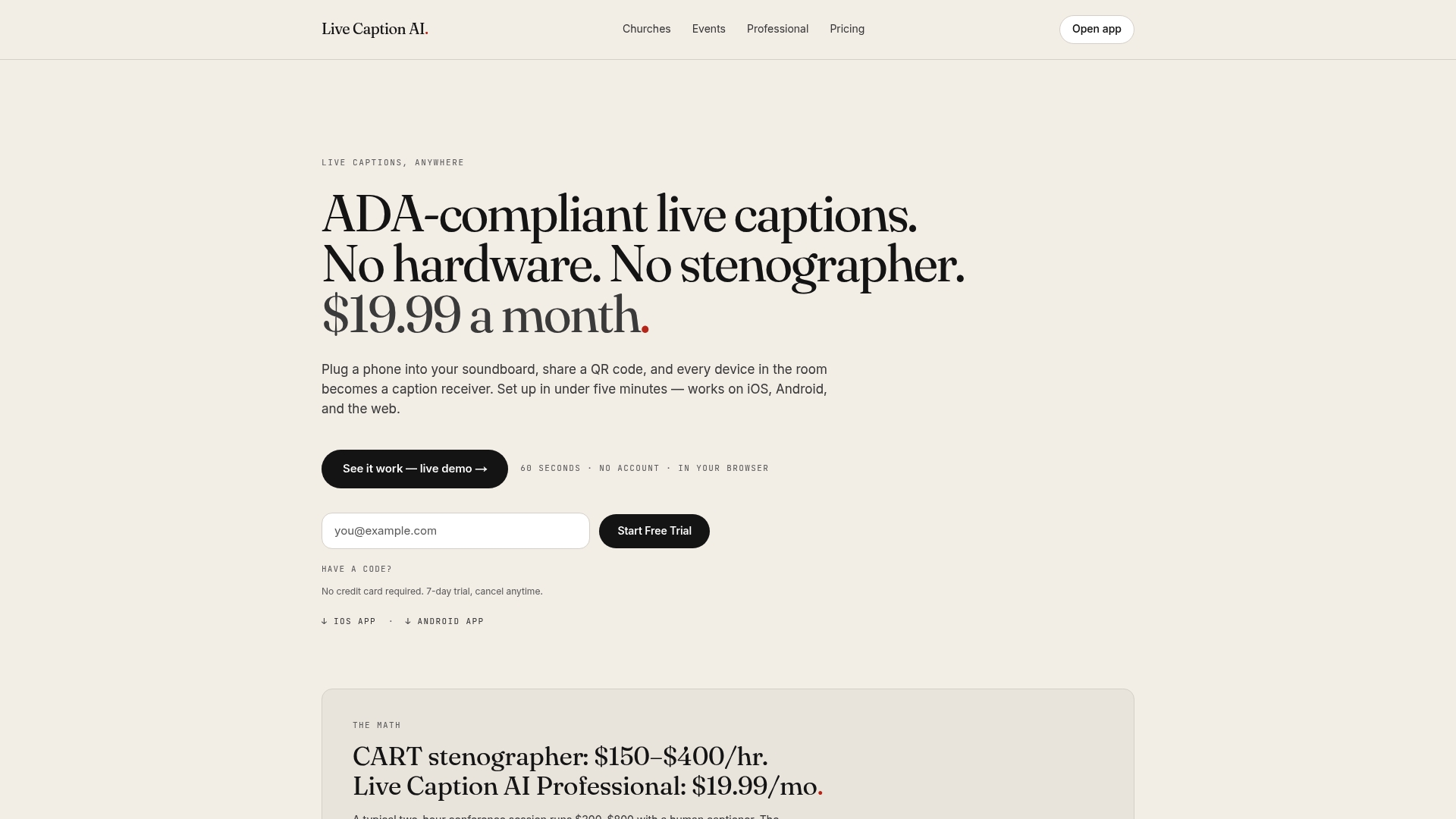
If you’re setting up for a church service, a conference, or a HIPAA-sensitive consultation, start by loading your custom vocabulary list and running a quick test session with your own audio feed before the real event. That five-minute check catches routing problems while there’s still time to fix them. The Free, Professional, and Business plans each fit a different scale of operation, from a single weekly service to a multi-room AV deployment, and you can compare features directly on the pricing page before choosing one. For teams weighing automated captions against a hybrid or fully human model, it’s also worth reading how automated transcription compares to other options so you pick the right tier of accuracy for what you’re running.
Sources
For legal grounding, keep the ADA effective communication guidance and DOJ Title II/III excerpts handy. For operational detail, the NAD conference guidance and accuracy guide for live events cover monitoring and fallback planning, and accessibility’s overlap with discoverability and SEO is worth a read too.
This article is general information, not a substitute for advice from a qualified lawyer. Consult a qualified legal professional about your own circumstances before acting on anything here.
FAQ
Is Cloud Live Transcription the Same as Closed Captioning?
They overlap but aren’t identical. Cloud live transcription generates the text in real time using cloud-based speech recognition, while closed captioning refers to how that text is displayed and controlled by the viewer, a distinction WCAG’s live captioning guidance addresses directly.
Does the ADA Require Live Captions at Every Event?
The ADA requires auxiliary aids and services, including real-time captioning, when necessary for effective communication under 28 C.F.R. § 36.303(b). Whether captions are required depends on the venue type and audience need, not a blanket rule for every gathering.
How Accurate Does a Live Caption Need to Be?
Professional events generally aim for 95 to 99 percent accuracy, a benchmark drawn from WCAG 2.1 Level AA guidance for synchronized media. High-stakes settings like courtrooms or medical consultations often need human or hybrid review to reach that consistently.
What Does Cloud Live Transcription Cost?
Live Caption AI’s Professional plan runs $19.99 per month, with a Free tier for basic on-device captions and a Business plan starting from $199 per month for larger deployments. One-off translation credit packs are also available for occasional multilingual sessions.
Can Cloud Live Transcription Handle Medical or Legal Terminology?
Domain-tuned models trained on medical, legal, or specialized vocabulary catch terms that generic speech-to-text tools regularly miss.