September 24, 2026 · 19 min read
Five Second Latency Is the Limit: ASL vs Captions for Event Organizers
Practical, compliance-first advice for event organizers: when to choose ASL or captions, test five second caption latency, use QR distribution, and...

Live captions are the right call when a deaf or hard-of-hearing attendee accepts text-based access, or when your event format (large crowds, multiple languages, livestreams) makes a one-to-one ASL interpreter impractical for everyone in the room. Here, “captions” means real-time, device-delivered text synchronized with spoken audio, the kind Live Caption AI provides through a phone screen. That said, the choice is never yours alone to make. Ask the person requesting accommodation first, then match the tool to their answer.
Table of Contents
- ASL vs Captions: What Each Actually Delivers
- How Live Captions Align With ADA, WCAG, and HIPAA Requirements
- What Accuracy, Latency, and Readability Targets Actually Look Like
- A Step-By-Step Setup Checklist for Live Captions
- How Live Caption AI Addresses the Checklist and Compliance Needs
- Comparing Communication Effectiveness for Different Audiences
- What Captions and ASL Interpreters Actually Cost
- Credentials Behind the Interpreter vs. the Caption Engine
- Legal Exposure: ASL Interpretation vs. Live Captioning Under the ADA
- Accessibility Trade-Offs Across Churches, Medical, and Legal Settings
- When to Combine ASL and Captions in the Same Event
- Practical Perspective: When to Combine Captions With Other Aids
- Try Live Caption AI for Your Next Event
- Primary Sources for Compliance Verification
- Sources
- FAQ
ASL vs Captions: What Each Actually Delivers
The phrase “ASL vs captions” gets thrown around like the two are interchangeable substitutes, but they solve different problems for different people. ASL interpretation delivers meaning through a human translator working in American Sign Language, a distinct language with its own grammar, not a signed version of English. Captions deliver English text, word for word, synced to the audio feed.
For someone whose first language is ASL, captions are a second-language experience, similar to reading subtitles in a language you speak but don’t think in. For someone who is hard of hearing but grew up speaking English, captions may be the clearer, more natural option. Neither format is universally “better.” Both are recognized auxiliary aids under the ADA’s effective communication rules, and the law does not let organizers pick whichever is cheaper or easier to book. It requires you to weigh the requester’s preference as the primary factor.
That single distinction, ASL as a language versus captions as a text transcript of English, is the piece most event organizers miss when they assume one auxiliary aid works for every deaf or hard-of-hearing guest. It doesn’t. A church with a multigenerational congregation, a hospital intake room, and a courtroom deposition each carry different stakes, different audiences, and different answers to the ASL vs captions question. The rest of this guide walks through how to make that call correctly, and how to build the compliance and technical scaffolding around it.
How Live Captions Align With ADA, WCAG, and HIPAA Requirements
The ADA requires effective communication, not a specific technology. The Department of Justice gives “primary consideration” to the preference of the person requesting the accommodation, which means asking first and documenting the answer, not defaulting to whatever your AV team already owns.
Once captions are the chosen method, WCAG 2.2 Success Criterion 1.2.4 sets the technical bar for live captioning: the text must capture speech in real time, identify who is speaking when multiple people talk, and flag significant non-speech audio (an alarm, applause, a phone ringing) when that audio carries meaning for the scene. A caption feed that only transcribes words while dropping speaker changes technically falls short of this standard, even if the words themselves are accurate.
Medical and legal settings carry a second compliance layer.
Before your next event, confirm these four items:
- Who on your team is responsible for asking the requester their preferred accommodation
- Whether your captioning vendor will sign a BAA if any session touches ePHI
- Whether speaker identification is turned on for multi-speaker sessions
- Whether your invitation language sets a deadline for accommodation requests, per ADA meeting guidance
What Accuracy, Latency, and Readability Targets Actually Look Like
Caption quality comes down to three measurable things: accuracy, latency, and readability. Get any one badly wrong, and the captions stop being “effective communication” no matter how good the other two are.
Accuracy tracks how many meaningful errors show up in the transcript, not just raw word count. A caption engine that nails 98% of common words but consistently mangles a defendant’s name or a drug dosage has a low error rate on paper and a real problem in practice. Latency measures the delay between spoken word and displayed text.
Usability research points to roughly five seconds as the practical ceiling for real-time captions to support conversational participation, according to captioning latency research from Carnegie Mellon. Push much past that, and viewers lose the thread between what’s being said and what they’re reading.
Readability is the third leg, and it’s often overlooked. Research on live television captions found that even small timing mismatches between audio and text noticeably hurt how users rate caption quality, separate from whether the words themselves were correct.
Several real-world factors degrade all three at once:
- Poor mic routing or crosstalk between speakers inflates error rates fast
- Domain vocabulary (clinical terms, legal citations, technical jargon) trips up generic speech-to-text engines
- Multiple simultaneous speakers strain speaker-ID accuracy
- Multilingual sessions need a captioning pipeline built for the target languages, not a bolt-on translation layer
Automated speech recognition has closed most of the gap with human-assisted methods, but comparative research on respeaking versus automated captioning still finds human-in-the-loop workflows ahead on raw accuracy in some conditions, particularly dense technical speech. The trade-off is scale and cost. A trained stenographer handles one room; automated captioning scales to unlimited devices at a fraction of the price. Test both in rehearsal before you commit to either at a live event.
A Step-By-Step Setup Checklist for Live Captions
Getting captions right on event day starts weeks earlier, not the morning of. Here’s the order that actually works:
- Consult the requester first. Confirm captions meet their preference before booking anything.
- Collect speaker names and vocabulary early. Upload proper nouns, technical terms, and speaker lists in advance. Domain-specific vocabulary uploads measurably reduce error rates on names and jargon that generic engines routinely botch.
- Check mic routing and network bandwidth. Captioning quality is only as good as the audio feed reaching it; test the signal path, not just the microphone.
- Choose your distribution method. Decide between a QR code that turns any attendee’s phone into a caption receiver, an in-room display screen, or embedded captions on a livestream. See practical setups in these live captioning event guides.
- Rehearse and measure latency. Have a speaker read a timestamp or test phrase, then time how long it takes captions to appear on a test device. CMU’s latency research suggests treating five seconds as your internal pass/fail line.
- Test speaker ID and multilingual output if your session includes either.
- Position the caption display so it doesn’t block slides, signers, or the speaker’s face.
- Line up a human backup. Know who to call if the tech fails mid-session.
Pro Tip: Run your latency test with the same network conditions you expect on event day, not your office Wi-Fi. A packed conference hall with hundreds of connected devices behaves very differently than an empty room.
How Live Caption AI Addresses the Checklist and Compliance Needs
There are live captioning solutions built around exactly this checklist. Such solutions can eliminate the need for expensive hardware or stenographers, and can turn any phone into a caption receiver through a simple QR code, no app download, no device rental line item.
QR-based distribution solves the “how do attendees actually get the captions” problem instantly, at scale, whether captioning a church service or a 500-seat conference.
Comparing Communication Effectiveness for Different Audiences
Communication effectiveness in the ASL vs captions debate depends entirely on who’s in the room, not which tool tests better in isolation. For attendees whose first language is ASL, an interpreter delivers meaning the way they process language natively, capturing tone, emphasis, and idiom that a flat text transcript can flatten out. For hard-of-hearing attendees who read and think in English, captions often communicate just as effectively, sometimes better, since there’s no translation layer between the spoken word and what appears on screen.

Group size changes the equation too. A single interpreter can serve an unlimited number of ASL-fluent attendees in a room, as long as they can all see the interpreter clearly. Captions delivered by QR code scale differently: every attendee gets their own device-level feed, which works better for large or spread-out crowds where sightlines to an interpreter would be inconsistent anyway.
Content type matters as well. Fast-paced, emotionally nuanced speech (a sermon, a closing argument, a patient explaining symptoms) can lose subtlety in text form. ASL interpretation, delivered by a skilled human, carries that nuance more naturally. Straightforward informational content, like a conference keynote or a product demo, tends to translate cleanly into captions with little lost.
Neither format is a universal upgrade over the other. The right answer changes with the audience, the room, and the content, which is exactly why the ADA puts the decision in the requester’s hands rather than the organizer’s.
What Captions and ASL Interpreters Actually Cost
Budget is often the real reason organizers default to captions, and the gap is significant. A single certified ASL interpreter typically runs into the hundreds of dollars for a two-hour booking, and many settings require two interpreters working in rotation to avoid fatigue-driven errors during longer sessions, effectively doubling that cost. Multiply that across a multi-day conference or a weekly church service, and interpreter costs stack up fast.
Live captioning changes the cost structure entirely. Instead of paying per session, per interpreter, per hour, Live Caption AI runs on a flat monthly subscription: the Professional plan is $19.99 per month, and a Business plan starts from $199 per month for organizations running captions across multiple rooms or events. There’s also a Free tier for basic on-device captioning with no published price, useful for testing before committing to a paid plan.
That fixed-cost model matters most for organizations running frequent events. A church captioning every Sunday service, or a university captioning dozens of lectures a semester, faces a wildly different budget curve with a flat monthly rate than with per-session interpreter fees. ASL interpretation remains the right call when a requester needs it, cost aside, since the ADA doesn’t let budget override effective communication. But for organizations trying to serve broad, mixed audiences without an unlimited accessibility budget, captioning at a predictable monthly price is often the more sustainable long-term choice.
Credentials Behind the Interpreter vs. the Caption Engine
ASL interpreters typically hold certification through the Registry of Interpreters for the Deaf or a similar credentialing body, requiring formal training, supervised practice hours, and ongoing continuing education to maintain certification. Legal and medical settings often call for interpreters with specialized certification on top of general fluency, since courtroom terminology and clinical vocabulary carry real consequences when translated imprecisely.
Live captioning providers don’t carry an equivalent individual credential, because the “qualification” shifts from a certified human to the technology stack and its governance. What matters instead is whether the platform’s speech recognition has been trained on relevant vocabulary, whether the vendor supports custom terminology uploads, and whether the company will sign a BAA for HIPAA-regulated sessions. A captioning vendor’s credibility rests on measurable output (accuracy rates, latency benchmarks, uptime) rather than a certification number tied to one person.
This distinction has practical weight for procurement. When you book an ASL interpreter, you’re vetting a person’s certification and experience with your subject matter. When you evaluate a captioning platform, you’re vetting the vendor’s compliance posture, its domain-vocabulary tools, and its track record for accuracy across the kind of content you run. Neither vetting process is lighter than the other. They just look almost completely different, and organizations that apply interpreter-style vetting to a software vendor (or vice versa) tend to miss the questions that actually matter.
Legal Exposure: ASL Interpretation vs. Live Captioning Under the ADA
Both ASL interpretation and live captioning satisfy the ADA’s effective communication requirement when they match what the requester actually needs. The legal exposure shows up when an organizer picks the cheaper or more convenient option instead of the one the requester asked for. Providing captions to someone who explicitly requested an ASL interpreter, without a documented reason the interpreter wasn’t feasible, is the kind of decision that draws complaints and, in some cases, litigation.
The DOJ’s guidance places the burden of consultation on the covered entity, not the requester. That means the organizer has to initiate the conversation, document the preference, and provide a rationale if a different aid is substituted. Simply having captions available at every event isn’t a blanket defense if a specific attendee needed an interpreter and didn’t get one.
Compliance differences also show up in scale. A single missed interpreter booking affects one accommodation request. A caption system with a systemic accuracy or latency problem, one that fails WCAG’s speaker-identification or non-speech-audio requirements, potentially affects every attendee relying on it across every session it’s used for. That’s a different risk profile: individual grievance versus a policy-level compliance gap.
For medical and legal settings specifically, the compliance stakes compound. A misheard word in a caption feed during a patient consultation or legal deposition isn’t just an accessibility failure. It’s a documentation and liability issue that can follow the case. That’s the practical argument for treating caption accuracy testing with the same seriousness as interpreter credential checks, not as an afterthought bolted onto AV setup.
Accessibility Trade-Offs Across Churches, Medical, and Legal Settings
Each setting stresses ASL and captions differently. In a church, the audience is often multigenerational and mixed-ability, some attendees fluent in ASL, others hard of hearing and reading-focused, and some simply appreciating captions for a noisy sanctuary or a soft-spoken guest speaker. Captions scale well here because a QR code reaches everyone’s phone at once, while an interpreter serves best when a known, recurring ASL-fluent congregant has made that preference clear.
Medical settings raise the stakes on precision. A patient describing symptoms or a doctor explaining a diagnosis needs communication that captures nuance, tone, and exact terminology. An ASL interpreter trained in medical vocabulary often communicates that nuance more completely than a text feed, particularly for patients whose first language is ASL. Captions still matter here, especially for waiting rooms, group health seminars, or patients who prefer text, but the one-on-one clinical consultation is where interpreter quality tends to matter most.
Legal settings split similarly. Depositions and courtroom testimony often require certified legal interpreters because so much turns on exact phrasing and tone. Captions serve well in legal seminars, public hearings, or large compliance trainings where the content is informational rather than testimonial.
Across all three settings, the limitation that repeats is the same: captions can’t fully replicate the linguistic nuance ASL interpretation carries for ASL-fluent users, and interpreters can’t scale to serve unlimited devices the way a QR-code caption feed does. Matching format to setting, and to the individual’s stated preference, is what makes either option actually effective rather than just technically present.

When to Combine ASL and Captions in the Same Event
Some events don’t call for a single answer. A large conference with both ASL-fluent and hard-of-hearing attendees may need an interpreter positioned on stage or on a dedicated video feed, plus captions running simultaneously on a screen and through a QR code for everyone else. Livestreamed services increasingly do both by default, since online viewers can’t always see an interpreter clearly depending on camera framing, while captions travel cleanly through any streaming platform.
Combining both formats also covers gaps neither handles perfectly alone. Captions capture exact wording for the record. An interpreter captures tone, emphasis, and idiom that text can flatten. In legal and medical settings, running both simultaneously creates a documentation trail (the caption transcript) alongside the communication quality an interpreter provides in the moment.
The cost trade-off is real. Running both means paying for interpretation and captioning, not choosing the cheaper of the two. For organizations that can absorb that cost for high-stakes or recurring sessions, it’s the most complete accessibility approach available. For everyone else, the ADA’s consultation-first principle still applies. Ask what each individual attendee actually needs, and build the accommodation plan around those answers rather than defaulting to a one-size-fits-all combination out of caution.
Practical Perspective: When to Combine Captions With Other Aids
The consultation-first rule isn’t a compliance formality. It’s the whole decision. Offer captions when a requester accepts them, but keep an in-person interpreter on standby whenever someone asks for one, or whenever the content (a diagnosis, a legal ruling, a sensitive pastoral conversation) carries enough nuance that text alone risks losing it.
Small-group clinical consultations and legal proceedings are where I’d push hardest for pairing captions with an interpreter rather than picking one. The caption transcript gives you a documented record. The interpreter gives the patient or client real-time comprehension they can act on immediately.
Whatever you choose, write it down. Record which accommodation was requested, what was provided, and why, before the event, not after a complaint arrives.
— Ryan
Try Live Caption AI for Your Next Event
If your organization needs captions that attendees can actually use without renting hardware or booking a stenographer weeks in advance, Live Caption AI is built for exactly that gap.
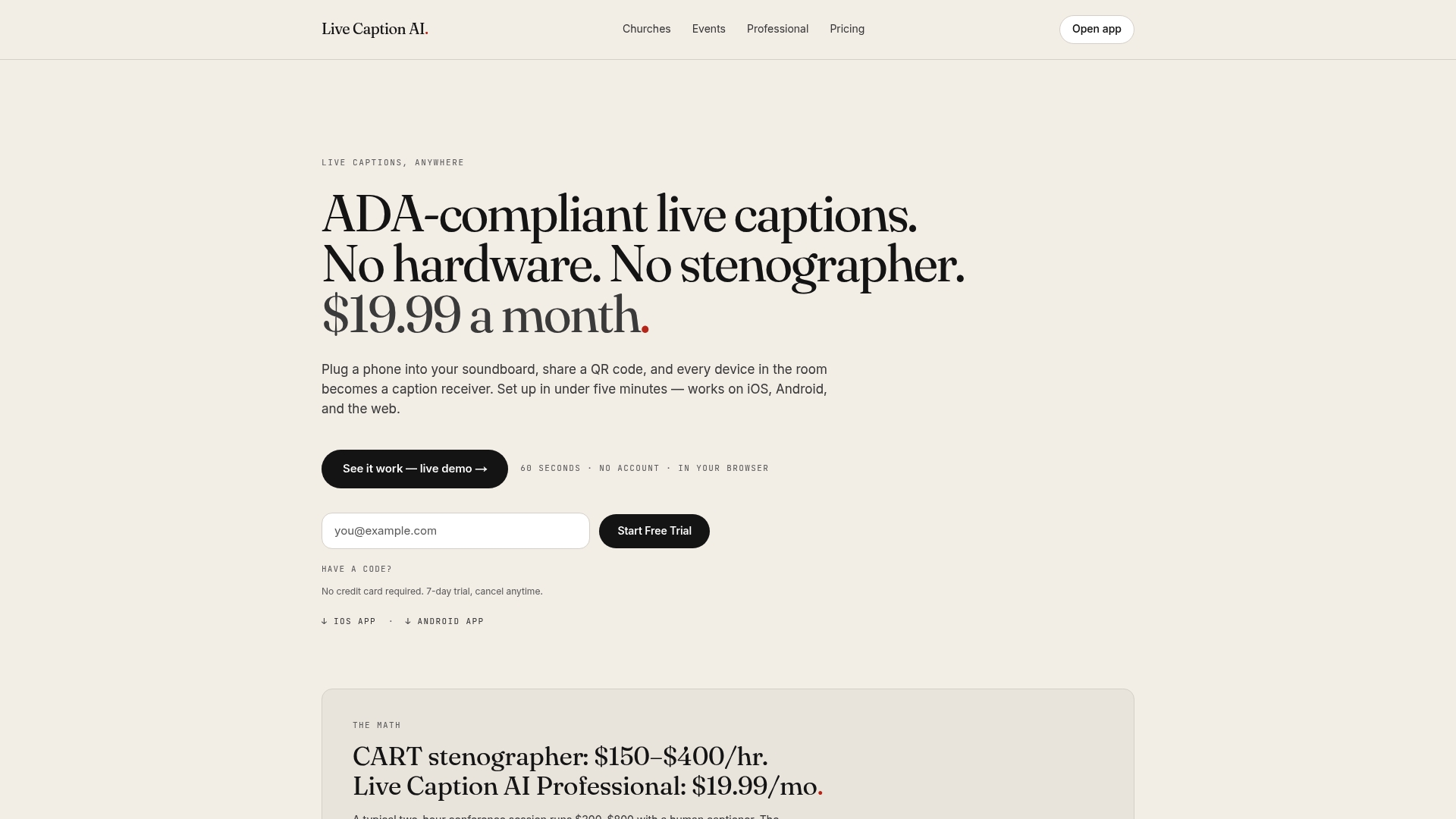
Setup runs through a QR code attendees scan with their own phones, no app, no rented receivers, no per-session stenographer invoice. Domain-specific vocabulary uploads catch the terminology generic speech-to-text tools miss, whether that’s a clinical term, a legal citation, or a speaker’s name. Compare the Free, Professional, and Business plans to see which fits your event calendar, and check the credit packs if you only need captions for occasional one-off sessions. Review the pricing page today and see how a flat monthly rate stacks up against your current accommodation budget.
Primary Sources for Compliance Verification
For legal and technical due diligence, start with the ADA’s effective communication guidance, WCAG 2.2’s live caption criterion, HHS guidance on BAAs, and captioning latency research from CMU. Accessibility and SEO teams may also find this accessibility and search visibility overview useful for documenting accommodation policies.
Sources
- ADA: Effective Communication (U.S. Department of Justice)
- HHS guidance on business associates and BAAs
- How users experience closed captions on live television: quality metrics remain a challenge (ACM, 2024)
- Real-time captioning latency and usability research (CMU / Scribe research)
FAQ
Is ASL or Captioning Required Under the ADA?
Neither is universally required. The ADA requires effective communication and directs organizers to give primary consideration to the requester’s stated preference when choosing between ASL interpretation, captions, or another auxiliary aid.
Do Live Captions Need to Identify Different Speakers?
Yes. WCAG 2.2’s live caption standard requires captions to identify speakers when multiple people are talking, along with capturing speech and significant non-speech audio.
Does a Captioning Vendor Need to Sign a BAA for Medical Events?
Yes, if the vendor creates, receives, or transmits electronic protected health information. HHS guidance treats that vendor as a business associate, which makes a signed BAA a requirement, not an option.
What Does Live Caption AI Cost Compared to Hiring an Interpreter?
Live Caption AI’s Professional plan runs $19.99 a month, compared to a typical stenographer or interpreter session that can run into the hundreds of dollars. A Business plan starts from $199 a month for multi-room or multi-event organizations.
How Fast Should Live Captions Appear on Screen?
Usability research points to roughly five seconds as a practical latency ceiling for real-time captions to stay usable in conversational settings. Test this during rehearsal with a timed cue word before the event.