September 26, 2026 · 11 min read
Room Acoustics Captions That Meet ADA requirements, From $19.99/Month
Deploy phone captions that meet ADA and HIPAA. Use QR delivery, test acoustics, and vocabulary models for accuracy. From $19.99/month.

Room acoustics captions means live, in-room captions delivered straight to attendees’ phones. It’s an accessibility solution that works for events, churches, and clinics without hauling in extra equipment, following best practices outlined in Web Accessibility: Boosting Inclusion and SEO Impact.
TL;DR:
Voice quality and room acoustics significantly affect caption accuracy, making a direct microphone feed essential for optimal results.
Domain-specific vocabulary models and custom terms improve recognition of specialized words, especially in medical, legal, or financial settings.
Legal and privacy requirements, such as HIPAA and ADA compliance, necessitate clear policies on data storage, session audio handling, and provider agreements before use.
Running thorough room tests with typical background noise, speaker variations, and device placement ensures reliable captioning during the event.
Automated captions suit routine events with high volume or limited budgets, but high-stakes or sensitive situations may still require human captioners for safety and accuracy.
Table of Contents
How phone-based live captions work
The flow is simple. A microphone or mixer feed captures the speaker’s audio, a cloud speech-to-text engine transcribes it, and captions land on attendee phones through a QR code or shared link. There’s no app to download and no cap on how many devices can join a session.
Audio source matters more than most people expect. A direct mixer line-out or a dedicated presenter mic gives the cleanest signal. Ambient room mics or a laptop pulling audio through OBS or a stream ingest work too, but they pick up more background noise, which pushes error rates up.
Latency depends on network conditions, audio routing, and processing load, but a direct feed with good bandwidth keeps captions close to real time.
-
QR codes and shared links let unlimited devices join without installing anything.
-
Direct mixer or lavalier mic feeds outperform ambient room mics for accuracy.
-
Domain-specific vocabulary models and Custom Terms catch specialized words that generic speech recognition misses.
-
Session audio handling varies by provider, so ask directly whether audio is stored or discarded.
Cloud speech-to-text engines can handle live audio streams across many languages with strong accuracy in varied conditions, though performance depends heavily on audio quality and domain vocabulary. That’s the technical reason a clean feed and a matched vocabulary model matter more than the captioning software itself.
Legal and privacy checks before you deploy captions
Before you turn captions on for a public event, walk through the compliance side. The Americans with Disabilities Act requires public accommodations to provide auxiliary aids and services, including real-time captioning, when needed for effective communication, and these aids must be offered at no cost to the person requesting them. Real-time captioning is specifically recognized as appropriate for complex, lengthy, or interactive situations, though simpler exchanges may only need a notepad or a printed handout.
Not every situation calls for automated captions. High-stakes legal proceedings, mental health consultations, or anything involving nuanced back-and-forth often still need a qualified interpreter or CART stenographer instead.
Medical settings carry an extra layer. HIPAA doesn’t mandate a specific technology, but it does require safeguards, and many clinics treat any session showing clinical findings as an ePHI workflow with limited transcript retention.
Before you sign with any vendor, ask:
-
Will you sign a Business Associate Agreement if PHI appears in captions?
-
What’s your data storage and retention policy for session audio and transcripts?
-
What latency should we expect on a live feed?
-
Do you support domain-specific vocabulary for our field?
Pro Tip: Get BAA and storage answers in writing before your first clinical session, not after.
Venue planning: test the room before the event
Acoustics change caption accuracy more than almost any other factor. A room that sounds fine to a human ear can still confuse a speech engine if there’s echo, HVAC hum, or a speaker standing too far from the mic. Run a dry run in the actual room, not a similar one down the hall.
-
Connect the direct mixer line or presenter mic feed rather than relying on an open room mic.
-
Have two or three representative speakers read a short passage, including anyone with a strong accent or fast speech pattern.
-
Play typical background noise (HVAC, crowd chatter, a slide advance sound) at expected volume and watch how captions hold up.
-
Check latency by timing the gap between spoken words and caption display on a phone in the back row.
-
Confirm caption text is readable from the farthest seat, checking font size and screen brightness under actual room lighting.
Seating layout shapes the plan too. A single large screen works for a small, forward-facing room, but phone-based captions scale better for wide rooms, side seating, or venues where sightlines to a shared screen are blocked.
Always have a fallback ready. A large-screen caption display or an on-call interpreter covers you if the network drops or a device fails mid-session.
Pro Tip: Run your dry run at the same time of day as the real event, since HVAC cycles and outside noise change by the hour.

Accuracy limits and how to improve caption quality
Automated captions are good, not flawless. Background noise, distance from the mic, heavy accents, and specialized terminology are the four biggest sources of error in live speech recognition.
Domain-specific vocabulary models close a lot of that gap. A generic engine might mangle a drug name, a liturgical term, or an accounting phrase, but a medical, worship, or finance-tuned model, plus your own Custom Terms list, catches words a general model would flag as noise.
Speaker habits matter just as much as the technology:
-
Use a lavalier or hand mic rather than speaking from a distance.
-
Speak at a measured pace and avoid talking over other speakers.
-
State a short speaker identification when switching voices, especially in panel formats.
-
Pause briefly between sentences rather than running thoughts together.
Automated captions work well for routine lectures, services, and training sessions. For legal depositions, courtroom proceedings, or situations where a single misheard word carries real consequences, a human captioner or CART provider is still the safer choice.
Cost justification: captions versus stenographers
Traditional CART stenography or in-person interpreters typically run on a per-session or hourly fee that scales with event length and can add up fast across a regular schedule of services or classes. A subscription-based captioning tool shifts that cost structure to a flat monthly rate or a prepaid credit pack, which is easier to budget across multiple events.
When building a cost case, include:
-
The monthly subscription or per-session credit cost.
-
Any AV setup time or added mic hardware.
-
Staff time to run the dry run and manage the QR code display.
-
ADA compliance value: fewer complaints, faster response to accommodation requests, and a documented good-faith effort.
A pilot study on clinical captioning found participants trusted caption accuracy in 90% of scenarios and rated the experience as not distracting in 86% of scenarios, which points to strong real-world usability even without a live human captioner in the room.
Live Caption AI implementation notes
Live Caption AI turns any phone into a caption receiver through a QR code. No hardware, no stenographer. It offers Medical, Worship, and Finance vocabulary models plus your own Custom Terms, translation into one of 29 languages per session, and it doesn’t store session audio.
Setup is designed to be quick: connecting an audio source and generating a QR code for an OBS-based stream or a live room feed typically takes a short setup window rather than a lengthy technical install. Latency in typical deployments runs in the low seconds, close enough to real time for most lecture, worship, and training formats.
Churches, festival stages, and event venues have used the tool for live event captioning, and the assistive captioning technology tag on the company blog documents ongoing feature updates and accessibility notes.
When to choose automated captions versus human support
Automated phone-based captions make sense as the default for routine lectures, worship services, and training sessions where scale and cost matter more than word-perfect transcription. Reserve human CART or interpreters for legal proceedings, mental health sessions, or any exchange where one misheard phrase creates real risk.
Test the room before the event, not during it. Clinics should lock in a BAA before the first session touches PHI, and every venue should tell attendees plainly how to find and use captions.
After the event, track caption complaints, accommodation requests, and attendee satisfaction. Those three numbers tell you faster than anything else whether your setup is working.
— Ryan
Bringing room acoustics captions to your venue
Live captions on every phone in the room. Live Caption AI turns any phone into a caption receiver through a QR code. No hardware, no stenographer. Medical, Worship, and Finance vocabulary models plus your own Custom Terms, translation into one of 29 languages per session, and session audio is never stored.
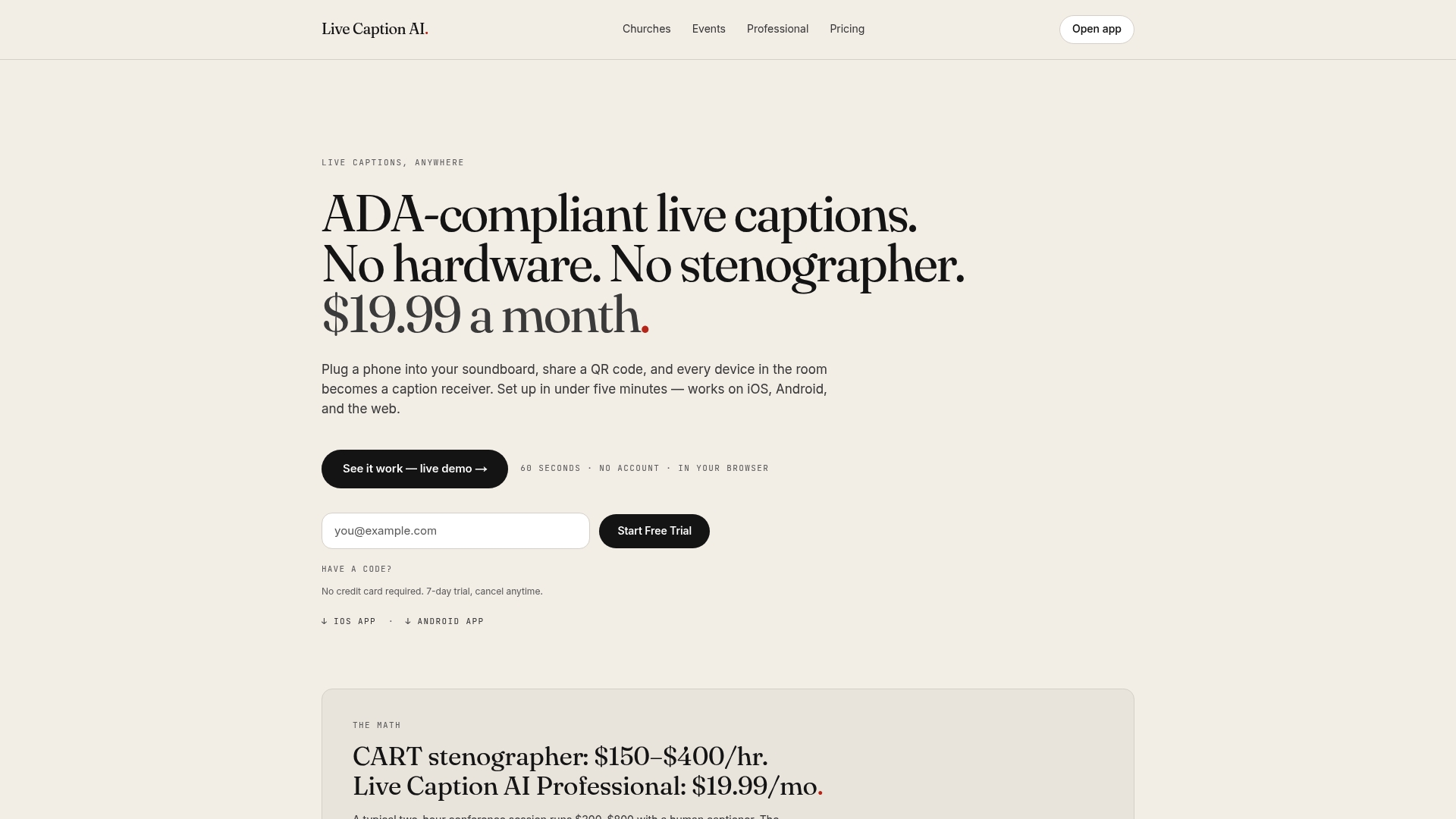
That combination maps directly onto the checks this guide walks through: a compliant path for ADA obligations, a privacy-first approach for clinical settings, and vocabulary models tuned to the fields that generic tools miss most.
| Capability | Detail |
|---|---|
| Delivery method | QR code to any phone, unlimited devices |
| Vocabulary models | Medical, Worship, Finance, plus Custom Terms |
| Translation | Multiple languages supported per session |
| Audio storage | Session audio not stored |
| Professional plan | $19.99 per month |
| Business plan | From $199 per month |
Check the pricing page for plan and credit pack details, or visit the professional plan page to see options built for medical, legal, and professional deployments.
Sources
This article is general information, not a substitute for advice from a qualified doctor. Consult a qualified healthcare professional about your own circumstances before acting on anything here.
FAQ
Are phone-based live captions ADA compliant?
Phone-based captions can satisfy ADA requirements when they meet the standard for effective communication, which includes accuracy, timeliness, and no cost to the attendee. The ADA’s own guidance recognizes real-time captioning as appropriate for complex or lengthy communication, though the specific technology chosen still needs to fit the situation.
Do captioning tools need a HIPAA Business Associate Agreement?
If the captioning tool processes protected health information for a covered entity, yes, a Business Associate Agreement is generally required. HHS guidance on cloud computing confirms that any vendor handling ePHI needs a completed risk analysis and a BAA where appropriate.
How much latency should I expect from live captions?
Latency varies with network conditions and audio routing, but a direct mixer or mic feed keeps captions close to real time in most deployments. Ambient room mics or indirect audio sources tend to add noticeable delay and reduce accuracy at the same time.
How does Live Caption AI handle session privacy?
Live Caption AI does not store session audio, and it supports Medical, Worship, and Finance vocabulary models along with Custom Terms for specialized language. Pricing runs from a free tier up through paid plans, with the Professional plan at $19.99 per month and the Business plan starting from $199 per month.
When should I use human captioners instead of automated ones?
Automated captions work well for routine lectures, services, and training sessions where scale and cost matter most. Legal proceedings, mental health consultations, and other high-stakes interactions generally still call for a qualified interpreter or CART stenographer instead.