September 28, 2026 · 14 min read
Attorneys: Legal Speech Recognition Without Stored Audio or Hardware
Guide for attorneys to adopt legal speech recognition safely: consent first vendor questions, steps, and QR captions that store no audio.

Legal speech recognition can cut drafting time and improve transcription accuracy, but only when firms vet vendors for legal vocabulary and clear data policies. Used well, it speeds up dictation, client meeting notes, and billing entries. Used carelessly, it creates confidentiality gaps. The right approach pairs a domain-adapted tool, like Dragon Professional or a phone-based option like Live Caption AI, with consent practices and human review.
TL;DR:
- Legal speech recognition improves accuracy when using domain-adapted models and custom vocabulary lists that include case-specific terms and names.
- Protect confidentiality by ensuring recordings are stored according to strict policies, and obtain written client consent before using automated transcription tools.
- Local processing offers data privacy for sensitive matters, but cloud-based services provide higher accuracy and additional features like translation and meeting summaries.
- Review vendor contracts for data handling, deletion protocols, and training practices, as hesitations in these areas signal potential security and privacy concerns.
- Most firms should implement a combination of tools: advanced dictation software for drafting and live captioning for accessibility, with ongoing glossary updates for improved accuracy.
Table of Contents
- What legal speech recognition does for law firms
- How accuracy and domain adaptation affect legal transcripts
- Security, privacy, and ethics for attorney-client recordings
- Local processing versus cloud-based speech recognition
- Turning transcripts into billable, filed work product
- Checklist for choosing a legal speech recognition vendor
- How Live Caption AI fits legal team needs
- Comparing popular legal speech recognition tools
- Training and customizing speech models for your firm
- Regulatory compliance considerations for legal speech tools
- Where legal speech recognition technology is headed
- What responsible adoption looks like in practice
- A practical next step for legal teams
- Sources
- FAQ
What legal speech recognition does for law firms
Legal speech recognition covers four main tools: live dictation for drafting, file-based transcription for recordings, live captioning for meetings and hearings, and AI notetakers that summarize conversations automatically.

Firms use these for drafting memos and pleadings, transcribing client meetings, capturing depositions and hearings, and logging billing notes right after a call. Solo attorneys and small firms often see the biggest relative time savings since they lack in-house transcription staff. Litigation teams benefit from fast turnaround on witness statements, and support staff use dictation to keep case files current without falling behind on data entry.
None of this replaces judgment. Speech recognition drafts get reviewed, formatted, and checked against the actual recording before they become a work product. Treat the output as a strong first draft, not a filed document.
How accuracy and domain adaptation affect legal transcripts
Generic speech recognition struggles with citations, party names, and Latin phrases, as explained in the AI Content Optimization Guide for Legal Marketers. Domain-adapted models and custom term lists reduce error rates on legal vocabulary compared to general-purpose tools, since the underlying model has seen enough similar language to recognize it reliably, according to a technical review of domain adaptation methods.
Audio quality matters just as much as the model. A noisy conference room, overlapping speakers, or a lawyer dictating while driving all degrade output quality, and multi-speaker recordings need speaker separation to stay usable, a point echoed in guidance from the Oklahoma Bar Association.
Concrete steps that help:
- Build a custom vocabulary list of frequently used case names, statutes, and firm-specific shorthand.
- Train a voice profile for each regular dictator rather than relying on a shared generic profile.
- Use speaker separation or labeling for depositions and multi-party calls.
- Require a human proofreader on anything headed for filing or client delivery.
Pro Tip: Keep a shared glossary of firm-specific terms, client names, and recurring case references, and upload it to your speech tool every time you onboard a new matter.
Security, privacy, and ethics for attorney-client recordings
Recording a client conversation without disclosure raises consent problems before it raises accuracy problems. Bar guidance increasingly treats AI notetakers and automated transcription the same way it treats any other recording: the client needs to know, and often needs to agree in writing, according to a recent analysis of AI notetaker ethics. New York City and other jurisdictions have started requiring disclosure and written consent for these tools, and similar rules are likely to spread.
Before adopting any tool, work through this checklist:
- Confirm whether the vendor trains its own models on your audio data.
- Verify where recordings and transcripts are stored, and for how long.
- Get a written deletion policy and a non-training clause in the contract.
- Ask what remedies apply if the vendor has a data breach.
- Check whether your state treats voice recordings as biometric data subject to separate statutes.
A few habits keep firms conservative:
- Add consent language to engagement letters before you record anything.
- Confirm audit rights in the vendor contract when possible.
- Watch bar association resources for updates on biometric privacy rules that could apply to voice data.
Local processing versus cloud-based speech recognition
Local, on-device processing keeps audio off third-party servers entirely, which appeals to firms handling sensitive matters, according to reporting on dictation tools for law firms. The trade-off is that local models often lag cloud services on advanced features like automatic summarization or translation.
Cloud-based tools tend to deliver higher accuracy and improve continuously, plus they add features like live translation and meeting summaries. The catch is that firms need to read the vendor’s data policy closely rather than assume confidentiality.
Some firms split the difference:
- Use local processing for privileged client conversations and sensitive depositions.
- Use cloud tools for internal drafting, memos, and non-privileged correspondence.
- Reserve hybrid setups for firms with dedicated IT support to manage both environments.
The IT overhead scales with complexity: a single cloud subscription is simpler to manage than a mixed local-and-cloud environment, but it puts more trust in a vendor’s stated security practices.
Turning transcripts into billable, filed work product
A transcript sitting in a folder does nothing for a case file. The value comes from getting it into the matter record correctly.
- Dictate the note or draft, then do a quick self-review for obvious errors.
- Attach the reviewed transcript to the matter in your case management system.
- Log billable time tied to that specific task, not a general catch-all entry.
- Redact privileged or sensitive content before the document leaves your system.
- Keep version history so the final filed document can be traced back to the original dictation.
Most tools integrate with Word, common practice management systems, and time-entry platforms, which is where the workflow above becomes routine rather than an extra step. On the hardware side, a decent USB or lavalier microphone beats a laptop’s built-in mic every time recognition accuracy matters, especially in a room with any background noise.
Checklist for choosing a legal speech recognition vendor
Buying decisions come down to a short list of non-negotiables and a longer list of nice-to-haves.
Core criteria worth insisting on:
- Support for legal-specific vocabulary and the ability to add custom terms.
- A written data policy covering storage location, retention period, and deletion.
- Contract language confirming the vendor does not train its models on your audio.
- Integration with the practice management and document systems you already use.
Operational fit matters just as much:
- Admin controls for user provisioning and access.
- Audit logs you can produce if a client or bar complaint requires one.
- A clear service level agreement and responsive support.
Cost varies by licensing model. Some vendors charge per seat monthly, others price by usage or minutes transcribed, so map the pricing structure against how many attorneys will actually dictate regularly before committing to a tier.
Pro Tip: Ask every vendor the same three questions: do you train on my audio, where is it stored, and how fast can you delete it on request? A vendor that hesitates on any of the three is a red flag.
How Live Caption AI fits legal team needs
Live Caption AI turns any phone into a caption receiver through a QR code, no hardware, no stenographer. It offers Medical, Worship, and Finance vocabulary models plus your own Custom Terms, translation into one of 29 languages per session, and session audio is never stored.
For legal teams, that setup fits specific moments rather than full case transcription:
- Live captioning for client meetings where a participant needs real-time text.
- Remote hearing or CLE accessibility, where attendees join from different locations.
- Multilingual client intake, where translation into another language during the session matters more than a permanent recording.
The practical draw is straightforward: no hardware to buy, session access through a QR code, and no stored audio to manage after the fact.
Comparing popular legal speech recognition tools
The market splits into a few clear categories rather than one universal winner.
Dedicated legal dictation software, like Dragon Professional, focuses on drafting accuracy and custom vocabulary support, with admin controls built for firm deployment rather than individual consumer use. These tools tend to integrate directly with Word and common practice management systems, which is their main advantage over general consumer apps.
General AI notetakers aimed at meetings capture and summarize conversations automatically, which works well for client intake calls but raises the consent questions covered earlier in this guide. Firms adopting these tools need contract language addressing training and retention before rollout, not after.
Phone-based live captioning tools, such as Live Caption AI, solve a narrower problem: getting real-time text to a room or a remote participant without installing anything or renting equipment. They are not built to replace full dictation software for drafting long documents, but they cover accessibility and live-meeting scenarios that dictation tools do not touch.
Platform-level dictation built into phones and operating systems is usable for a quick voice memo, but it lacks the management controls, vocabulary customization, and retention policies a firm needs for anything client-facing, a limitation noted in coverage of law firm dictation tools.
The right choice depends on the task: dictation software for drafting, notetakers for meeting summaries, and live captioning tools for real-time accessibility.
Training and customizing speech models for your firm
Out-of-the-box accuracy improves quickly once a firm invests a little time in customization. Most legal speech recognition tools let you upload a custom vocabulary list covering case names, client names, and recurring legal terms specific to your practice area.
Voice profile training matters for dictation-heavy tools. A profile built from an individual attorney’s speech patterns over a handful of sessions performs noticeably better than a generic model, particularly for attorneys with strong regional accents or fast speaking patterns.
Some platforms allow firm-wide customization, meaning every user shares a common glossary of firm terminology rather than building individual lists from scratch. This matters most for firms in specialized practice areas: patent litigation, immigration, or bankruptcy each carry their own dense vocabulary that a generic legal model will not fully cover on day one.
Customization is not a one-time setup. As matters evolve and new terms come up, the glossary needs updates, and periodic review of transcription errors helps identify what to add next.
Regulatory compliance considerations for legal speech tools
Compliance obligations depend heavily on what kind of data the recording touches and who is involved. Attorney-client communications carry confidentiality duties regardless of jurisdiction, and bar guidance increasingly requires disclosure and written consent before recording those conversations, as detailed in the analysis of AI notetaker ethics.
If a firm serves clients in the European Union, GDPR principles around data minimization and deletion rights apply to any voice data collected during a matter.
State-level biometric privacy statutes add another layer. Some states treat voiceprints as biometric identifiers subject to separate consent and retention rules, which means a firm operating across state lines should check local statutes before assuming a national policy covers every jurisdiction, guidance echoed by state bar resources.
None of this requires avoiding speech recognition. It requires reading the vendor contract closely, confirming deletion timelines, and keeping consent language current in engagement letters.
Where legal speech recognition technology is headed
Accuracy on legal vocabulary keeps improving as domain-adapted models get better training data specific to legal language, a trend already visible in technical research on domain adaptation. Expect fewer errors on citations and case names over the next few years as more legal-specific training data becomes available to vendors.
Real-time analysis is expanding beyond simple transcription. Tools increasingly flag key moments in a recording, summarize long meetings automatically, and tag content by topic as the conversation happens rather than after the fact.
Regulatory attention is accelerating too. Disclosure and consent rules for AI recording tools are spreading beyond early-adopter jurisdictions, and firms should expect more bars to issue formal guidance rather than leaving the question to informal practice.
Translation is also becoming a standard feature rather than a premium add-on, which matters for firms handling multilingual clients or remote hearings with international participants.
What responsible adoption looks like in practice
Start with a small pilot: one practice group, clear consent language, and a review step before anything gets filed. Watch state biometric and privacy law developments closely, since bar guidance is still catching up to the technology.
— Ryan
A practical next step for legal teams
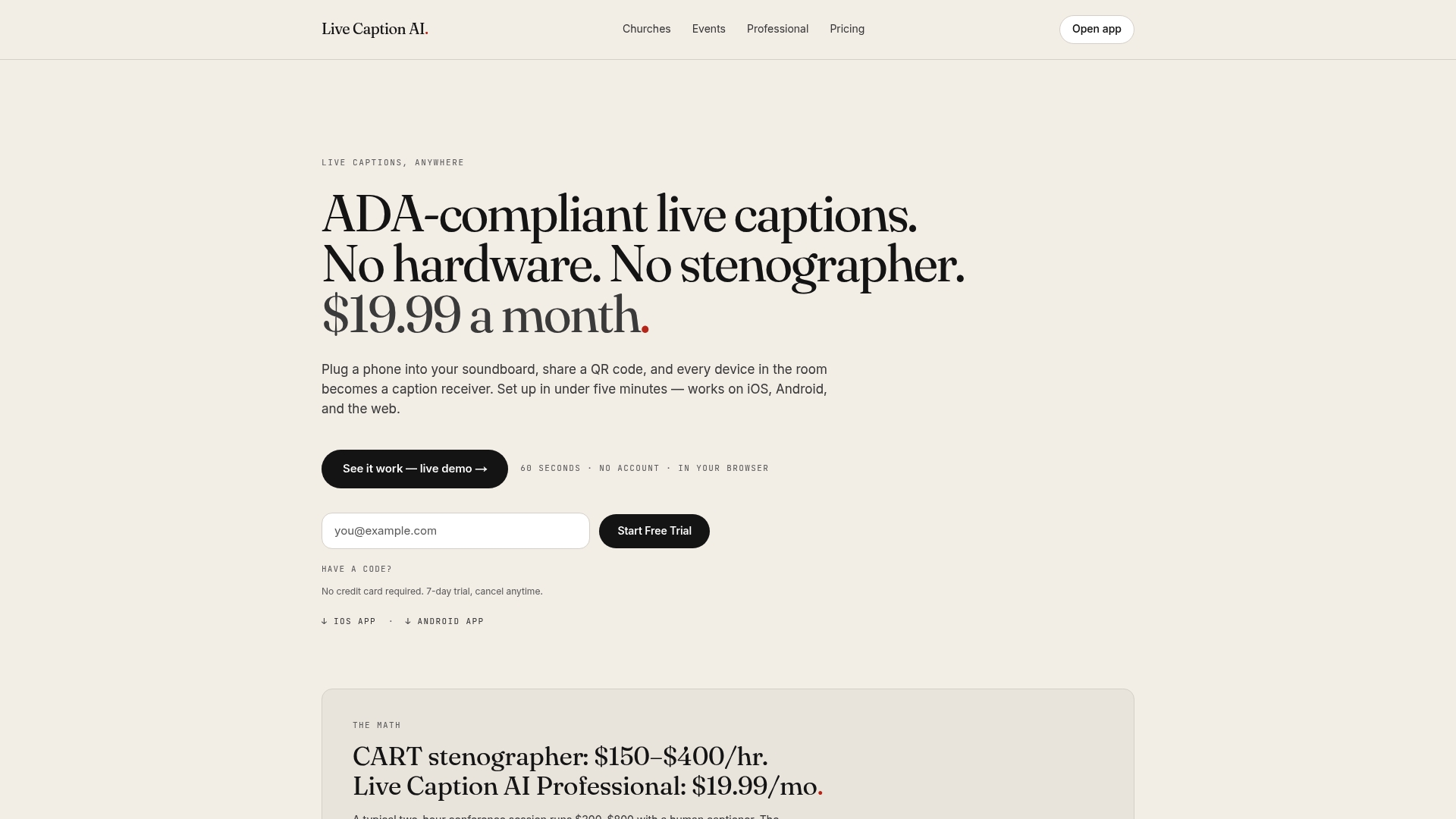
Client meetings, remote hearings, and CLE sessions all create moments where someone in the room needs real-time text, and buying a stenographer or hardware kit for every one of those moments gets expensive fast. Live Caption AI turns any phone into a caption receiver through a QR code, no hardware, no stenographer, with Medical, Worship, and Finance vocabulary models plus your own Custom Terms, translation into one of 29 languages per session, and session audio that is never stored.
Before rolling it out for client-facing work, confirm consent language in your engagement letters and review the pricing and plan details to match the right tier to your caseload. Firms managing frequent multilingual meetings often start with the Professional plan and scale up as needed.
Sources
For implementation details, see Dragon Professional’s support documentation and the Oklahoma Bar Association’s dictation overview. For data security practices, review Live Caption AI’s posts on transcription and data security and secure transcription workflows.
- The One With the Ethics of AI Notetakers for Attorney-Client Conversations | My Shingle
- Speech-to-text dictation: A 21st-century twist to a traditional law firm tool | ABA Journal
- Overview of Dictation and Transcription Options for Lawyers | Oklahoma Bar Association
- Dragon Professional support (example vendor documentation) | Microsoft Support
FAQ
What dictation software is best for attorneys?
The best choice depends on the task: Dragon Professional is a common pick for drafting-heavy dictation with legal vocabulary support, while phone-based tools like Live Caption AI suit live captioning for meetings and hearings. Firms often use more than one tool depending on the workflow.
What is a legal dictation?
Legal dictation is the practice of speaking a document, memo, or note aloud so speech recognition software converts it into text, which an attorney or staff member then reviews and edits. It has replaced older dictaphone workflows in most modern firms, according to reporting on law firm dictation tools.
What is the best speech recognition for legal work?
There is no single best tool. Domain-adapted software with custom vocabulary support tends to outperform generic consumer dictation on legal terms, citations, and case names, so firms should test a tool against their own recurring vocabulary before committing.
How do I allow speech recognition on a shared or client device?
Enabling speech recognition usually means granting microphone permissions in the device or app settings, then confirming the software has access to any custom vocabulary list you plan to use. For client-facing tools like live captioning, session access is typically granted through a QR code rather than an app installation, which avoids permission issues on devices you do not control.