July 17, 2026 · 10 min read
HIPAA Compliant Transcription: Best Providers in 2026
Secure options ensure your sensitive data remains protected.

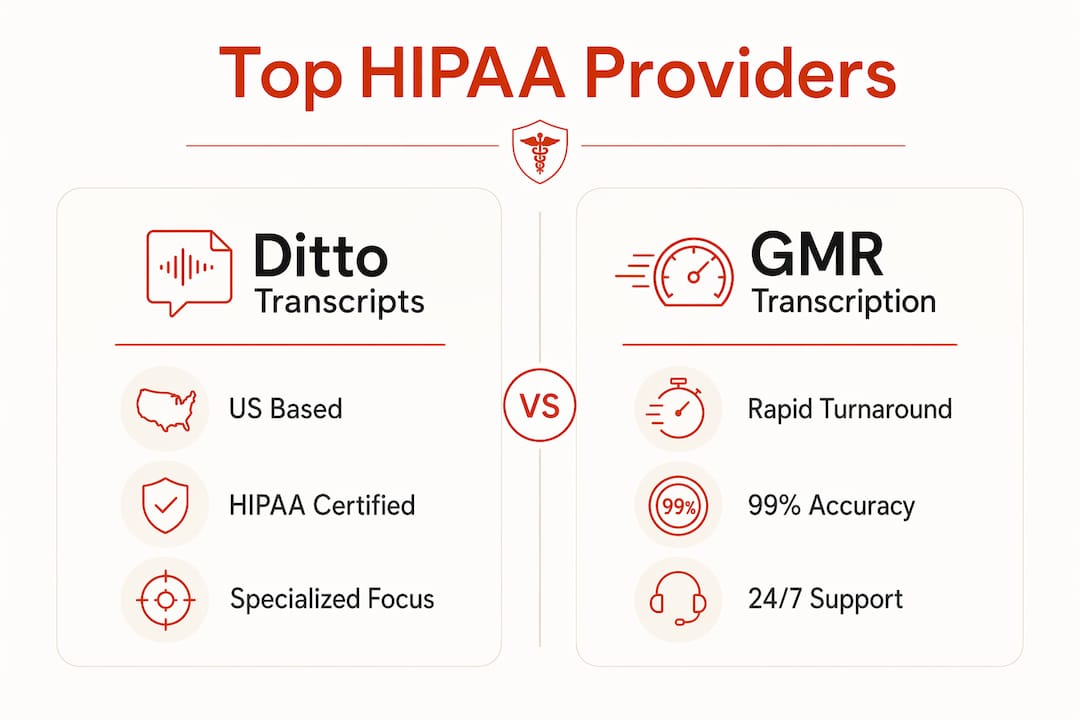
The strongest HIPAA-compliant transcription options for US healthcare professionals right now are Ditto Transcripts, GMR Transcription Services, 360 Transcription, and Transcription ETC. The table below maps all eight featured providers across the dimensions that matter most for healthcare settings.
| Provider | Type | Turnaround | Accuracy | HIPAA Features | Specializations | Best For | Rating |
|---|---|---|---|---|---|---|---|
| Ditto Transcripts | Human | Standard | High | BAA, encryption | Medical, legal | Healthcare orgs needing local, secure service | 4.9★ (232) |
| GMR Transcription Services, Inc. | Human | Same/next day | 99% guaranteed | BAA, encryption | Legal, medical, academic | Certified, specialized medical/legal work | 4.9★ (58) |
| Transcript Divas Transcription Services | Human | Standard | High | BAA | Healthcare, general | Expert transcription support | 4.9★ (37) |
| 1-888-TYPE-IT-UP | Human | Standard | High | BAA | Business, healthcare | Flexible pricing tiers | 4.8★ (33) |
| 360 Transcription | Human | 24/7, fast | 99.5% guaranteed | Medical, medico-legal | Rapid medical turnaround | 5★ (29) | |
| Transcription ETC. | Human | Standard | High | BAA, encryption | Medical, legal, government | Group practices and hospitals | 5★ (7) |
| Transcription Hub | Human | Standard | 99% guaranteed | BAA | Healthcare, academic, enterprise | Cost-effective volume transcription | 5★ (2) |
| Transcription USA | Human | Fast | High | Medical, legal, academic | Reliable long-term healthcare partner | — |
How do these HIPAA-compliant transcription providers compare?
All eight providers use 100% human transcription, which matters for PHI security. Automated bots that join sessions as third-party participants introduce consent and data handling liabilities that human-only workflows avoid entirely.
GMR Transcription Services stands out for its same-day and next-day delivery, a 99% accuracy guarantee, and its women and minority-owned business certification. It has served legal and medical clients since 2004, with custom formatting, speaker identification, and notarization available.

360 Transcription is the strongest pick for medical and medico-legal speed. IME and EMR transcription are core specialties.
Transcription ETC. custom-designs workflows for group practices, hospitals, and government clients.

Transcription Hub publishes concrete pricing: $0.75 per minute for audio and video transcription, and $0.71 per minute for academic work, with a 10% discount on first orders. For healthcare and enterprise clients watching per-unit costs, that transparency is useful.
It suits healthcare organizations that want a localized service with a dedicated compliance posture.
1-888-TYPE-IT-UP offers three price tiers covering verbatim, edited, and summarized formats, plus closed captioning and translation. It works well for healthcare clients who need format flexibility.
Transcript Divas covers healthcare and general professional transcription with experienced transcriptionists. It suits professionals who need quality-focused support without a specialized medical workflow.
Start with the BAA. No BAA means no legal basis for sharing PHI with that vendor. Full stop.
Beyond that, ask every candidate these questions before signing:
-
Does your BAA explicitly prohibit using patient data to train AI models? Vendors must contractually ban this, or you face a HIPAA privacy violation.
-
What encryption standards apply in transit and at rest?
-
Who has access to transcribed files, and how is that access logged?
-
How do you handle a data breach, and what is your notification timeline?
-
Are your transcriptionists US-based, and do they sign confidentiality agreements?
Red flags to watch for: vague compliance language like “we take security seriously” with no specifics, no published audit trail process, and refusal to sign a BAA before you commit.
Pro Tip: Integrate your transcription workflow directly within your EHR system’s secure perimeter wherever possible. Transcribed text becomes PHI the moment it links to a patient record, so keeping the data path inside your existing authorized environment reduces breach risk significantly.
Pricing transparency matters too. Providers like 360 Transcription and Transcription Hub publish per-unit rates. Others offer custom quotes. Either model is fine, but you should know exactly what you are paying before PHI changes hands.
What does HIPAA compliance actually require in transcription?
It is an ongoing operational state that covers the entire data path from recording to stored transcript.
The core technical requirements under 45 CFR 164.312 include:
-
BAA: Required whenever a third party handles PHI on your behalf. Without it, the arrangement is a HIPAA violation regardless of how secure the vendor claims to be.
-
Encryption in transit: TLS 1.3 is the current standard for protecting data moving between systems.
-
Encryption at rest: AES-256 protects stored files from unauthorized access.
-
Access controls: Only authorized personnel should reach PHI, enforced through role-based permissions.
-
Audit logs: Every access, download, and action must be timestamped and tied to a user identity.
A common misconception is that anonymizing a transcript removes the HIPAA obligation. It does not. Once transcribed text links to a patient record inside an EHR, it is PHI and the full security rule applies.
Specialized compliance needs you may not have considered
Behavioral health is different.
Substance use disorder records fall under 42 CFR Part 2, which imposes stricter protections than HIPAA alone. If your practice documents substance use disorder treatment, you need a transcription service with bespoke 42 CFR Part 2 workflows, not just a standard BAA.
Trauma-aware transcription is another emerging requirement. Behavioral health transcription increasingly demands specialized professional services that handle sensitive session content with appropriate clinical discretion, something a general transcription platform cannot replicate.
Additional best practices worth building into your vendor evaluation:
-
Confirm the vendor’s AI model training policy in writing, not just in marketing copy.
-
Require self-hosted or on-device processing options for the most sensitive session types.
-
Verify that transcription integrates within your EHR’s authorized perimeter rather than routing through a separate cloud.
-
Request documentation of the vendor’s internal security audits and breach response procedures.
What does onboarding with a HIPAA-compliant provider look like?
The process is more structured than standard transcription onboarding, and that structure protects you.
Expect to execute the BAA before any files are shared. Most providers then walk you through their secure file transfer portal, set up user accounts with role-based access, and configure any custom formatting or specialty vocabulary your practice needs. 360 Transcription includes free training and unlimited support in its all-inclusive pricing, which shortens the ramp-up time for new clinical staff.
For EHR integration, the onboarding process should include a technical review of how transcribed output flows into your records system. That handoff point is where data fragmentation risk is highest, so confirm the workflow in writing before go-live.
What should your service-level agreement cover?
It should specify accuracy guarantees, breach notification windows (HIPAA requires notification within 60 days of discovery), data retention and deletion policies, and the process for handling disputed transcripts.
GMR Transcription Services guarantees 99% accuracy in its SLA terms. 360 Transcription commits to 99.5%. Both are meaningful benchmarks for clinical documentation where errors carry real patient safety implications. Confirm that your SLA also addresses what happens if the vendor experiences a security incident, including your right to audit their response.
How do healthcare professionals assess transcription vendor reputation?
Verified Google reviews from healthcare clients are a useful starting signal, but they tell you more about service experience than compliance depth. Ditto Transcripts, GMR Transcription Services, and Transcript Divas all carry strong ratings from verified US healthcare clients.
The more reliable indicators are certifications, years of operation in healthcare-specific transcription, and whether the vendor can produce documentation of their compliance posture on request. GMR’s women and minority-owned business certification and its track record since 2004 are the kind of verifiable credentials that carry weight alongside client feedback. Ask for references from healthcare clients in your specialty before committing.
Live Caption AI offers a different approach to real-time clinical capture
Traditional transcription services handle recorded audio after the fact. If you need live, real-time captioning during patient consultations, telehealth sessions, or clinical team meetings, Live Caption AI takes a different route entirely.
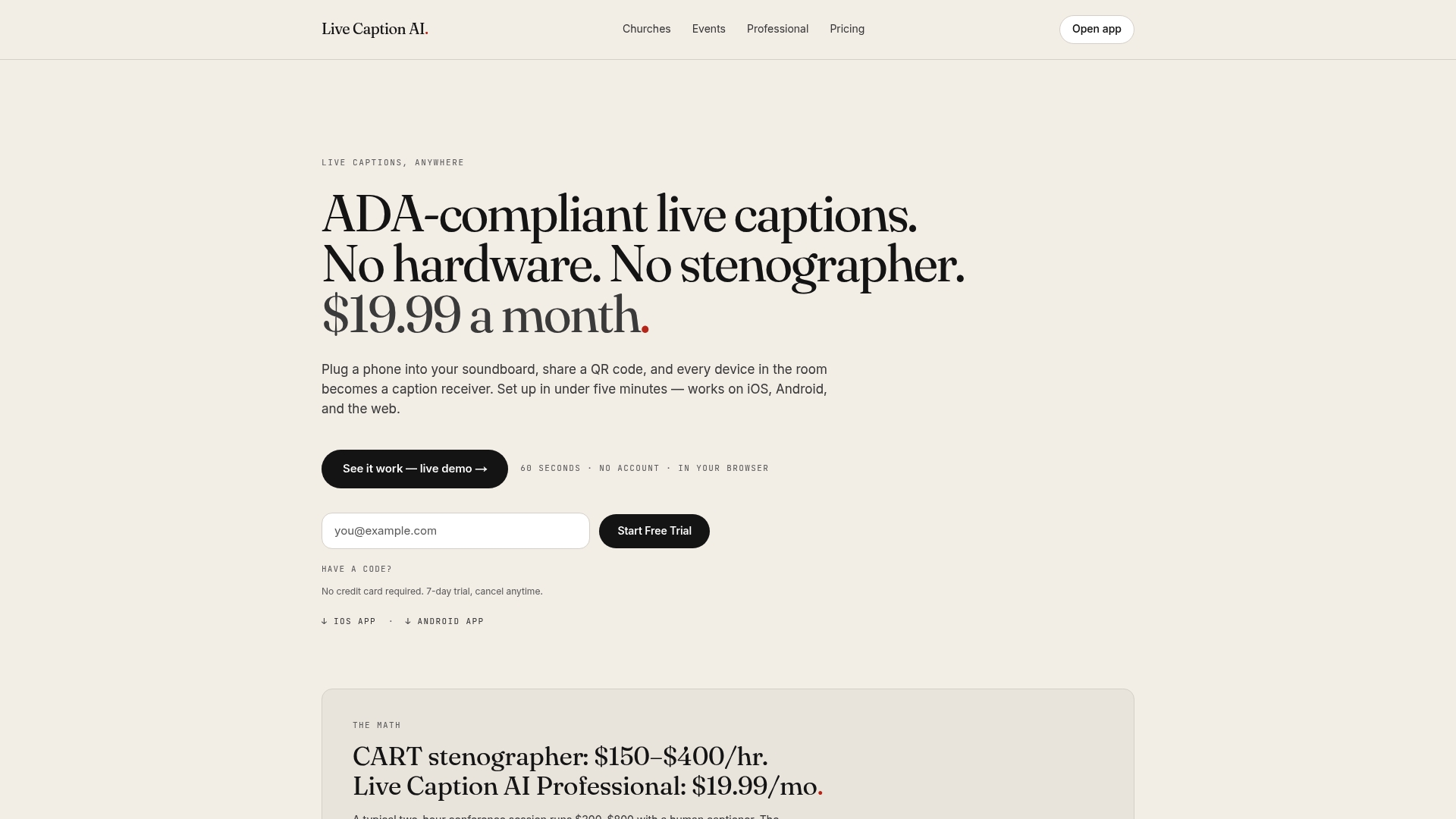
No hardware. No stenographer. Live Caption AI turns any phone into a caption receiver via a simple QR code, with domain-specific accuracy that captures medical terminology generic speech-to-text tools miss. Live Caption AI is a live captioning tool, not a HIPAA transcription vendor; it does not sign BAAs and should not be used to capture PHI; it fits clinical education settings (grand rounds, CME, staff training, patient-facing accessibility) where no PHI is involved. Exportable transcripts mean you get a record you can actually use. Plans start at $19.99 a month, a fraction of what traditional transcription or stenography costs per session. If real-time accessibility and live documentation are part of your workflow, it is worth a look alongside the post-session services above.
Key Takeaways
| Point | Details |
|---|---|
| BAA is mandatory | No BAA means no legal basis for sharing PHI; verify it before any files are transferred. |
| Encryption standards | TLS 1.3 in transit and AES-256 at rest are the current technical safeguards required under 45 CFR 164.312. |
| AI training prohibition | Vendors must contractually prohibit the use of patient data to train AI models, or you risk a HIPAA privacy violation. |
| Behavioral health needs more | Substance use disorder records require 42 CFR Part 2 compliance, which exceeds standard HIPAA and needs bespoke workflows. |
| Live Caption AI for live capture | Live Caption AI is a live captioning tool, not a HIPAA transcription vendor; it does not sign BAAs and should not be used to capture PHI; it fits clinical education settings (grand rounds, CME, staff training, patient-facing accessibility) where no PHI is involved. Real-time captioning starting at $19.99/month, suited for consultations and personal use telehealth sessions. |