September 5, 2026 · 16 min read
458 FTE Shortfall in California Exposes U.S. Court Reporter Shortage
California's 458 FTE shortfall caused millions of unrecorded hearings. A U.S. roadmap: 30/90/180 pilots, workforce training, and Live Caption AI.
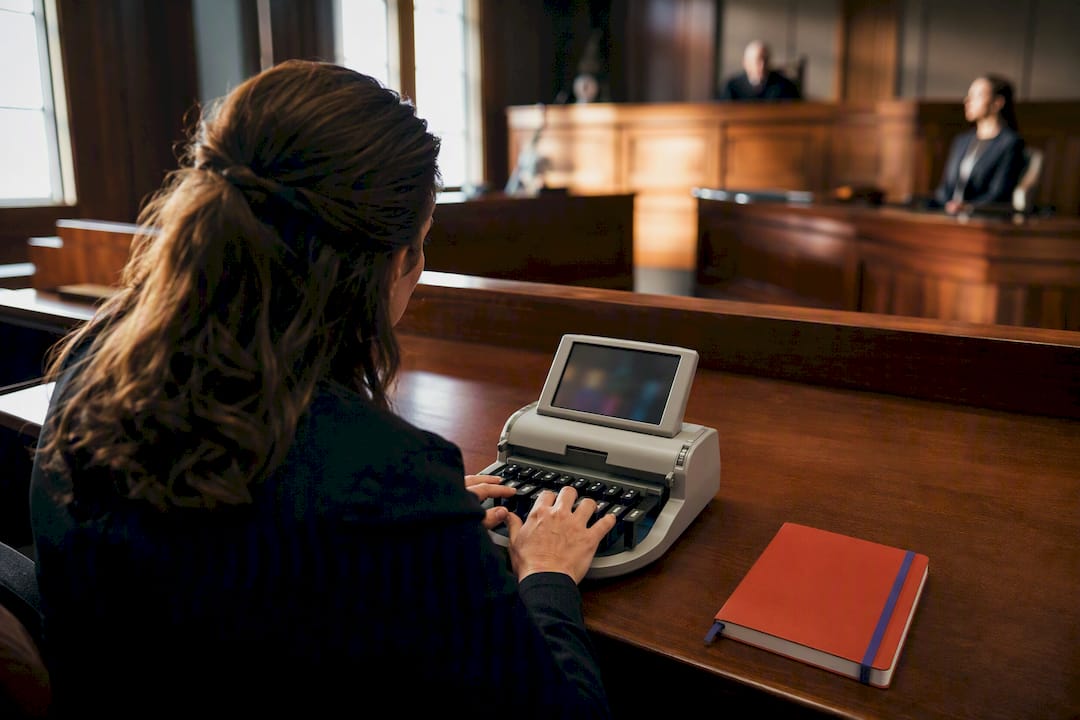
Yes, the United States has a genuine court reporter shortage, and California shows exactly how bad it can get. The Bureau of Labor Statistics counts only about 17,700 court reporters and simultaneous captioners working nationwide, with roughly 1,700 openings a year mostly from people leaving the field. California’s courts need at least 458 more full-time reporters than they have, and millions of hearings have already happened without a verbatim record. The rest of this article breaks down why it happened, what it costs courts and litigants, and what’s actually working to fix it.
TL;DR:
- California needs at least 458 more full-time court reporters to handle over 3 million hearings without a verbatim record in recent years.
- The workforce shortage stems from an aging membership, limited training programs, and higher private deposition rates pulling talent away from courts.
- Delays in training and certification mean building new reporting capacity will take at least three years, with incremental progress possible through incentives and pilots.
- Digital tools like electronic recording and AI-assisted transcription can supplement human reporters but cannot replace legally required certified transcripts.
- Implementing short-term pilots with digital captioning and public data tracking can help courts address immediate accessibility and interim documentation needs.
Table of Contents
- How Big Is the Court Reporter Shortage Right Now?
- Why Is There a Court Reporter Shortage in the First Place?
- What Happens When Courts Don’t Have Enough Reporters?
- How Long Does It Take to Train a New Court Reporter?
- What Are Courts Doing About the Reporter Shortage Today?
- Where Does Technology Fit Alongside Human Reporters?
- How Can Live Caption AI Support Courts Facing This Gap?
- What Should Courts and Policymakers Prioritize First?
- What Should a 30/90/180-Day Pilot Look Like?
- Why This Crisis Needs Recruitment, Funding, and Technology Together
- How Live Caption AI Fits Into a Responsible Court Modernization Plan
- Sources
How Big Is the Court Reporter Shortage Right Now?
The numbers tell a consistent story: too few reporters, too much demand, and a pipeline that isn’t replacing retirees fast enough. Nationally, the BLS projects about 1,700 annual openings against a workforce of 17,700, a replacement rate that leaves little room for growth in court capacity. California’s Judicial Council puts a sharper point on it.
By the numbers: California courts employ about 1,101 court reporters but need 458 additional full-time reporters to meet current caseload demand. Between April 2023 and March 2026, more than 3 million hearings in certain case types happened with no verbatim record at all.
Los Angeles County makes the abstraction concrete. The Superior Court’s own dashboard reported more than 525,000 proceedings without a verbatim record between January 2023 and June 2024, alongside persistent recruitment and retention struggles despite active hiring incentives.
Cost pressure compounds the staffing gap. Where courts do rely on private reporters to fill in, they’re paying rates that dwarf staff salaries.
- BLS: 17,700 workers nationwide, ~1,700 openings a year, mostly to replace departures rather than add capacity.
- California: 1,101 court reporters on staff, a 458 FTE shortfall, over 3 million unrecorded hearings across three years.
- Los Angeles County alone: over 525,000 proceedings without a record in an 18-month window.
- Private market rates run around $2,580 per day for depositions and $3,300 per day for trials, a cost courts and litigants increasingly absorb when staff reporters aren’t available.
That gap between a $2,580 daily private rate and a court’s fixed budget explains why so many courtrooms simply go without a reporter rather than pay the market price.
Why Is There a Court Reporter Shortage in the First Place?
This isn’t a temporary staffing dip. It’s a structural problem built from three converging trends: an aging workforce, a shrinking training pipeline, and a private market that pays better than most court jobs.
The National Court Reporters Association reports a membership skewing toward the mid-50s in average age, meaning a wave of retirements is already underway with far fewer new entrants behind it. Training program counts have contracted alongside new-license issuance, both nationally and in California specifically. Becoming a licensed court reporter typically takes two to four years of stenographic or voice-writing training followed by state certification exams, and pass rates in several states, California included, have not kept pace with demand for new licensees.
Meanwhile, the private deposition and freelance market pulls talent away from court employment entirely. A reporter who can earn deposition-day rates in the thousands has little financial incentive to take a lower, fixed court salary, especially in high-cost regions like Los Angeles or the Bay Area. Add geographic maldistribution, rural counties often can’t compete with urban firms for the reporters who remain, and budget-constrained courts that can’t offer competitive starting salaries, and the shortage becomes self-reinforcing.
- An aging workforce with a median age in the mid-50s creates a retirement cliff with no matching entry pipeline.
- Fewer stenography and voice-writing programs mean fewer graduates each year, nationally and in California.
- Multi-year training and certification timelines mean today’s recruiting decisions won’t show results for years.
- Private deposition and freelance rates routinely outpace court salaries, pulling licensed reporters away from public employment.
- Rural and lower-budget counties struggle to compete for the shrinking pool of available reporters.
Pro Tip: If you’re a court administrator building a workforce case for budget approval, pair the NCRA’s age data with your own vacancy rate. A five-year retirement projection makes a far stronger funding argument than current staffing numbers alone.
What Happens When Courts Don’t Have Enough Reporters?
Missing a verbatim record isn’t a paperwork inconvenience. It’s a direct threat to a litigant’s ability to appeal. California’s Judicial Council has been explicit that without a certified transcript, appellate courts often can’t review what actually happened at trial, which can foreclose meaningful appellate relief regardless of the merits of the underlying case.
The burden lands hardest on people who can least afford it. Self-represented litigants, who make up a large share of family law and unlawful detainer calendars, are the least equipped to arrange or pay for private reporting when the court can’t provide one. Rural communities face a parallel problem: fewer reporters willing to travel, longer waits, and less leverage to demand court-provided coverage.
Operationally, the shortage shows up everywhere:
- Hearings get delayed or rescheduled around reporter availability rather than case readiness.
- Transcript turnaround for pending appeals stretches out, sometimes past statutory deadlines.
- Courts that hire private reporters to cover gaps pay $2,580 to $3,300 per day, a cost that either falls on litigants or strains already tight court budgets.
- Some case types proceed with electronic recording or no record at all, creating appellate risk that wouldn’t exist with a certified reporter present.
The core problem: Over 3 million hearings in California happened without a verbatim record in a three-year window. Every one of those cases carries elevated appellate risk if a party later needs to challenge the outcome.
How Long Does It Take to Train a New Court Reporter?
Anyone proposing a hiring push needs to understand the timeline honestly: this workforce cannot be rebuilt quickly, no matter how much money gets allocated this year.
- Enrollment through certification (typically 2 to 4 years). Stenographic and voice-writing programs require sustained speed and accuracy training, followed by state licensing exams. California’s pass rates on certification exams have lagged the number of program graduates needed to close the gap, which means even healthy enrollment doesn’t guarantee proportional new licensees.
- Program capacity keeps shrinking. Fewer schools offer reporting programs than a decade ago, both in California and nationally, which caps how many students can even start the pipeline in a given year.
- Programmatic levers can accelerate specific cohorts. Court-funded training partnerships, scholarships tied to guaranteed court employment, and apprenticeship-style placements shorten the practical path from enrollment to a courtroom seat, though they don’t shorten the underlying skill-acquisition timeline.
- Set expectations in stages. At 12 months, expect early cohort enrollment and incentive program rollout, not workforce change. At 24 months, expect the first wave of newly certified hires trickling in. At 36-plus months, expect measurable movement in vacancy rates, assuming sustained investment the whole way through.
Courts that treat recruitment as a one-year fix will be disappointed. The realistic planning horizon is measured in multiple budget cycles, not one.
What Are Courts Doing About the Reporter Shortage Today?
Recruitment and retention incentives have become the default first move, and they’re worth understanding for what they can and can’t accomplish. Signing bonuses, retention pay, and salary increases have shown up in job postings across California courts, alongside finder’s fee programs that reward current staff for successful referrals.
Los Angeles Superior Court has gone further, running training pilots and hiring commitments aimed at building an internal pipeline rather than only competing for reporters already in the market. The court’s own dashboard, published alongside its August 2024 press release, tracks proceedings without a verbatim record as a public accountability measure, an approach other counties could reasonably copy.
- Salary increases and signing bonuses are now common in California court job postings, though adoption and amounts vary by county.
- Finder’s fee programs incentivize current staff and outside professionals to refer licensed reporters.
- Court-run training partnerships, like LA’s, aim to build a pipeline rather than only poach from competitors.
- Legislative and litigation activity in California continues around electronic recording rules, which would expand where courts can use recorded proceedings instead of a live reporter in defined case types.
Early results are instructive but modest. The Judicial Council’s own analysis suggests that incentive spending alone produces incremental gains, not enough on its own to close a 458 FTE gap. Incentives fill individual vacancies faster; they don’t expand the total supply of licensed reporters in the state.
Where Does Technology Fit Alongside Human Reporters?
Digital tools are reshaping courtroom documentation, but the terminology matters, and so do the legal limits. Electronic recording captures audio (sometimes video) of a proceeding without a live stenographer present. AI-assisted transcription converts speech to text automatically, often as a draft that still needs human review. Voice writing is a certification path where a trained reporter speaks proceedings into a masked microphone for later transcription. CART (Communication Access Realtime Translation) and live captioning display real-time text for accessibility, most often for deaf or hard-of-hearing participants rather than as the certified legal record.
California law still restricts electronic recording as a substitute for a certified reporter in many civil case types, so courts need to check current statute and local rule before assuming a recording satisfies verbatim-record requirements. That legal boundary is exactly why technology works best as a supplement, not a replacement.
Industry analysis of the shortage describes AI-assisted workflows as force multipliers: they cut mechanical transcription time and speed up draft turnaround, freeing certified reporters to focus on verification rather than typing from scratch. That’s a meaningful capacity gain, but it doesn’t eliminate the need for a licensed professional wherever a certified transcript is legally required.
- Electronic recording: captures the proceeding but often can’t substitute for a certified reporter under current California rules in many civil matters.
- AI-assisted transcription: speeds up draft generation, still needs human review for certified accuracy.
- CART and live captioning: built for real-time accessibility, not as the official legal record.
- Blended workflows: pairing a certified reporter with digital tools increases how many proceedings a limited reporter pool can cover.
Pro Tip: Before piloting any digital transcription or captioning tool in a courtroom, confirm in writing which case types still legally require a certified verbatim transcript. Skipping that check risks an appeal getting overturned on record grounds, not merits.
How Can Live Caption AI Support Courts Facing This Gap?
Accessibility and interim documentation needs don’t pause while a court waits years for new reporters to graduate. Live Caption AI offers a practical tool to improve accessibility and documentation, complementing traditional certified reporting where required.
The platform enables attendees to view real-time captions on their phones via a QR code, without the need for dedicated hardware or stenographers, supporting enhanced web accessibility and inclusion. That matters for self-represented litigants, non-English speakers, and hard-of-hearing participants who need live access to what’s being said regardless of whether a certified transcript is being produced simultaneously. The system employs accuracy enhancements for specialized terminology and offers deployment options compatible with certain privacy requirements relevant in medical settings.
| Use case | What Live Caption AI provides | What it doesn’t replace |
|---|---|---|
| Accessibility for hard-of-hearing parties | Real-time captions via phone, no hardware | ADA accommodation obligations still require appropriate access planning |
| Self-represented litigant support | Live translated captions in multiple languages | A licensed interpreter where one is legally required |
| Interim documentation during reporter shortages | A draft-level record for internal reference | A certified verbatim transcript where statute requires one |
| Cost-constrained courtrooms | Captioning at a fraction of stenographer day rates | Certified reporting for appealable proceedings |
The boundary is straightforward: use it to expand accessibility and produce interim documentation, not to certify a legal record where a licensed reporter remains statutorily required.
What Should Courts and Policymakers Prioritize First?
Fixing this shortage requires action on three different clocks at once. Trying to solve it with only one lever, incentives without pipeline investment, or technology without policy clarity, explains why progress has been slower than the crisis demands.
- Short-term (0 to 12 months): Launch supervised captioning pilots for accessibility and interim documentation, build emergency staffing pools that can float between courthouses, and expand hiring incentives with clear tracking of actual placements versus applications.
- Medium-term (1 to 3 years): Fund court-sponsored training cohorts with guaranteed-hire commitments, establish reimbursement rules so indigent litigants aren’t paying private reporter rates out of pocket, and invest in centralized scheduling systems that can backfill vacancies across county lines.
- Long-term (3-plus years): Pursue statutory changes allowing electronic recording in clearly defined, lower-stakes case types, and commit sustained funding to reporting program accreditation and workforce development so the pipeline stops shrinking. Federal workforce grant programs are one funding avenue worth pursuing alongside state budget requests.
Track progress with concrete KPIs: vacancy rate by county, proceedings without verbatim record per quarter, average transcript turnaround time, and cohort completion rates for any funded training program. Review quarterly for the first year, then annually once trend lines stabilize.
Pro Tip: Publish your vacancy and unrecorded-proceeding numbers the way LA Superior Court does. Public dashboards create political pressure that budget requests alone rarely generate.
What Should a 30/90/180-Day Pilot Look Like?
Start with data, not procurement. Before buying anything or announcing a pilot, audit current vacancy rates by department and count proceedings currently happening without a verbatim record.
- Days 1 to 30: Complete the data audit, identify the three highest-risk case types for missing records, and begin vendor evaluation for supervised captioning or interim documentation tools.
- Days 31 to 90: Procure the pilot tool, train courtroom staff and clerks on deployment, and run trial sessions in a small number of low-risk case types with defined success criteria.
- Days 91 to 180: Expand the pilot based on early results, formally evaluate against KPIs (turnaround time, staff satisfaction, litigant feedback), and brief judicial leadership and the bar association on findings before scaling further.
Loop in stakeholders early: judges, court reporters’ own representatives, legal aid organizations, and the local bar. A pilot that lands as a surprise to the reporters currently on staff invites resistance that a short internal briefing could have avoided.
Why This Crisis Needs Recruitment, Funding, and Technology Together
The evidence points to one conclusion: no single fix closes this gap. California’s own experience proves that incentive spending alone produces modest gains when the underlying pipeline still can’t produce enough new licensed reporters each year. At the same time, a shortfall of 458 full-time positions is too large to wait out with training cohorts alone, not when people’s appellate rights depend on records that don’t currently exist.
Los Angeles County’s public dashboard shows what transparency can accomplish. Publishing hard numbers on unrecorded proceedings turned an abstract staffing problem into a documented access-to-justice issue that justified further investment. That’s the model worth replicating: measure the gap publicly, then attack it from every angle at once, recruitment, funding, and responsibly deployed technology.
Courts that wait for a single solution will still be waiting in five years. The ones making progress are running pilots now while funding the pipeline for later.
— Ryan
How Live Caption AI Fits Into a Responsible Court Modernization Plan
Live Caption AI works best as the fast, affordable layer courts can deploy right now, while the multi-year fixes for the court reporter shortage work through legislatures and training programs. Compared to booking a private reporter at $2,580 to $3,300 a day, a monthly subscription starting at $19.99 gives courts a way to provide real-time captions for accessibility and interim documentation without new hardware or a stenographer on retainer.

The platform’s QR-code feature allows attendees and participants to access live captions on their phones in multiple languages. The platform includes specialized accuracy features to better capture legal terminology and supports privacy-compliant deployment for sensitive proceedings. That combination pairs well with existing real-time transcription approaches courts already use for accessibility, and with broader assistive captioning technology standards courts increasingly need to meet.
None of that replaces a certified reporter where statute requires a verbatim transcript for appeal. It does mean courts don’t have to choose between doing nothing and waiting years for the pipeline to catch up. If your court is evaluating accessibility tools or interim documentation options, visit Live Caption AI to see plan details and request a pilot demo for your courtroom.