September 15, 2026 · 13 min read
U.S. Captioning Grants: ED 84.327C and $500–$2,000 Microgrants
A U.S.-focused, application-first playbook for nonprofits seeking captioning funds: pursue ED 84.327C, tap $500–$2,000 state microgrants, and bridge gaps...

If your nonprofit needs money for captioning, start with federal grants (ED 84.327C), then check your state arts council’s accessibility microgrants, then look at private foundations and vendor programs. Apply before you buy anything. While you wait on decisions, a low-cost captioning subscription keeps your programs accessible without derailing your budget.
TL;DR:
Microgrants from state arts councils typically offer $500 to $2,000 with modest match requirements, helpful for covering a single event or season of captions.
Federal grants under ED 84.327C support large-scale projects but require early application, approval, and careful alignment with project timelines, often taking four to six months for funding.
Private foundation and vendor programs usually provide limited, fast-access credits or discounts but frame captions as part of broader accessibility initiatives rather than standalone funding.
Applying for captioning grants before purchasing services is essential, since federal and most institutional funds do not reimburse costs incurred prior to approval.
Table of Contents
-
What I’d Prioritize First If I Ran a Nonprofit’s Accessibility Budget
-
A Faster Path When Grant Timelines Don’t Match Your Calendar
What Are the Main Captioning Grant Options for Nonprofits?
Every nonprofit chasing captioning grants for nonprofits ends up choosing between five general paths. Some move fast with small dollars. Others move slow with real money. Here’s the breakdown:
-
Federal grants (ED 84.327C via Grants.gov) work best for larger K-12 partnerships or multi-organization media projects with real budgets.
-
State and regional arts or accessibility microgrants fit small arts presenters and community nonprofits that need a fast, modest award for a single event or season.
-
Private foundations and corporate sponsors support program-level accessibility work, often as part of a broader grant relationship rather than a standalone captioning line item.
-
Vendor nonprofit programs and in-kind discounts move quickly but vary widely in scope, from a few free credits to a discounted annual rate.
-
Short-term alternatives, like crowdfunding or a subscription captioning service, cover the gap while grant decisions are pending.
Most nonprofits end up combining at least two of these. A microgrant might cover one quarter’s captioning costs while a federal application works its way through review for next year’s larger project.
What Does ED 84.327C Actually Fund?
The Educational Technology, Media, and Materials for Individuals with Disabilities program, known by its Assistance Listing Number 84.327C, is the U.S. Department of Education’s primary vehicle for funding captioning, audio description, and ASL interpretation at scale. It’s not a general accessibility slush fund. Program priorities target specific outcomes: increasing the volume of high-quality captioned and audio-described media, coordinating across projects so organizations aren’t duplicating work, and encouraging responsible use of new technology, including AI-assisted captioning tools.
For FY26, the program listed Accessible Education Video Projects as a named priority area, with an application notice that spells out exactly what reviewers want to see.
Funding pool snapshot: The FY26 notice for Accessible Education Video Projects describes multi-million dollar funding pools for this priority area, a scale that supports substantial multi-year media projects rather than single-event captioning.
Eligibility isn’t limited to school districts. Nonprofit organizations can apply directly or participate as subgrantees under a lead applicant, depending on how a given competition is structured. The FY26 application notice lays out applicant eligibility categories in detail, and federal guidance under 34 CFR describes how organizations prove nonprofit status for eligibility purposes, typically through an IRS 501©(3) determination letter, a state attorney general’s statement, or a certificate of incorporation.
A few things nonprofits consistently get wrong with this program:
-
Assuming captioning has to be the entire project. It’s usually one component of a broader accessible media initiative.
-
Missing the AI guidance language in the application notice, which asks applicants to describe how any AI-assisted tools fit into a responsible, human-reviewed workflow.
-
Waiting until after a captioning vendor is booked to start the application. Federal grants almost never reimburse purchases made before an award is approved.
-
Overlooking the subgrantee pathway, which lets smaller nonprofits participate in a federal-scale project without carrying the full administrative burden of being the prime applicant.
To actually track these opportunities, set up a Grants account and search by Assistance Listing Number 84.327C. Grants.gov opportunity pages list a unique opportunity ID for each competition, along with submission deadlines and required forms. Subscribe to email alerts tied to that ALN, and you’ll get notified the moment a new competition posts instead of finding out three weeks into the application window.
One more practical note: federal timelines run long. Between notice publication, the application window, review, and award notification, you’re often looking at four to six months minimum before funds move. Plan your captioning needs accordingly, and don’t count on a federal award covering an event that’s happening next month.
Which State and Regional Microgrants Cover Captioning?
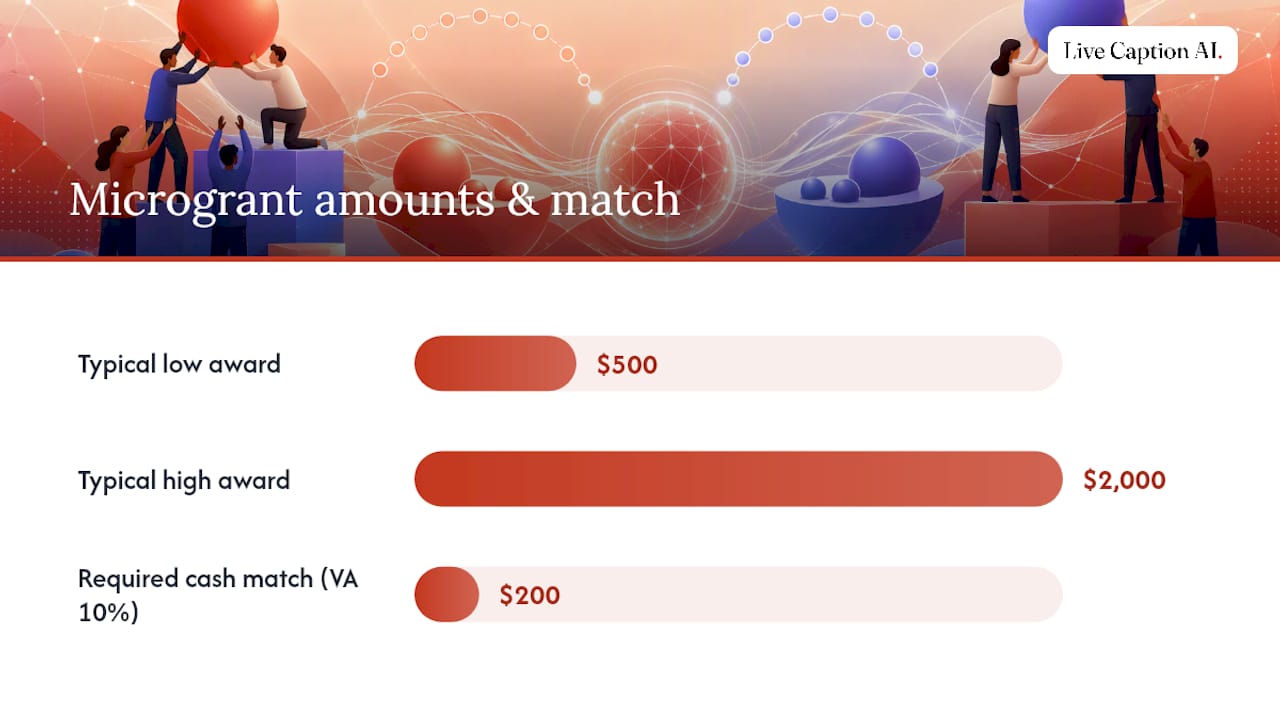
Microgrants are where most small and mid-size nonprofits actually get funded, and the typical award falls between $500 and $2,000. That’s real money for a single production or a season’s worth of live-event captions, even if it won’t touch a full-year subscription budget on its own.
Match requirements vary by program, and they matter more than the award size itself. The Virginia Commission for the Arts Accessibility Microgrant provides up to $2,000 with a required 10% cash match, meaning a nonprofit requesting the full amount needs to bring $200 of its own money to the table. Other regional programs use steeper ratios, occasionally as high as 1:10 in cost-share structures, so read the match language carefully before you build your budget around a specific number.
A few programs worth knowing by name as you research your own state or region:
-
Theatre Development Fund’s TAP Plus accessibility grants support theater and performing arts organizations adding captioning and other access services to productions.
-
Virginia Commission for the Arts Accessibility Microgrant funds accessibility projects, including captioning and speech-to-text apps, for eligible Virginia arts organizations.
-
South Arts offers regional matching grants across its member states, typically structured as dollar-for-dollar matches for accessibility measures.
Most of these microgrant programs run on rolling application cycles rather than one fixed annual deadline, which is good news and bad news. Good, because you can apply close to your event date. Bad, because funds allocated for the year can run out before the cycle officially closes. Smaller arts microgrants also tend to fund exactly the kind of relatively low-cost items nonprofits need for single events, including apps and subscription services, not just large capital equipment.
Pro Tip: Call your state arts council program officer before you write a single word of the application. Ask directly whether captioning subscriptions and apps qualify as allowable expenses under the current cycle. A five-minute phone call can save you from writing a budget that gets flagged during review.
Practical steps here are simple: identify your state arts council’s accessibility program page, read the allowable expense list closely, and prepare light documentation. Microgrants rarely require the heavy narrative and compliance paperwork federal applications demand.
How Do Private Foundations and Vendor Grants Compare?
Private funding for captioning tends to arrive as part of a broader accessibility or program grant, not as a standalone line item, which changes how you should pitch it.
Start your search with tools like Candid’s GrantSpace (formerly Foundation Center), your local community foundation’s grant portal, and the corporate social responsibility pages of businesses with a presence in your community. Regional banks, healthcare systems, and utility companies frequently run small community grant programs that fund accessibility upgrades, including captioning, as part of “community impact” or “inclusion” giving categories.
Vendor nonprofit programs, meanwhile, run on a different logic entirely. Captioning technology companies sometimes offer discounted rates, credit packs, or limited free tiers to registered 501©(3) organizations. These programs move fast, often approving requests within days rather than months, but the tradeoff is scope: expect a capped number of credits, a limited trial period, or a narrower feature set than a full paid plan.
When you reach out to either type of funder, frame captioning as audience access and measurable programmatic impact, not a technical add-on. A sentence like “captioning increased engagement among our deaf and hard-of-hearing attendees by removing a real barrier to participation” lands better than “we need money for captions.”
Watch for a few red flags before signing any vendor or sponsor agreement:
-
Vague renewal terms that auto-lock you into a higher rate after an introductory period.
-
Sponsorship agreements that require prominent logo placement in exchange for funding that barely covers the service cost.
-
Vendor programs with no clear data or privacy policy, especially relevant if you’re captioning medical or legal content.
How Do You Write a Strong Captioning Grant Application?
Reviewers consistently favor applications that tie captioning to a bigger institutional accessibility goal rather than treating it as an isolated purchase. Build your application with that framing from the first paragraph.
-
Gather your documentation first. That means your IRS 501©(3) determination letter, any required state nonprofit certification, current bylaws, and a board resolution if the funder requires formal board approval for grant applications.
-
Write the significance section around your mission, not the technology. Explain how captioning removes a specific barrier for a specific audience your organization already serves.
-
Detail your project design with measurable outcomes. Number of events captioned, audience members served, or accessibility complaints resolved all work better than vague language about “improving accessibility.”
-
Build a line-item budget scaled to the funder. A microgrant budget might list a single vendor invoice and a small stipend for staff coordination time. A federal budget needs vendor fees, staff time, training, and possibly hardware, broken out by year if it’s a multi-year project.
-
Document your match funding before you submit, not after. If a program requires a 10% cash match, show exactly where that money comes from, whether it’s a board-designated fund or a confirmed sponsor pledge.
-
Line up vendor quotes early. Most funders want at least two comparable quotes for services over a certain dollar threshold, and having them ready speeds up both the application and the award process.
Pro Tip: Build a simple procurement packet before you apply anywhere: two vendor quotes, a one-paragraph scope of work, a short accessibility impact statement, and a one-page budget justification. Reuse that packet across every grant application you submit this year.
Almost every program, from NC State’s institutional captioning fund to major federal competitions, carries the same warning: apply before you order captioning services. Retroactive purchases are rarely reimbursed, and Grants.gov guidance reinforces that federal funders generally require approval before any spending begins. A realistic timeline runs six to ten weeks from a completed application to a funding decision for state and regional programs, and considerably longer for federal awards.
What Should You Do While Grant Decisions Are Pending?
Grant timelines rarely match event calendars, so build a bridge while you wait.
-
Launch a small crowdfunding campaign or seek a one-time sponsor specifically for accessibility, framing the ask around the audience it serves rather than the technology itself.
-
Use a subscription captioning service as a predictable, lower-upfront-cost option that keeps your programs ADA-compliant right now, not months from now.
-
Combine a small microgrant award with vendor in-kind credits to stretch limited funds across more events.
What I’d Prioritize First If I Ran a Nonprofit’s Accessibility Budget
Chase microgrants first. They’re fast, the paperwork is light, and a $2,000 award can cover a full season of event captions. Apply for federal ED 84.327C funding in parallel if you’re planning a larger media project, but don’t expect that money to arrive in time for anything happening this quarter.
The mistake I see most often: nonprofits wait on a grant decision before captioning a single event, then lose months of accessibility compliance in the meantime. A subscription isn’t a consolation prize. It’s the bridge that keeps your programs compliant while the bigger funding works itself out. Document your match funding early, never buy before approval, and treat grants and subscriptions as complementary, not competing, budget lines.
— Ryan
A Faster Path When Grant Timelines Don’t Match Your Calendar
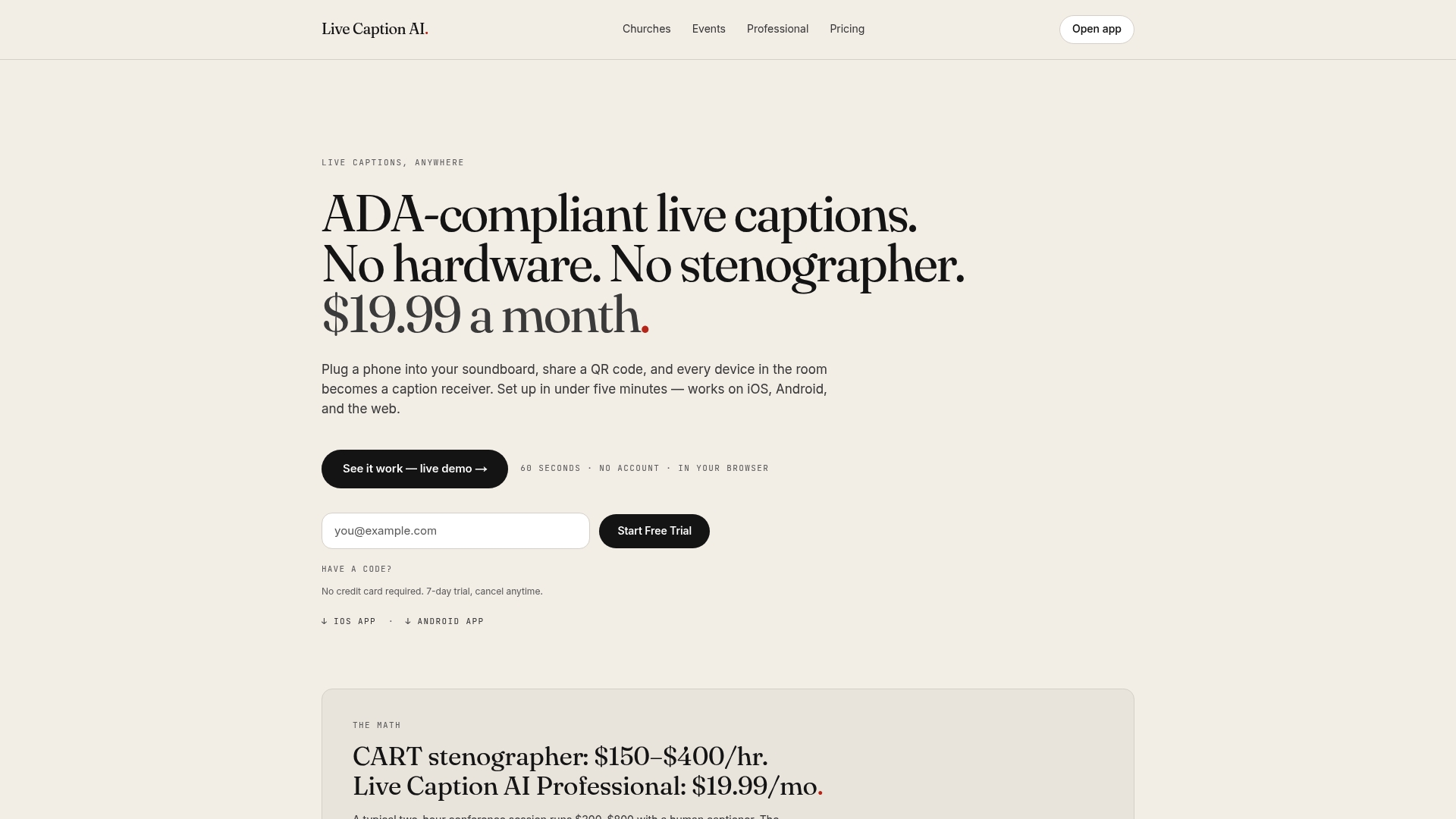
Grants take months. Your next event might be next week. Live Caption AI offers live captioning without the hardware costs or stenographer fees…, at $19.99 a month. Visit their pricing page for current details.
Before you commit to any short-term captioning option, whether it’s a vendor discount or a full subscription, run through the same checklist grant reviewers use: transparent pricing, no audio retention, unlimited viewers through a QR code, and exports you can reuse. Their domain-trained models catch specialized terminology that generic speech-to-text tools miss, which matters if programming covers clinical, legal, or technical content. Pair that kind of accessibility investment with a broader digital accessibility strategy and your captioning spend works harder across your whole organization.
Check the pricing page to compare plans, and start a trial for your next event while your grant applications are still working their way through review.
Sources
FAQ
What Is the Best First Step for Captioning Grants Nonprofits Should Take?
Check your state arts council’s accessibility microgrant program first, since awards are smaller but decisions come faster than federal grants.
How Much Do Captioning Microgrants Typically Award?
Most state and regional accessibility microgrants award between $500 and $2,000, often with a cash match requirement such as the 10% match required by Virginia’s program.
Can Nonprofits Apply for ED 84.327C Directly?
Yes, nonprofit organizations can apply directly or participate as subgrantees, depending on how a specific ED 84.327C competition is structured, according to the FY26 application notice.
Can Nonprofits Buy Captioning Before a Grant Is Approved?
Generally no. Most federal and institutional captioning funds, including NC State’s program, warn that purchases made before approval are rarely reimbursed.
What Does Live Caption AI Cost for Nonprofits Waiting on Grant Funding?
Live Caption AI’s Professional plan runs $19.99 per month, with a free tier and a Business plan starting at $199 per month for larger organizations; full details are on the pricing page.