July 28, 2026 · 13 min read
Accessibility Grants for Churches: Where to Apply and Win
Discover key accessibility grants for churches, including top funders and vital steps to secure funding for your congregation's needs.

TL;DR:
- Churches can access accessibility grants from denominational foundations, national funds, and local government programs. Successful applications emphasize strategic planning, including assessments, matching funds, and aligning projects with mission goals. Listing affordable assistive technologies like Live Caption AI enhances funding chances for communication accessibility.
The best places to find accessibility grants for churches are denominational foundations like DK-MN Foundations, national capital programs like the National Fund for Sacred Places, federal community development funds through HUD’s Community Development Block Grant (CDBG) program, and state or local historic preservation grants. The National Fund for Sacred Places offers capital grants that range from $50,000 to $500,000, with matching requirements; DK-MN Foundations provide smaller rolling grants up to $2,500 for Minnesota and $2,000 for the Dakotas. Your single best next step: commission an independent building condition assessment and contact your preferred funder’s grants manager before you write one word of the application.
Top funding channels at a glance:
-
National Fund for Sacred Places — capital grants for historic congregations: $50,000–$500,000, with matching requirements
-
DK-MN Foundations — rolling small grants up to $2,500 (Minnesota) and $2,000 (Dakotas) for eligible churches
-
HUD CDBG — federal block grants distributed by local municipalities, often available to faith-based facilities serving the public
-
State historic/heritage grants — vary by state; check your State Historic Preservation Office
-
Assistive technology — items like live captioning (e.g., Live Caption AI) qualify as eligible expenses under many programs
Quick reference: National Fund for Sacred Places handles large capital grants between $50,000 and $500,000. HUD CDBG covers community-serving facility work. Live Caption AI fits as an assistive-technology line item in almost any accessibility budget.
Table of Contents
-
Denominational and faith-aligned sources that fund accessibility
-
How do you strengthen a church accessibility grant application?
-
Live Caption AI: an affordable captioning line for your grant budget
Where do churches find accessibility funding?
Funding channels fall into roughly five buckets, and the right one depends on your project size and your building’s historic status.
Denominational and faith-based foundations are often the fastest entry point. They know your governance structure, accept rolling applications, and fund smaller scopes that national programs won’t touch.
National sacred-places capital funds like the National Fund for Sacred Places target historic congregations with larger capital needs. Awards run from $50,000 to $500,000, with a multi-step selection process (Letter of Intent, invited application, then capital grant submission). These are competitive and take 12–18 months to navigate.
HUD CDBG money flows through city and county governments. Municipalities can sub-grant to faith-based organizations for facility work that serves a broad public benefit. Call your local community development office first to ask whether they fund faith-based facility projects in the current program year.
State historic/heritage grants are worth checking if your building is listed on or eligible for the National Register of Historic Places. Many states run small capital programs specifically for preservation-related accessibility work.
Corporate and community foundations round out the picture. Local community foundations often have rolling small-grant programs with fewer restrictions than national funders.
Federal programs and tax incentives worth knowing
Churches rarely qualify for direct federal grants, but several federal levers can still reduce your out-of-pocket costs.
-
HUD CDBG: Municipalities receive annual block grants and can direct funds to nonprofit and faith-based facility projects that serve low-to-moderate income residents. Contact your city or county’s community development department to ask about the current program year’s priorities and whether faith-based applicants are eligible.
-
Disabled Access Credit (IRS Form 8826): A tax credit of up to $5,000 per year for eligible small businesses that spend money making facilities accessible. Churches with unrelated business income may be able to use this; consult a tax advisor for your specific situation.
-
Barrier Removal Deduction (IRS Section 190): Allows a deduction of up to $15,000 per year for costs of removing architectural barriers. Again, applicability depends on whether the organization has taxable income.
Pro Tip: Combine a small federal tax incentive with a denominational grant to close a funding gap. Even a modest credit can cover permit fees or engineering costs that grants won’t pay for.
Denominational and faith-aligned sources that fund accessibility
Denominational programs are often the most accessible starting point, especially for smaller projects.
DK-MN Foundations runs two regional programs worth knowing. Their Minnesota Accessibility Grants offer awards up to $2,500 on a rolling review basis, meaning you don’t wait for a panel cycle. The Dakotas Accessibility Grants offer up to $2,000, distributed as funding becomes available throughout the year. Both programs are designed for congregations making targeted improvements, not full capital rehabs.
The Parish Accessibility Fund model (used by the Church of England) illustrates how larger denominational bodies structure tiered programs: small grants up to £5,000 for equipment and signage, larger grants up to £50,000 for structural work, with mandatory application templates at both levels. U.S. denominations with similar structures include Episcopal dioceses, ELCA synods, and Presbyterian foundations. Check your regional body’s grants page directly.
Framing matters. Faith-based grantmakers want to see accessibility upgrades connected explicitly to mission and program growth — not presented as a standalone compliance checklist.
Secure your conference or diocesan endorsement before applying. Many denominational programs require it, and it signals organizational stability to the review panel.
How do you strengthen a church accessibility grant application?
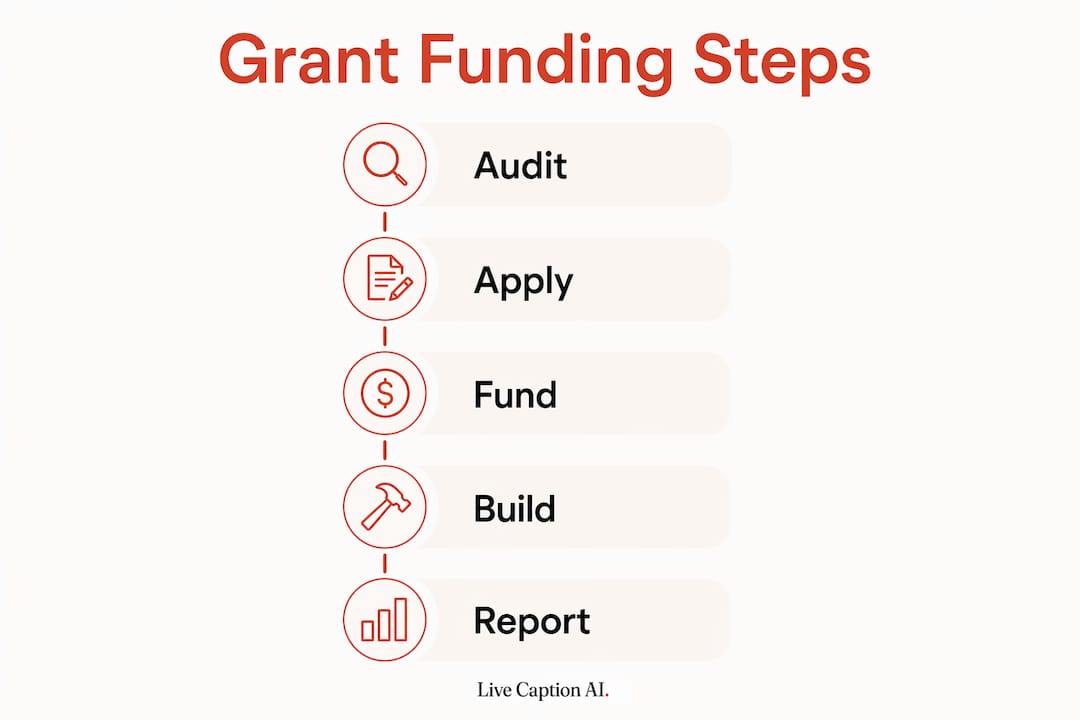
Follow this sequence to reduce rejection risk:
-
Contact the grants manager before you apply. Ask about prioritization, allowable expenses, required templates, match rules, and reporting. Funders often share unpublished guidance in these conversations.
-
Commission an access audit or building condition assessment. Many funders require one completed within the past five years. The National Fund requires a building condition assessment and prioritizes envelope repairs before interior ADA work.
-
Use the funder’s budget template. Submitting your own format when a template is required can disqualify an otherwise strong application.
-
Connect the project to your congregation’s broader mission. Show how the accessible entrance, lift, or captioning system will expand programming and community use.
-
Secure letters of support from congregation members, partner nonprofits, or community organizations who will benefit from the improvements.
-
Show matching funds or a sustainability plan. The National Fund requires matching funds for grants, with higher matches for larger awards.
Common pitfalls: ignoring building-envelope issues (funders notice), weak or generic letters of support, and skipping the funder’s required template.
What do accessibility grants typically pay for?
| Eligible expense | Notes |
|---|---|
| Entrance ramps and grading | Standard capital item; most programs fund this |
| Platform lifts and elevators | Larger capital programs; may require structural engineering |
| Accessible restroom renovation | Common in mid-size and capital grants |
| ADA-compliant doors and hardware | Often bundled with entrance work |
| Tactile and visual signage | Eligible in small-grant programs |
| Hearing loops (induction loops) | Equipment grants; some denominational programs cover this |
| Live captioning / assistive tech | Eligible as assistive technology; budget as a subscription or hardware line |
| Engineering, permits, and fees | Eligible under most capital programs |
Sample award ranges from real programs:
-
DK-MN Foundations (Minnesota): up to $2,500, rolling
-
DK-MN Foundations (Dakotas): up to $2,000, rolling
-
National Fund for Sacred Places: $50,000–$500,000, competitive multi-step process
For small equipment purchases (hearing loops, captioning subscriptions), start with denominational rolling grants. For capital rehab (lifts, restrooms, structural), target the National Fund for Sacred Places (capital grants of $50,000–$500,000 with required matching funds) or HUD CDBG.
What kind of audit do funders actually expect?
Three document types come up repeatedly across major programs.
An accessibility audit identifies barriers against ADA standards and recommends prioritized improvements. Certified Access Consultants (CACs) or accessibility-focused architects produce these. The Cloudesley Access Fund required an access audit completed within five years as a baseline eligibility requirement.
A building condition assessment goes broader, covering the structural envelope, roof, windows, and mechanical systems. The National Fund for Sacred Places requires this and will not fund interior ADA work until urgent envelope repairs are identified and addressed.
Permit-ready architectural documents are required for capital grants. The National Fund specifically requires these before a capital grant submission is accepted.
“Funders expect the building envelope’s urgent repair needs to be identified and addressed before proposing ADA or interior rehabilitation projects.”
Hire a historic-preservation architect if your building is listed or eligible for the National Register. Their credentials matter to funders who require compliance with the Secretary of the Interior’s Standards for Rehabilitation.
A practical timeline for your accessibility grant project
-
Months 1–2: Commission access audit and building condition assessment. Identify priority repairs.
-
Months 2–3: Research funders, contact grants managers, confirm eligibility and templates.
-
Months 3–5: Prepare application, gather quotes, secure letters of support, confirm matching funds.
-
Months 5–6: Submit application (or Letter of Intent for multi-step programs like the National Fund).
-
Months 6–12: Award decision, permitting, procurement, contractor selection.
-
Months 12–18: Construction, project completion, final reporting.
Budget a 10–15% contingency for permit delays and scope changes. Permit lead times for structural work in historic buildings often run longer than expected.
Accessibility upgrades you can budget for right now
High-impact, fundable items that belong in almost every accessibility scope:
-
Entrance ramps with proper grading and handrails
-
Platform lifts for split-level sanctuaries or fellowship halls
-
Accessible restroom renovation (grab bars, turning radius, door hardware)
-
Doorway widening to meet ADA clear-width requirements
-
Tactile and visual signage throughout the building
-
Hearing-assist systems (induction loops or FM systems)
-
Live captioning solutions for worship services and community events
For the captioning line, Live Caption AI is a practical budget item. It delivers ADA-compliant live captions to any device via QR code, with no dedicated hardware required. In web Conversation mode, you set two languages, and Deepgram may also recognize other languages it hears in the room, though accuracy is best for the two you select. Translation output goes to the language you choose — 29 are available. List it under “assistive technology” in your grant budget at the monthly or annual subscription rate.
Post-grant reporting: what funders require
Winning a grant is not the finish line. Most programs require documented proof that funds were spent as proposed.
Typical reporting obligations include: receipts and invoices for all grant-funded expenses, photos of completed work, a narrative describing outcomes and any scope changes, and confirmation that the project met applicable ADA or funder-specific standards. The National Fund ties grant payments to project milestones, so staged reporting is built into the award structure.
Keep a dedicated project file from day one. Store contracts, change orders, permits, and payment records together. If your scope changes mid-project, notify the funder in writing before spending grant funds on the revised scope. Unauthorized scope changes are among the most common reasons funders require repayment.
ADA compliance and legal considerations
Churches are generally exempt from Title III of the ADA as private religious organizations, but this does not mean accessibility work is optional or that grant funders ignore compliance standards. Most grant programs require that funded work meet or exceed ADA Standards for Accessible Design, regardless of the legal exemption.
If your congregation receives federal funding (including CDBG sub-grants), Section 504 of the Rehabilitation Act applies and requires program accessibility. State and local building codes may impose additional requirements when you pull a permit for renovation work.
This article is general information, not legal advice. Confirm current ADA requirements and local code obligations with a qualified accessibility consultant or attorney before finalizing your project scope.
Key Takeaways
Churches that treat accessibility as mission-driven capital work, not just code compliance, consistently produce stronger grant applications and win more funding.
| Point | Details |
|---|---|
| Start with an audit | Commission a building condition assessment and access audit before contacting any funder. |
| Contact funders early | Speak with the grants manager before submitting; they often share guidance not in the published guidelines. |
| Use required templates | Submitting your own budget format when a template exists can disqualify an otherwise strong application. |
| Match funds matter | National Fund for Sacred Places requires matching funds, with higher matches for larger awards. |
| Live Caption AI fits the budget |
The grant application lesson most churches learn too late
The single most consistent mistake I see in church accessibility applications is treating the project as a facilities task rather than a ministry statement. Funders at every level, from a $2,000 denominational rolling grant to a $300,000 National Fund award, are asking the same question: how does this physical change expand who your congregation can serve?
The churches that win are the ones who answer that question before the funder asks it. They attach an access audit, yes. They use the required budget template, yes. But they also write a project narrative that names the specific programs that will grow, the community partners who will use the space, and the people who currently cannot get through the door. That narrative is what separates a funded application from a well-organized rejection.
One more thing: call the grants manager. Every program I’ve seen rewards applicants who reach out early. It signals seriousness, and it gives you information your competitors don’t have.
Live Caption AI: an affordable captioning line for your grant budget
Physical accessibility gets most of the attention in grant applications, but communication access matters just as much. If your congregation includes members who are Deaf, hard of hearing, or speak a language other than English, live captioning belongs in your accessibility scope.
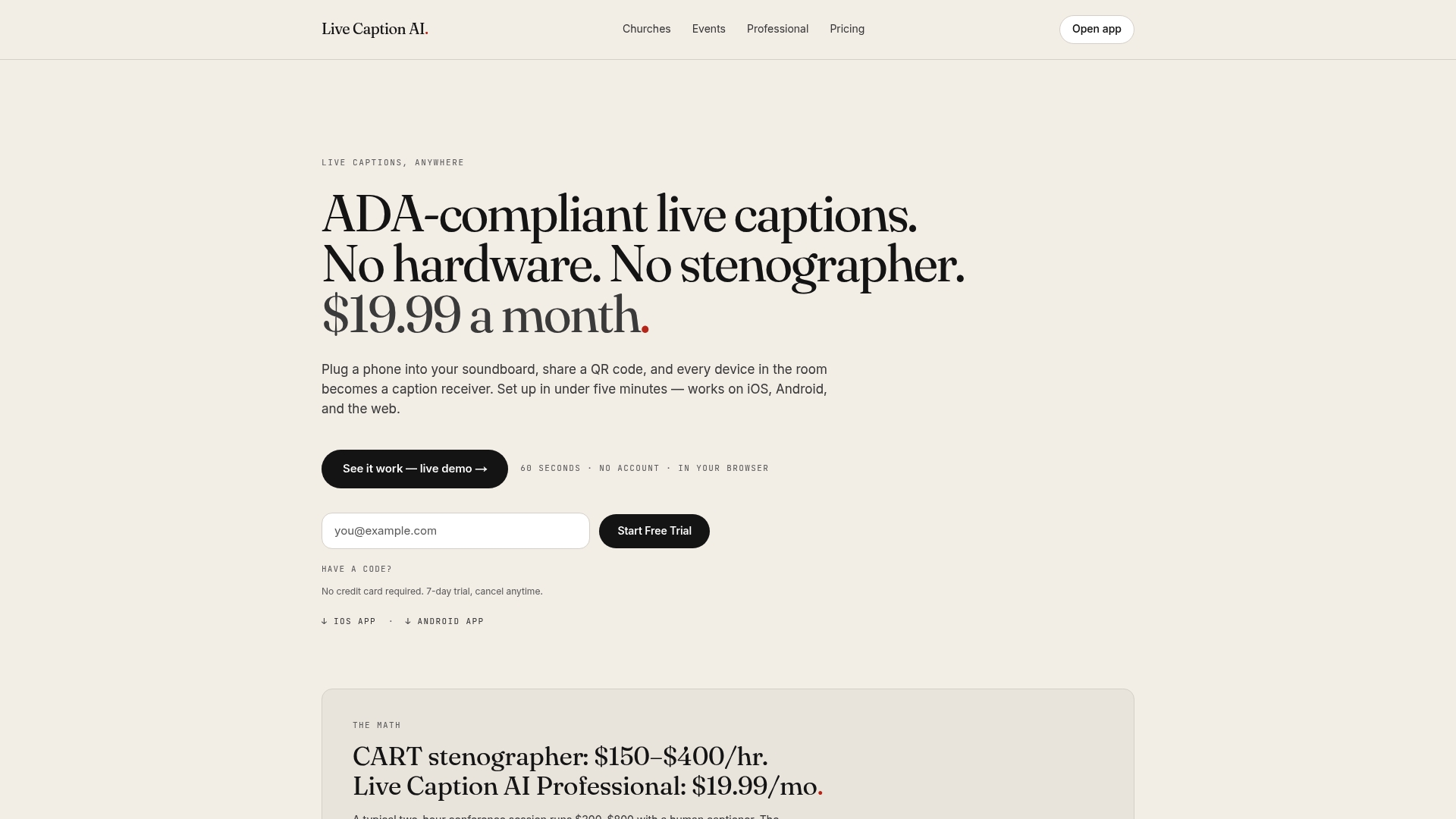
No hardware to purchase. No stenographer to hire. The broadcaster selects the caption language, and the system recognizes and translates to the target language. At $19.99 a month for the Professional plan, it’s a line item any grant budget can absorb under “assistive technology.” Include the annual subscription cost in your grant request alongside hearing loops and signage. Start a free trial at livecaptionai.com and have a real budget figure ready before you submit.
Useful sources and resources
-
National Fund for Sacred Places Guidelines and Eligibility — the authoritative source for capital grant requirements, matching rules, and documentation standards
-
DK-MN Foundations Minnesota Accessibility Grants — program page for rolling grants up to $2,500 for Minnesota congregations
-
DK-MN Foundations Dakotas Accessibility Grants — program page for rolling grants up to $2,000 for Dakotas congregations
-
Cloudesley Access Fund Guidelines — detailed eligibility and documentation requirements; useful as a model for what U.S. funders typically expect
-
Parish Accessibility Fund (Diocese of Ely) — illustrates tiered small/large grant structures and mandatory template requirements
-
Live Caption AI — pricing, deployment options, and feature details for budgeting a captioning line item in your grant application